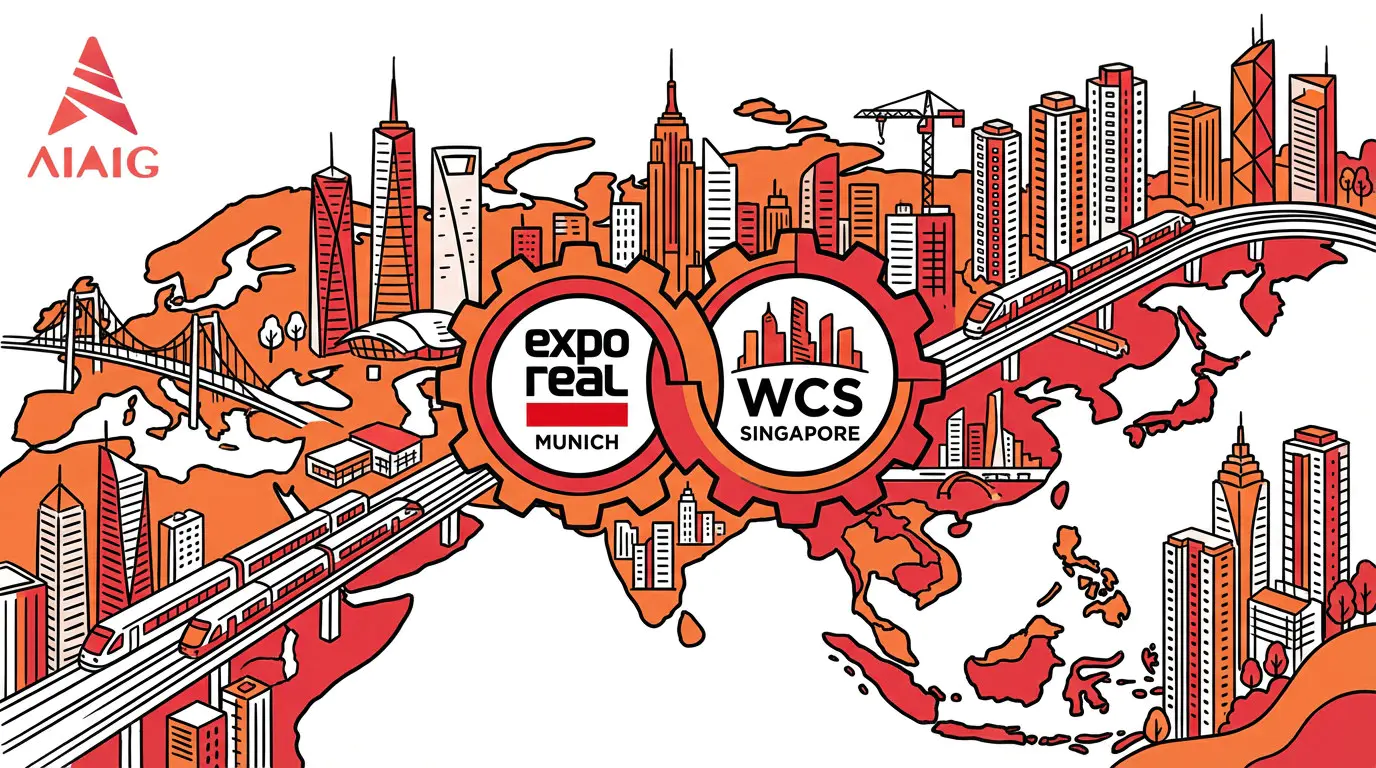
2026 Asia Real Estate and Infrastructure Summit Hot Topics and Insights: EXPO REAL (Munich) × WCS (Singapore) (2026 Update)
Conclusion First: This is not "gossipy exhibition coverage," but a pre-event hotspot map
- WCS 2026 (Singapore, June) leans more towards "policy and implementation of urban governance and infrastructure," with the theme Liveable and Sustainable Cities: ACT Now! and multiple thematic tracks (including Smart Cities, Financing for Cities, etc.).
- EXPO REAL 2026 (Munich, October) leans more towards "transactions and repricing in real estate capital and assets," focusing on investment, housing, logistics, hotels, retail, and discussions on regulation and transformation (such as EU Taxonomy, Green Deal, AI, etc.) within "Transform & Beyond."
- The most useful approach for AIAIG readers: transform topics into verifiable policy signals and quantifiable asset filters (financing, energy consumption, leases, CapEx, data centers, and power constraints).
Note: As of March 2026, this article is compiled based on publicly released themes/dates/agenda frameworks and explanations by the organizers; "policy announcements" are possible during the event, but this article does not fabricate unpublished conclusions, instead providing a list of "what you should watch."
1. How do the two platforms divide their work? First, separate the "information density" of EXPO REAL and WCS
1) WCS (World Cities Summit, Singapore, June 14–16, 2026): The "Control Panel" for Policy and Urban Implementation
WCS is a platform for government leaders and industry experts to discuss urban sustainability and livability challenges. Public information shows that WCS 2026 spans 3 days, including main conferences, mayor forums, youth leaders, Lee Kuan Yew World City Prize, urban science workshops, exhibitions, and site visits.
2) EXPO REAL (Munich, October 5–7, 2026): The "Trading Floor" for Capital Markets and Asset Pricing
EXPO REAL is a major European real estate and investment exhibition, focusing on investment and asset types (housing, logistics, hotels, retail, etc.), while featuring "Transform & Beyond" to concentrate on transformation topics.
3) An Easily Overlooked Connection Point: WCS 2026 concept notes mention "EXPO REAL Asia Pacific (Singapore)" running parallel to WCS
The WCS 2026 concept notes state: "EXPO REAL Asia Pacific" will be held concurrently with WCS 2026 (June 15–17, 2026), and there is also Asia Infrastructure Forum (June 16–17, 2026) as a partner event. This is crucial for writing linked coverage on "Asian real estate × infrastructure": in the same week in Singapore, one can capture cross-cutting topics of urban policy, infrastructure, and real estate capital simultaneously.
II. 2026 Hot Topic Map: Covering "Real Estate × Infrastructure × City" with 4 Main Lines
The following four main themes are the most stable framework for writing "Hotspot Updates and Interpretations": they allow for continuous updates without relying on on-site gossip.
Theme A: AI and "Smart Cities" Transition from Concept to Procurement and Compliance
- WCS 2026 explicitly sets up a Smart Cities track and mentions in the concept note that cities are accelerating the deployment of AI technologies.
- Writing angles (tool-oriented):
- List of "actionable scenarios" for AI in transportation, security, urban operations, and energy management
- Compliance boundaries for data governance/privacy/algorithm transparency
- How smart buildings (BMS) and energy efficiency retrofits affect CapEx and tenant preferences
Theme B: Financing for Cities: Green Financing and Infrastructure Funding Gaps
- WCS 2026 sets up a Financing for Cities track; the concept note also emphasizes green financing and funding gaps.
- Writing angles:
- Structure of funding sources for urban infrastructure (government budgets, PPP, green bonds, sustainability-linked financing, etc.)
- Transmission to real estate: interest rates, capitalization rates, rent affordability, and project financeability
Theme C: Housing and Urban Renewal: Livability Issues Will Continue to "Anchor the Real Estate Narrative"
- WCS emphasizes livability and resident well-being (Cities for People, Resilient & Regenerative Cities, etc.).
- EXPO REAL also lists Housing as a key focus area in its theme.
- Writing angles:
- Policy toolkit for housing affordability, rental regulation, and urban renewal
- Impact on the asset side: retrofitting old assets, use conversion, ESG compliance costs
Theme D: Data Centers and "High-Performance Infrastructure": From Industrial Story to Hard Constraints of Power and Land
- EXPO REAL's conference introduction publicly mentions topics including data centers and AI (as one of the real estate industry hotspots).
- Writing angles:
- Three key factors for data center site selection: power capacity/electricity price/power supply stability + land compliance + cooling conditions
- Structural opportunities and risks for surrounding real estate: industrial parks, logistics, and talent rental housing
III. Turning "Hot Topics" into Verifiable: AIAIG Conference and Investment Due Diligence Checklist (Ready for Reuse)
You can make this into a fixed module for the "Exhibition Tools Page," with only the dates and topics updated annually.
1) Policy and Project Implementation: What should you ask the organizers/government/developers?
- What are the new restrictions in urban renewal/housing policies this year? (Rental, short-term rental, use conversion, energy efficiency standards)
- Are there new eligibility criteria for green financing? (Disclosure, classification standards, KPIs)
- Are infrastructure projects leaning more towards "road and bridge construction" or "digital/energy/resilience infrastructure"? Who is paying?
2) Capital and Asset Side: What should you ask funds/institutions?
- What types of assets do they prefer in 2026: core office/housing/logistics/hotel/data center? Why?
- What are their assumptions for refinancing and capitalization rates?
- How do they model "Flight-to-Quality" and "discounts for aging assets"? (CapEx and lease renewal assumptions)
3) Data Center/AI Infrastructure: What should you ask operators/power providers?
- Is the biggest bottleneck for new computing power deployment electricity or permits?
- For external investors, which is the easiest pitfall: "land use/grid connection/electricity costs"?
4) Quick Draft Template (structure that can be sent within 48 hours after the meeting)
- 3 most clear trend consensuses (from repeatedly mentioned viewpoints by multiple parties)
- 2 truly "actionable" policy/funding tools
- 1 most important risk reminder for investors (financing, energy consumption, compliance, operations)
- When are WCS 2026 and EXPO REAL 2026 scheduled to take place?
- The official information for WCS 2026 (Singapore) is June 14–16, 2026; for EXPO REAL 2026 (Munich), it is October 5–7, 2026. The WCS concept note also mentions that "EXPO REAL Asia Pacific" will be held concurrently with WCS in Singapore from June 15–17, 2026, with the Asia Infrastructure Forum taking place on June 16–17.
- What does "office market recovery" typically refer to in the context of exhibitions?
- It more commonly refers to "capital and tenants returning to core areas and high-quality office spaces (Flight-to-Quality)," rather than a broad increase across all office assets. Writing should emphasize differentiation: core CBD Grade A/upgradable assets versus older, low-quality offices.
- How can this article be made into a real-time update?
- It is recommended to create a "yearly update center page + update log": the first screen should display the last update time and 3–5 hot topic summaries for the current month; the main text should maintain four fixed themes (AI/funding/housing updates/data centers), with each update only adding newly released agendas, key speech points, policy stances, and links to project cases.
- If readers only look at one table, what do you suggest including?
- Include a comparison table of 'hot topics → verifiable metrics': for example, AI implementation corresponds to procurement/compliance metrics, green financing corresponds to disclosure and KPIs, office recovery corresponds to vacancy rates/rent/CapEx, and data centers correspond to power capacity/electricity prices/approval cycles.
- What are the most common mistakes in writing reports on such exhibitions?
- Mistaking 'discussion hotspots' for 'implemented policies', or 'trend consensus' for 'inevitable predictions'. For AIAIG, it's better to write: which information has been confirmed by officials/organizers, which belongs to market opinions, and provide verifiable observation metrics.
Last updated Mar 4, 2026