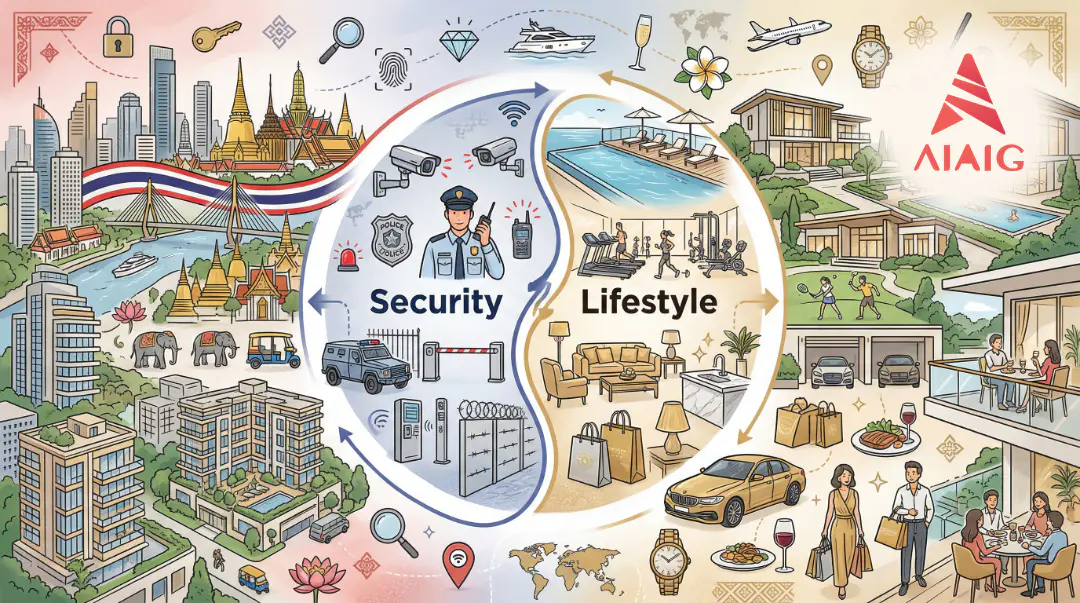
1. First, clarify "public security": In affluent areas, what's safer is the "building," not necessarily the "street"
The overall experience of living safety in Bangkok for foreigners typically presents a structure:
Community/Building Level: High-end apartments and gated communities generally have institutionalized security measures such as access control, 24-hour security guards, CCTV, visitor registration, license plate recognition, and Juristik (property management entity); nighttime lighting and patrols in public areas are also better.
Street Level: Even in "affluent areas," the most common risks are still opportunistic crimes (such as phones/bags being snatched, motorcycle theft, disputes and risks from intoxication in nightlife scenes, and disputes over taxi/ride-hailing detours and fares), as well as tourist scams (involving currency exchange, jewelry, tickets, bar bills, etc.).
Inter-District Commuting Level: The time you are truly exposed to risks often occurs at: BTS/MRT entrances and exits, mall corridors, waiting for vehicles on the roadside at night, bar streets, weekend markets, and crowded tourist areas, rather than in your residential lobby.
Therefore, the conclusion that "affluent areas are safer" needs to be broken down: buildings are safer and life is more convenient, but street and travel scenarios still require safety strategies.
II. Data and Authority Reminder: Crime Cases Decrease in 2025, but 'Opportunistic Risk' Remains the Main Theme
Overall trend in police statistics: According to the Bangkok Post's report on the Metropolitan Police Bureau (MPB), the total number of criminal cases recorded in Bangkok in 2025 decreased by approximately 17% compared to the previous year, with the annual total disclosed as 76,744. Such macro-level data only indicates that "things have not worsened overall," but it does not guarantee that your neighborhood is free from mobile phone thefts or scams.
Safety profile for expatriates: The U.S. Overseas Security Advisory Council (OSAC) safety report on Thailand highlights that the most common crimes are non-confrontational street crimes and opportunistic thefts (such as pickpocketing, bag snatching, tourist fraud, etc.), with serious violent crimes against foreigners being relatively rare, but risks increase in scenarios like nighttime, alcohol consumption, or traveling alone.
Official travel safety advice: Both the UK FCDO and Australia's Smartraveller have long warned of risks of pickpocketing and scams in Thailand; Smartraveller also notes potential terrorist attack risks and drink spiking risks in nightlife, emphasizing the need to stay vigilant in popular tourist areas, including Bangkok.
Conclusion (more useful for buying property/long-term stays): Bangkok is more like a "low-intensity, high-probability city of small risks"—major issues are few, but minor problems are common; the more convenient the nightlife, the denser the tourist crowds, and the more central the transportation hubs, the more one should manage risks as part of daily operational costs.
Three, Analysis of Typical Wealthy Areas in Bangkok: Real Security Differences and Living Experience (by Residential Scenarios)
The following is not about 'absolutely safe/unsafe', but rather 'what risks are more likely to be encountered, and why'.
A) Sukhumvit High-End Segment: Phrom Phong/Thonglor/Ekkamai
- Living Experience: Extremely high level of internationalization, high density of dining and nightlife, mature Japanese/Western expat communities, concentrated resources in malls and international schools, strong rental demand.
- Security Characteristics: Building security is usually strong, but street-level risks are more 'scenario-based'—high nighttime foot traffic and bar density can lead to: phone loss/theft, motorcycle snatch-and-grab, bar bill disputes, post-drinking disputes, and traffic accidents.
- Investment Implications: Suitable for a dual focus on 'asset + cash flow' (rental-friendly), but the 'nightlife premium' and 'nightlife risks' must be evaluated together.
B) Embassy District/Core Business: Ploenchit/Chidlom/Lumphini
- Living Experience: Dense concentration of office buildings, five-star hotels, embassies, and high-end malls, high efficiency for commuting and business meetings, park resources (Lumphini/Benjakitti) improve living comfort.
- Security Characteristics: Strong overall sense of order during the day, cleaner streets, more visible surveillance and patrols; but pickpocketing remains high-risk in malls/subway entrances/crowded areas.
- Investment Implications: More focused on 'stable value preservation + high-end tenants', with high absolute rents but not necessarily the highest returns, excelling in volatility resistance.
C) Sathorn-Central Business Extension: Sathorn/Silom
- Living Experience: Close to CBD, international schools, and hospital resources, suitable for families working in the central area who prefer a more 'mature and quiet' living environment.
- Security Characteristics: Commuter flow from office buildings makes peak hours and traffic nodes the main risk points; nighttime walking experience varies significantly in some alleys ('high sense of safety on main roads, alley safety depends on project management level').
- Investment Implications: More friendly to 'family-type tenants', key factors being project property management and entry/exit routes.
D) Ari/Phaya Thai and other 'New Middle-Class Aesthetic Areas'
- Living Experience: Combination of cafes, low-density residences, and boutique businesses, more 'localized' pace of life, suitable for long-term stays and lifestyle orientation.
- Security Characteristics: Nightlife intensity is lower than Thonglor, but neighborhoods are more dispersed, nighttime walking safety heavily depends on lighting, foot traffic, and road conditions.
- Investment Implications: More like a 'lifestyle asset', with stable clientele but expansion speed and rental liquidity depend on urban renewal pace.
E) Riverside High-End Properties (Riverside)
- Living Experience: Clear advantages in scenery and hotel amenities, suitable for self-occupancy and high-end vacation-type tenants.
- Security Characteristics: Project internal security is usually strong; external streets in some sections have poor experience due to 'unfriendly walking conditions + sparse nighttime foot traffic'.
- Investment Implications: Significant scenic premium, but liquidity relies more on macro tourism and high-end rental demand.
Four, the "Risk Interfaces" You Really Need to Focus On: A Practical Checklist for Buying/Renting a Home
By breaking down "public safety" into checkable interfaces, you can turn anxiety into due diligence.
(1) Building Security (Most Important, Most Controllable)
- Is the lobby staffed 24/7? How are visitors registered? Can food delivery/couriers go upstairs?
- Are elevators card-access zoned? Are there blind spots in surveillance from the garage to the elevator?
- CCTV coverage: lobby, elevator, corridors, garage, garbage room, pool/gym entrance.
- Is the Juristic (property management) strong: clear rules, fast complaint response, strict short-term rental management.
(2) Short-Term Rental Penetration (Affects "Stranger Density")
- Are there many short-term rentals in the same building? Luggage density in elevators, security's attitude toward short-term rentals, obvious temporary check-in processes.
- For owner-occupiers and family tenants, short-term rental penetration typically reduces "sense of security" and "neighborhood stability."
(3) Commuting and Street Conditions (Where Risks Mainly Occur)
- Route from home to BTS/MRT/shopping malls: Does it require passing through dark alleys, overpasses, or parking lot edges?
- Nighttime lighting and pedestrian flow: Are there still people walking home after 10 PM? Are there convenience stores/shops forming "street eyes"?
- Ride-hailing/taxi pickup and drop-off points: Are they safe, convenient for stopping, and often congested, causing you to wait on the roadside?
(4) Nightlife and the "Alcohol Variable" (Amplifies Probability)
- If your living radius includes nightlife areas like Thonglor, Sukhumvit 11, Khao San, always treat "drink safety, transportation home, buddy system" as standard configurations.
(5) Insurance and Document Management (Reduces Loss)
- Phone anti-theft straps/wristbands, slash-proof backpacks, separating passport and cash.
- Only carry necessary document copies or electronic backups when going out; set credit card limits and freeze access points.
- Is it true that in Bangkok's affluent areas, you can 'walk around freely at night'?
- It is not advisable to interpret safety as 'walking around freely'. The safety in affluent areas is more about the orderliness of buildings and commercial districts, but the nighttime walking experience highly depends on 'lighting, pedestrian flow, and movement routes'. If you need to walk home at night, prioritize: main roads, shopping mall corridors, and well-lit areas around BTS stations; try to avoid dark alleys, construction site edges, and the outer circles of parking lots.
- Thonglor/Phrom Phong is very expensive, so why are there still risks?
- Because risks often come from 'scenarios', not from 'property prices'. Thonglor/Phrom Phong has a higher density of nightlife and greater mobility of foreigners and tourists, which means a higher probability of incidents like phone theft, petty theft, and disputes triggered by alcohol. The advantage of expensive areas is: you are safe once you return to your building; the challenge is: the time you spend on the streets is more likely to be affected by probability.
- Which area should be prioritized for buying a home for self-occupation?
- If you value a sense of order and stability more: Ploenchit/Chidlom/Lumphini and parts of Sathorn are more suitable; if you value dining and social convenience: Phrom Phong/Thonglor/Ekkamai are stronger, but you need to pair them with stricter travel and nighttime safety strategies; if you prefer lifestyle and cost-effectiveness: emerging middle-class areas like Ari are more comfortable, but you should pay more attention to nighttime movement routes and public transportation connections.
- How can you tell if a building is 'well-managed'?
- Look at three details: 1) Can visitors and food delivery personnel easily go upstairs; 2) Are there card access zones for elevators and garages; 3) Do security guards actually enforce registration and patrols. Management level often determines your daily sense of security more than location labels.
Last updated Jan 23, 2026