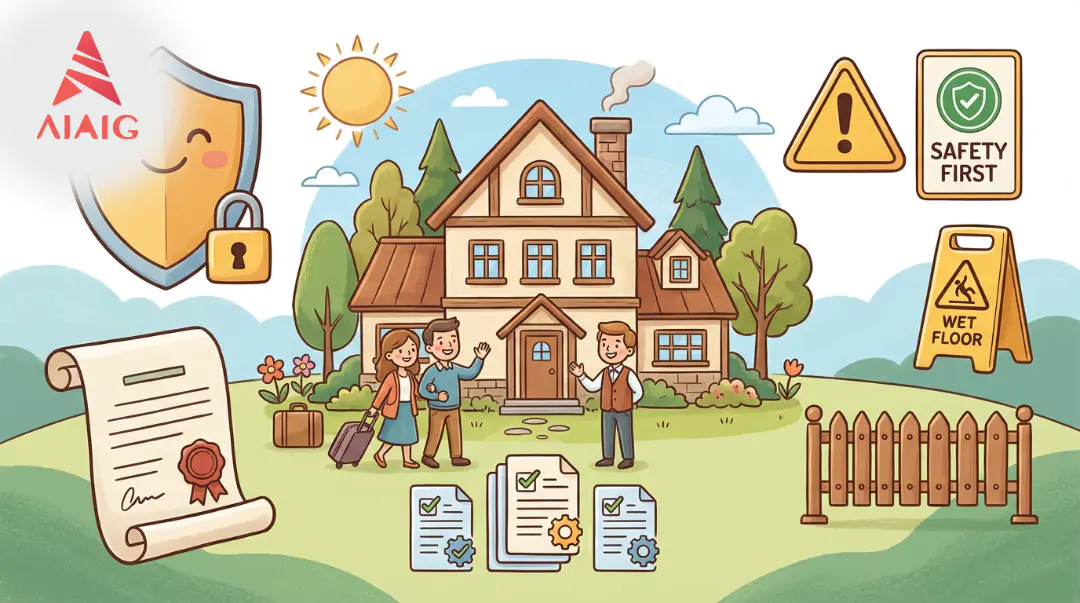
1. First, clarify the risks: Homestay liability risks cannot be solved by "one insurance"
Short-term rental (homestay) risks can be categorized into 6 types, each corresponding to different liability attributions and insurance products:
- Guest/Third-party Personal Injury: Slips and falls, stairway falls, cuts and burns, food allergies, pool/balcony accidents, etc. The biggest concerns are medical expenses + lost wages + litigation costs.
- Third-party Property Damage: For example, water pipe leaks affecting downstairs neighbors, fires spreading to adjacent properties, noise complaints leading to destructive actions, etc.
- Property Structure and Interior Asset Loss: Fire, water damage, theft, vandalism, furniture and appliance damage.
- Business Interruption/Income Loss: Downtime due to closure for repairs after an incident, forced rectification, or delisting from platforms.
- Compliance Risks (Fines/Suspension/Rectification): Unlicensed operation, exceeding permitted scope, failure to meet fire/safety standards.
- Operational Employment and Outsourcing Risks: Injuries to cleaning staff, work-related accidents during repairs, theft due to key management errors, etc.
Key point: ==What you need to do is implement the "insurance + contract + procedures + evidence chain" four-part system==, not just purchase a single "homestay insurance" policy.
II. How to Configure Insurance Combinations: Use the 'Foundation + Gap Filling' Approach, Not Blind Buying
It is recommended to arrange insurance in the order of "from liability to assets" (first cover liabilities that could bankrupt you, then protect the property):
A. Liability Foundation (Top Priority)
- Public/Third-party Liability (General/Public Liability): The core foundation covering guest injuries and third-party claims.
- Focus on three aspects: whether the coverage amount is sufficient, whether it covers short-term rental/commercial use, and whether it includes legal expenses.
B. Assets and Disasters (Second Priority)
- Property/Fire Insurance: Covers the building structure and interior contents.
- If located in high-risk areas for earthquakes/floods/typhoons: Confirm if separate coverage is needed (in many regions, earthquakes/floods are excluded from standard policies).
C. Income and Business Interruption (Third Priority)
- Business Interruption Insurance: Covers income loss when unable to rent out due to an incident (note that trigger conditions usually require "a covered property loss to occur first").
D. Employment/Outsourcing and Key Risks (As Needed)
- Workers’ Compensation / Employer’s Liability Insurance (if you hire cleaning/front desk/maintenance staff, or as required by local laws).
- Key/access management: More of a "procedural risk control"; insurance typically only covers some consequences and cannot replace proper systems.
E. Platform-Provided Coverage: Treat as "Supplemental," Not "Primary Insurance"
- Platform coverage often has country/regional differences, exclusions, claim thresholds, and evidence requirements.
- You should view it as a "supplemental layer that might be usable," not as "I don't need to buy insurance."
III. Turning "Claimable" into "Payable": Four Key Actions for Contracts and Evidence Chains
Many claim failures occur not due to lack of insurance, but due to absence of an evidence chain. It is recommended to institutionalize the following four practices:
- Pre-check-in Baseline Evidence (Check-in baseline)
- Before each check-in: Take photos/videos of key areas (kitchen, bathroom, sink, air conditioner, water heater, balcony, stairs) for documentation.
- Property Rules and Warnings (Duty to warn)
- Clearly indicate hazardous points: Steep stairs, balconies not for climbing, no lifeguard at the pool, glass door warnings, prohibition of candles/fireworks, etc.
- Make "rules provable": Through platform messages/electronic signatures/check-in guidelines page.
- Maintenance and Safety Inspection Records (Maintenance log)
- Regular inspection checklist: Smoke detectors, electrical leakage protection, fire extinguishers, emergency lighting, escape route signs, door locks, and guardrails.
- Having records = better ability to prove you fulfilled reasonable duty of care after an incident occurs.
- Incident Response SOP (Incident SOP)
- In case of guest injury: Provide first aid + immediately document the scene + retain communication records + report to insurance/platform within 24 hours + avoid making verbal admissions of liability (let insurance and lawyers handle it).
In a nutshell: ==Insurance is responsible for payouts, but the evidence chain determines whether a claim can be paid, how much is paid, and whether you are found negligent==.
IV. Special Reminders for Japanese Minshuku (Minpaku): Platform Insurance Differences + Legal "Safety Obligations" Must Be Aligned in Advance
If you are investing in and operating a homestay in Japan, you need to clarify at least two things:
1) Platform insurance in Japan may be a "separate plan," don't apply the global version directly
- Airbnb's general Host Liability Insurance page clearly indicates jurisdictional differences, with Japan being handled specially.
- Airbnb provides Japan Host Insurance in Japan (with a separate explanation page), covering specific limits for host property damage and liability/expenses; but the official also notes that it ==cannot replace== basic coverage such as fire insurance, home insurance, earthquake insurance, etc.
2) Compliance and safety obligations are "hard responsibilities," failing to do them can invalidate insurance as well
- Japan's official homestay information page requires operators to "ensure the safety of guests," such as installing emergency lighting, posting evacuation routes, and other safety measures.
Practical advice (Japan):
- Treat "firefighting/evacuation/safety equipment" as a threshold for opening, not as operational optimization.
- Use the "insurance checklist" to reverse-engineer the "hardware checklist": if you don't have fire extinguishers/emergency lighting/escape signs, many incidents can escalate into situations where you cannot prove due diligence, ultimately leading to high out-of-pocket costs or even claim denials.
- I have already purchased the platform's protection, do I still need to buy insurance myself?
- It is recommended. Platform protection typically has exclusion clauses and regional differences, while your main risks (guest injury claims, third-party damage, fire and water damage, business interruption losses) require a 'locally verifiable commercial insurance' as a foundation, with platform protection serving only as a supplementary layer.
- Where do the most common 'high-value claims' for vacation rentals come from?
- The most common are guest injuries and third-party damage: slips, falls, collisions with glass doors, water damage affecting neighbors, fires spreading to adjacent properties, etc. Their characteristics include: high monetary limits, long litigation cycles, and the need for legal fee support.
- How can I determine if the insurance truly covers 'short-term rentals/vacation rentals'?
- Have the insurance company or broker provide written confirmation: whether the usage includes short-term rentals/commercial accommodation, if there are restrictions on 'platform rentals', if there are restrictions on 'unattended/remote management'; and confirm key exclusions (parties, alcohol, pools, balconies, earthquakes/floods, etc.).
- If an accident occurs, what should I do first?
- Priority order: 1) Provide aid and control on-site risks; 2) Take photos/videos for documentation; 3) Keep communication records; 4) Report the incident promptly as required by the policy (delays may affect claims); 5) Avoid making private promises like 'I will pay for everything/it's my fault', let insurance and lawyers handle liability determination.
Last updated Feb 7, 2026