Policy Overview
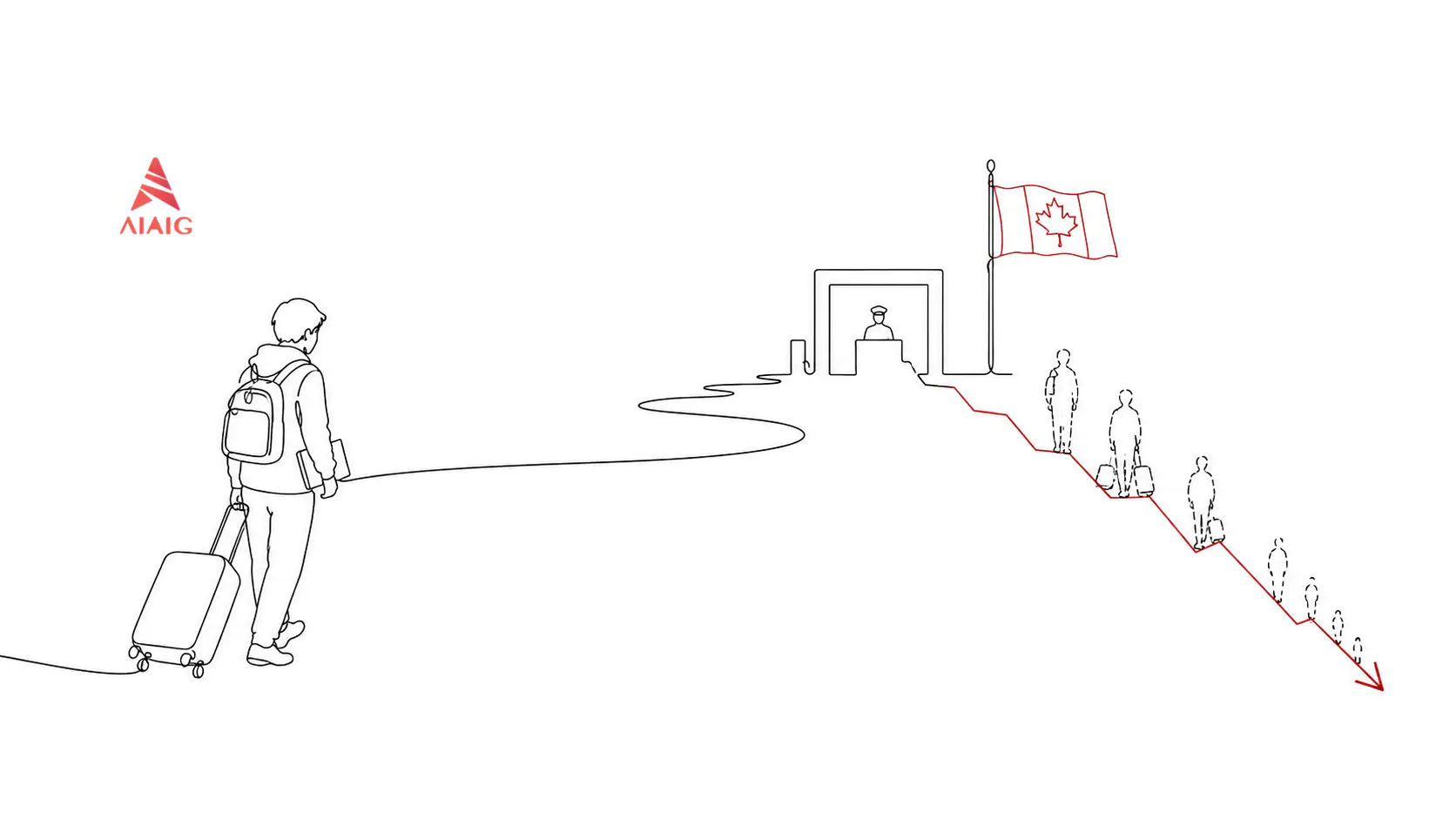
Immigration, Refugees and Citizenship Canada (IRCC) released data showing a historic plunge in new student and temporary worker arrivals in Q1 2026. From January to March 2026, Canada received just 47,730 new arrivals, including 11,195 study permit holders and 36,535 work permit holders.
This figure is 29% lower than the same period in 2025 and 75% below Q1 2024 levels, a reduction of 145,625 arrivals. This is one of the most significant contractions in Canada's recent immigration history. IRCC stated the decline reflects Canada's commitment to a "well-managed and sustainable immigration system," as the government has pledged to reduce the temporary resident population to below 5% of the total population.
Monthly Data Overview
| Month | Total Arrivals | Study Permit Holders | Work Permit Holders |
|---|---|---|---|
| Jan 2026 | 18,760 | 6,975 | 11,785 |
| Feb 2026 | 12,975 | 2,135 | 10,840 |
| Mar 2026 | 15,995 | 2,085 | 13,910 |
AIAIG Insight
For overseas Chinese families planning to study or immigrate to Canada, these numbers signal that competition for study permits and work visas has entered an unprecedented phase of intensity. Applicants should begin preparing materials 6-8 months in advance and consider diversifying their study destinations rather than placing all bets on Canada alone.
Deep Dive: Student Arrivals Plunge 79%
Student arrivals saw the steepest decline. Canada recorded just 11,195 new student arrivals in Q1 2026 -- 6,975 in January, 2,135 in February, and 2,085 in March.
Compared to 53,660 student arrivals in Q1 2024, 2026 Q1 student arrivals dropped 79%, a reduction of 42,465. This far exceeds market expectations and reflects the compounding effect of both the Provincial Attestation Letter (PAL) system and tightened visa processing.
Key Drivers
Provincial Attestation Letter (PAL): First introduced in 2024, PAL caps study permits by province. The cap was reduced by 10% to 437,000 in 2025, and from 2026 onward, master's and PhD students also require PALs.
Higher Financial Requirements: SDS program financial proof requirement rose from CAD $20,635 to CAD $29,710 in 2026, significantly increasing the barrier for applicants from developing countries.
Stricter Visa Screening: IRCC has intensified authenticity checks on study permit applications, including education provider verification and source-of-funds tracing.
Worker Arrivals Drop 74%
Temporary worker arrivals also fell sharply. Canada recorded 36,535 new work permit holders in Q1 2026.
Compared to 139,695 in Q1 2024, worker arrivals dropped 74%, a reduction of 103,160 people.
Policy Tightening Measures
- Stricter LMIA processing: Low-wage stream applications face greater scrutiny
- PGWP reforms: Age limit reduced to 35, IELTS requirement raised to 6.5
- Temporary resident cap: Government committed to keeping temporary population below 5%
AIAIG Insight
For overseas Chinese pursuing the study-work-PR pathway, Canada's doors are narrowing systematically. Recommended strategies: apply 6-8 months early, diversify across Australia, Ireland, and New Zealand, monitor provincial nominee programs, and improve language test scores for competitive advantage.
- How does Canada's PAL system work and how does it affect overseas Chinese applicants?
- The PAL (Provincial Attestation Letter) system requires study permit applicants to submit a quota attestation letter issued by the provincial government. This effectively caps study permits by province. In 2025, the federal government cut the cap by 10% to 437,000, and from 2026, master's and PhD students are no longer exempt. For overseas Chinese: approval rates have dropped significantly, competition is fiercest in Ontario and British Columbia, and applicants may have better luck in Atlantic or Prairie provinces where quotas are less saturated.
- Is the Canada study-to-PR pathway still viable in 2026? What are alternatives?
- The pathway remains viable but narrowed. Express Entry added four new category-based draws in 2026 (STEM, healthcare, trades, transport), favoring graduates in these fields.
Alternatives: Australia (485 graduate visa 18-48 months), Ireland (STAMP 1G 12-24 months), New Zealand (expanded post-study work visa), Japan/Singapore (relaxed work rights for graduates).
Key advice: never rely on a single country. Develop a 'primary + backup' study-migration plan. - How do tightening work permits affect graduates who already hold PGWPs?
- PGWP holders face: 1) Higher CRS cut-off scores in Express Entry draws despite fewer new entrants in the pool; 2) LMIA-supported job offers remain critical for 50-200 CRS bonus points; 3) Provincial nominee programs are being adjusted -- track your target province updates; 4) If PGWP is expiring, consider BOWP (Bridge Open Work Permit) or SOWP (Spousal Open Work Permit) extensions.
Last updated May 31, 2026