Hong Kong Office Market 2026: Core Area Recovery vs. High Vacancy, Real...
In 2026, the Hong Kong office market is not about a 'full recovery' but a clear divergence: prime offices in core areas like Central are starting to recover, but overall vacancy rates remain high, supply is still heavy, and institutional funds are reassessing returns and liquidity of Hong Kong office assets. This article analyzes whether the market is 'rebounding' or entering a new phase of 'core asset recovery first, weak assets continuing to clear out,' based on recent trends such as improved absorption in core areas, high overall vacancy, and Singapore REITs selling Hong Kong office buildings.
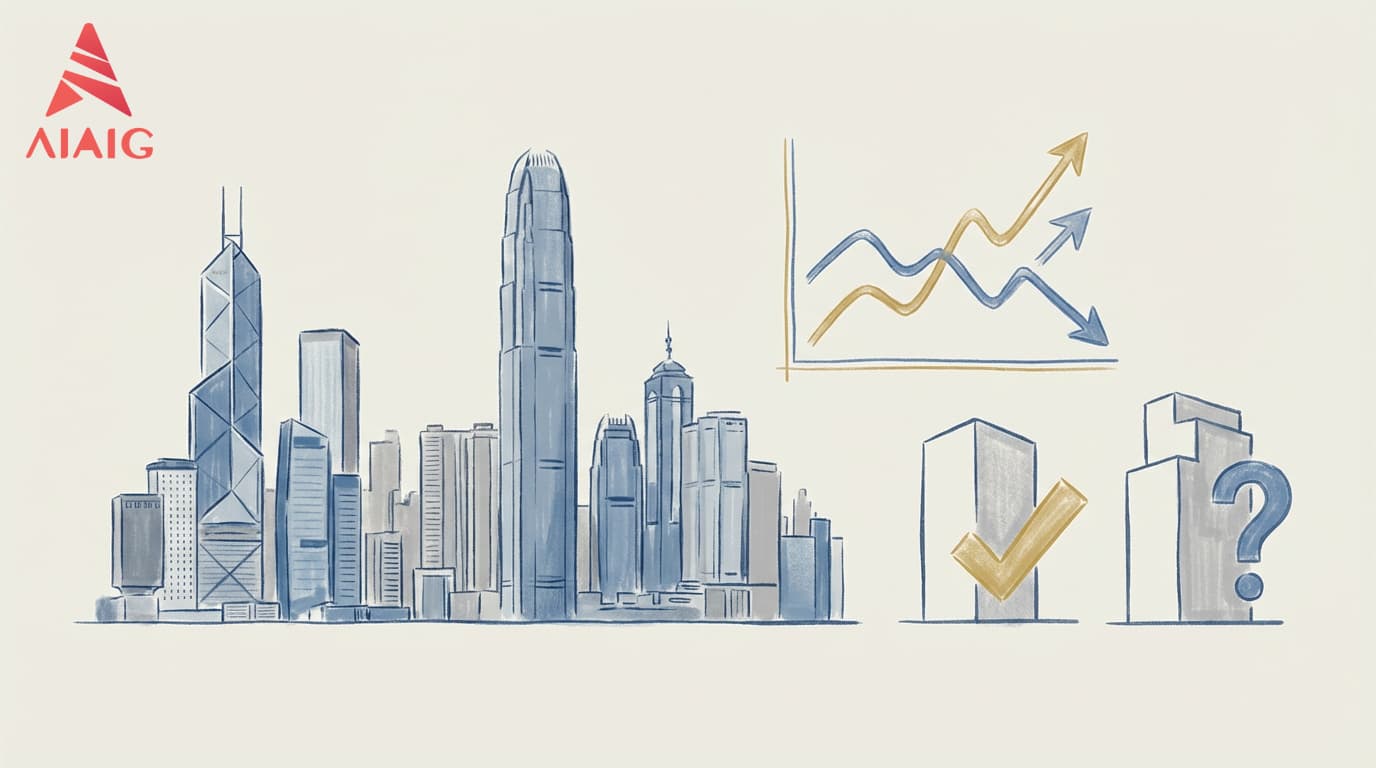
Hong Kong Office Market 2026: Core Area Recovery, Overall High Vacancy, Should Real Estate Investment Look at "Rebound" or "Differentiation"?
First, the conclusion: For Hong Kong's office market in 2026, it is no longer appropriate to understand it in terms of "full recovery" or "full downturn." A more accurate description is: Prime offices in core areas are beginning to recover, but the overall market is still constrained by high vacancy rates and supply pressures, so what is truly happening is not a simple rebound, but a clear divergence.
In recent months, two seemingly contradictory signals have emerged in the market simultaneously. On one hand, Grade A office rents and absorption in the Central core area have started to improve, with Reuters even describing the marginal recovery of core area offices in an April 2026 report as "finally seeing light after seven years of downturn." On the other hand, JLL's own outlook for 2026 clearly states: Hong Kong's office and residential sectors are "leading recovery segments after six years of adjustment," but the overall market recovery remains uneven, with retail, industrial, and certain parts of the capital markets still under pressure.
Therefore, to answer the question of "whether to look for a rebound or divergence," a more professional expression from AIAIG would be: Hong Kong's office market has moved from a "period of overall decline" to a stage of "core assets recovering first, while the entire market is still undergoing clearance."
1. Why Repair the Core Area First? — Central's Improvement is Not an Illusion, But Not a Synchronous Recovery Across the Entire Market
The reason Central is recovering first is not because "Hong Kong's office market as a whole is improving," but because demand is concentrating back into the most core, highest-quality buildings that are most readily accepted by financial and professional service tenants.
Reuters' April 2026 report cites JLL data, noting that Central Grade A office rents have already rebounded from their lows, with an annual increase of about 3.5%, and vacancy rates have dropped to 9.9%; meanwhile, leasing demand in the core area has significantly improved, driven by increased capital market activity, expansion of financial institutions, and some Chinese and international companies returning to the most central locations. The report also mentions that although hedge funds do not account for a high proportion of overall office demand, they contributed significantly to net absorption in 2025, as such high-value tenants inherently prefer Central.
The underlying essence of this is a typical "Flight-to-Quality": in an environment where overall demand remains cautious, tenants are not expanding comprehensively, but rather concentrating their limited budgets on the strongest locations, buildings, and office assets with the most brand appeal.
Therefore, Central's recovery does not mean that the entire Hong Kong office market is strengthening, but rather that: The most consensus-driven office assets are regaining pricing power first.
II. Why is the overall market still under significant pressure? — High vacancy rates and large-scale inventory have not yet been truly absorbed
If one only looks at Central, it's easy to conclude that 'Hong Kong office space has recovered'; but if the perspective is broadened to the entire market, a more complex reality emerges.
In its 2026 outlook released in December 2025, JLL explicitly stated that Hong Kong office and residential are 'leading recovery sectors after six years of adjustment,' but simultaneously emphasized that 'the recovery is not uniform.' This statement is crucial because it directly indicates: even if core areas are starting to improve, the overall market has not yet escaped high vacancy rates and pressure to reduce inventory.
From a market research perspective, the overall leasable area for Hong Kong Grade A office space remains relatively high, with vacancy pressures in non-core areas and older buildings significantly heavier than in Central. Savills' Hong Kong office monthly report in February 2026 also pointed out that office demand is recovering, but the real new growth drivers still mainly come from financial-related recovery and policy support. In other words, the market is not naturally strengthening across the board but relies on a few industries and regions to lead first.
This means that the most accurate state of Hong Kong office space is not 'overall upward,' but a 'two-speed market':
- On one side, premium office spaces in core areas like Central show marginal improvements in rents and absorption;
- On the other side, some non-core areas, secondary buildings, and older office spaces continue to face pressure under high vacancy conditions.
This is why, when writing about Hong Kong office space, AIAIG is more suited to emphasize 'structural differentiation' rather than vaguely stating 'office recovery.'
3. Mapletree Sells Hong Kong Office Assets, What Judgments Are Institutional Funds Making?
In December 2025, Mapletree Pan Asia Commercial Trust announced the sale of an office tower at Festival Walk in Hong Kong, with a transaction price of HKD 1.96 billion, expected to be completed in February 2026. Reuters' description of this transaction is clear: this is a portfolio optimization move by a Singapore-listed REIT 'against the backdrop of a weak Greater China office market.'
The significance of this transaction lies not in 'Hong Kong office space is no longer investable,' but in the more alarming signal it sends: institutional funds are no longer treating Hong Kong office space as a unified asset class but are starting to conduct more explicit priority screening.
From a REIT perspective, selling an office asset typically has three reasons:
First, to release capital, reduce leverage, or shift to markets and assets with higher certainty;
Second, to reduce exposure to assets with long-term vacancy and significant rental pressure;
Third, to focus the portfolio on parts with more stable returns and better liquidity.
For AIAIG readers, the implication is straightforward:
- This is not a stage where 'Hong Kong office space is overall cheap, so it's all worth buying';
- Rather, it's a stage of 'which buildings are worth continuing to hold, and which are more like assets the capital market is clearing out.'
Four, Hong Kong Office in 2026: Should We Focus on "Rebound" or "Differentiation"?
A more accurate answer is: one should look at 'partial rebounds within differentiation.'
If one only says 'rebound,' it might mislead readers into thinking the entire market will recover simultaneously; if one only says 'differentiation,' it might underestimate the reality that Central and a few premium assets have already started to recover. Therefore, a more fitting description should be: Hong Kong office space has entered a phase where core assets recover first, while weaker assets continue to be cleared out.
From an investment perspective, this means the logic for two types of assets is already completely different.
The first type is premium office space in core CBDs. It resembles a core holding asset, with logic based on relatively stronger liquidity, easier financing, higher tenant quality, and clearer long-term exit paths.
The second type is non-core or older office spaces. They are not without opportunities but are closer to 'value recovery assets'—requiring stronger leasing capabilities, larger renovation capital expenditures, longer holding periods, and higher tolerance for uncertainty.
Thus, in the 2026 Hong Kong office market, the most dangerous investment misconception is mistaking 'cheap' for 'valuable.' In a high-vacancy environment, cheap buildings can sometimes just be harder to lease, renovate, and sell.
Five, the most important tool AIAIG should provide to readers is not trend judgment, but the "Office Asset Health Check Form"
If you want to turn this article into a more powerful tool-based content, the most suitable addition is a set of 'Hong Kong Office Asset Health Check Form'. Because what determines value now is no longer the macro narrative, but the asset itself.
First, look at location. Whether it's Central or other truly core locations with tenant consensus.
Second, look at building grade. Grade A and old office buildings are not the same type of assets in the current environment, and tenant migration logic will only further amplify this difference.
Third, look at tenant structure. The stability of tenants in finance, professional services, and regional headquarters is usually higher than that in more marginalized industries; whether lease expirations are concentrated will also directly affect cash flow risks in the next two to three years.
Fourth, look at capital expenditures. The issue with many old office buildings is not 'whether they can be rented out today', but whether significant money needs to be spent in the future to upgrade mechanical and electrical systems, facades, public areas, and energy efficiency systems.
Fifth, look at financing and exit. Whether banks are willing to lend and whether there will be buyers in the future often determines the real return more than the book rent.
This framework is not only applicable to Hong Kong but also to office markets in Singapore, Tokyo, Seoul, etc. However, at this stage in Hong Kong in 2026, it is particularly important because the market has clearly shifted from a 'unified narrative' to 'asset screening'.
Is the Hong Kong office market considered to be recovering by 2026?

Why is Central recovering first?
Does Mapletree's sale of Hong Kong office buildings indicate that Hong Kong offices are not worth investing in?
What should be the top considerations for investing in Hong Kong office properties in 2026?
How can this article best be extended into an AIAIG-themed series?