Japan's 180-Day Homestay Limit: Weakening in Practice? Regional Variations...
The 180-day cap has not been abolished, but in practice, it is often reshaped by 'system path switching' and 'stricter local rules,' leading many investors to perceive the restrictions as weakened. This article uses a three-tier model (national law → local regulations → building rules) to explain the sources of differences and provides a reusable compliance checklist and investment strategies.
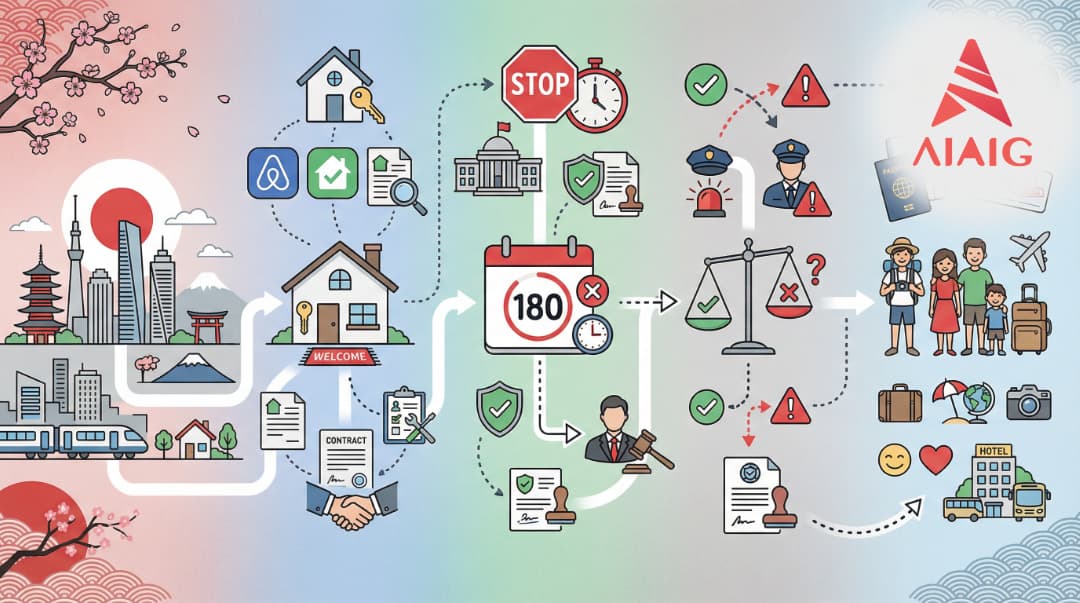
Is Japan's '180-Day Limit' for Minpaku Being 'De Facto Weakened'?
Many investors have observed a contradiction in Tokyo, Osaka, and Kyoto: legally, it's up to 180 nights per year, but the market is flooded with listings and operational models that 'appear to operate year-round.' Is it regulatory relaxation, insufficient enforcement, or have operators found ways to 'circumvent' it through compliant paths and local rule differences? This article uses institutional patchwork + local implementation variations to break down the issue clearly and provides actionable judgment methods for cross-border investors.
1. First, clarify the concept: The 180-day restriction only applies to which type of "homestay"?
The so-called "180-day restriction" refers to the annual limit of 180 days (180 nights) for providing accommodation under the "Housing Accommodation Business Act" (commonly known as the "Minpaku New Law").
The key point is: short-term rentals/guesthouses in Japan are not limited to this single path.
In practice, common compliant accommodation supply paths in Japan include at least:
- Minpaku New Law (Housing Accommodation Business): Has a hard cap of 180 nights, requires reporting/filing with local governments, and must meet requirements for noise, waste, and handling neighbor complaints.
- Hotel Business Act (Simple Lodging/Hotel Permits): Typically not subject to the 180-night limit, but has higher permit thresholds (stricter requirements for use, fire safety, and management).
- Special Zone Minpaku (National Strategic Special Zone Framework): Operates under a different rule system, allowing for effects closer to "year-round operation" in some areas (subject to special zone scope and local regulations).
Therefore, the first-level answer to "whether the 180-day restriction is being weakened" is: The restriction remains, but many operators are not operating under the same legal framework.
II. Why Does the Perception of "Fact Weakening" Arise? Three Most Common Mechanisms
Mechanism 1: Compliance Path Switching – From the "Minpaku New Law" to the "Hotel Business Law/Simple Lodging"
When the investment goal is "more stable annual cash flow," the most common practice is to switch to a Hotel Business Law permit (e.g., simple lodging). This shifts the operational logic from "residential-type shared accommodation" to something closer to "accommodation business operation," thereby in most cases no longer being directly constrained by the 180-night limit, but compliance costs, property conditions, and operational difficulty significantly increase.
Mechanism 2: Stricter Local Regulations – You May Not Even Use Up the 180 Nights
Many local governments impose stricter operational time/area restrictions on top of the Minpaku New Law, resulting in actual available operating windows being far below 180 nights.
- Typical case: Tokyo's Shinjuku Ward restricts operating times in specific residential use zones, with rules such as "no operation on weekdays, only weekend windows"; in non-such zones, it still follows the legal framework with a maximum of 180 nights.
Mechanism 3: Enforcement and Platform Governance Becoming More "Event-Driven"
Enforcement is not absent but increasingly manifests as a governance chain of "complaint – verification – rectification/delisting." Media reports show that relevant authorities request platforms to delist illegal/non-compliant property information, meaning compliance information disclosure and platform rules are becoming part of the substantive constraints.
Conclusion: The perceived "weakening" by investors is usually not the disappearance of the 180-night rule but rather its reshaping by "path switching + stricter local regulations + platform governance."
Three, How to Quickly Understand Local Implementation Differences? A Reusable "Three-Layer Overlay Model"
Understanding Japan's minpaku (private lodging) regulation as a three-layer overlay allows you to quickly assess the 'real operational space' for a city, a district, or even a building.
Layer 1: National Level (Legal Framework)
- If you follow the Minpaku New Law: the 180-night limit is a hard constraint.
- If you follow the Hotel Business Law/Simple Lodging: focus more on licensing thresholds and ongoing compliance capabilities.
- If you follow Special Zone Minpaku: look at special zone rules and local policy cycles.
Layer 2: Local Level (Ordinances/Zoning/Operating Hours)
Local governments can impose further restrictions on operating areas and times based on factors such as residential environment, proximity to schools, and residential zoning. The result is that different areas within the same city may have completely different operational windows.
Layer 3: Building Level (Apartment Management Regulations/Homeowners Association/Owner Resolutions)
Even if national and local regulations permit it, apartment management regulations may prohibit short-term rentals; this can shift you from 'compliant and feasible' directly to 'practically impossible'. This is the risk most easily overlooked by cross-border investors.
Key to Investment Judgment: Don't ask 'Is Japan 180 days?', ask what is the final outcome for your asset after considering the three-layer overlay.
IV. Compliance and Investment Checklist: How to Determine Actual Operable Days and Exit Risks?
By following the sequence below for verification, you can essentially filter out most projects that 'look good on paper':
- First, lock in the legal pathway: Is it registered under the New Minpaku Law? Licensed under the Hotel Business Law? Or designated as a Special Zone Minpaku? (This determines whether it is subject to the 180-night constraint.)
- Check local regulations: Are there restrictions such as no operation on weekdays in residential zones, limitations near schools, or stricter requirements for noise/waste? (This determines whether you can fully utilize the 180 nights, or even if you can operate at all.)
- Review building regulations: Does the apartment management agreement prohibit short-term rentals? Have there been any historical complaints or disputes?
- Verify the management system: Is there an operational management company, emergency contact, waste disposal, and a mechanism for handling noise and neighbor complaints?
- Check platform compliance display: Can registration numbers/license information be consistently displayed? Is there any record of being delisted or required to rectify issues?
AIAIG Tip: The 180 nights are not a 'revenue model parameter', but a 'system bifurcation point'
- If you follow the New Minpaku Law, cash flow is more like a 'seasonal tool'; do not use 'year-round hotelization' to project IRR.
- If you aim for year-round cash flow, the focus shifts to: availability of permits, feasibility of building regulations, operational and complaint-handling capabilities, and risks from future changes in local policies.
Is the 180-day limit being abolished?

Why do many listings appear to be able to "operate year-round"?
How significant are the differences in local enforcement?
How do platform removals and complaint management affect investments?