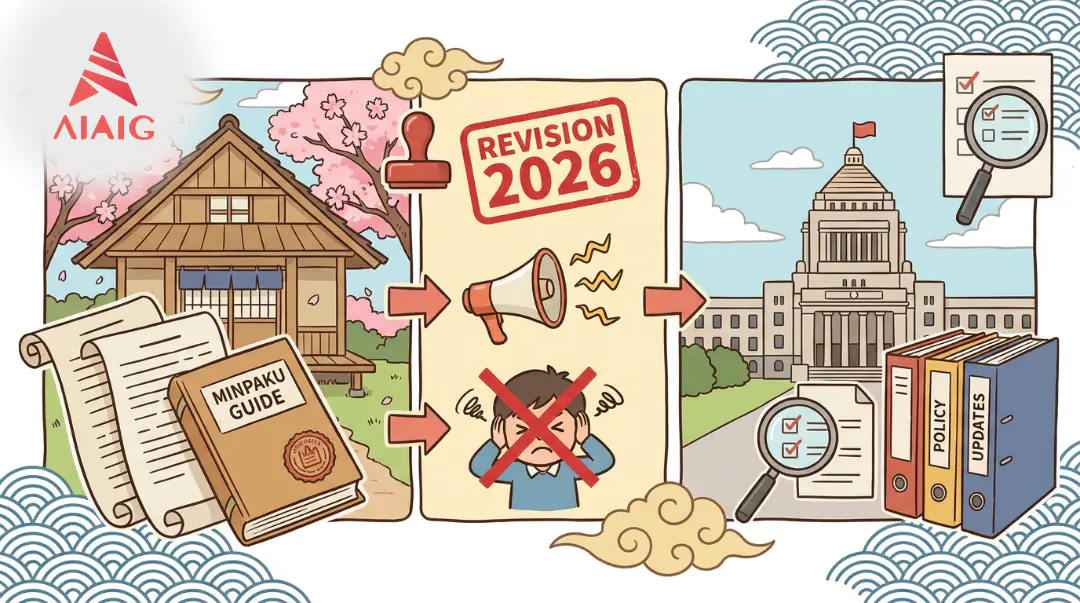
Japan's Minpaku Regulation 2026: Why "Revise the Guidelines"? What Types of Business Activities Will Be Affected (Focusing on Noise Complaints)
Update Information
- Last updated: 2026-02-18
- This article discusses: The Japan Tourism Agency plans to review the "Guidelines/Application Standards" in fiscal year 2026 to make it easier for local governments to take enforceable administrative measures against "nuisance minpaku"; it does not directly announce amendments to legal provisions.
First, the conclusion: Why revise?
After Japan's minpaku (private lodging) entered the "problem governance phase," the biggest pain point is not "whether there are rules," but:
- Resident complaints are mostly concentrated on "living environment" issues such as noise, garbage, late-night comings and goings, gatherings of strangers, and perceptions of public safety and fire risks;
- However, these issues often struggle to form an evidence chain that can lead directly to penalties (Who made the noise? Who threw the garbage? Did the operator fulfill management obligations?);
- As a result, local governments more often remain at the stage of administrative guidance (reminders/advice), and the threshold for actually reaching administrative penalties is high.
Therefore, the goal of revising the guidelines is more like: transforming "nuisance complaints" into verifiable, quantifiable, and accountable management obligations, enabling local governments to more clearly determine: at what point can stronger administrative measures be taken.
1. What issues does this "Revised Guidelines" aim to address? – Turning complaints into enforceable disciplinary standards
1) Why do "nuisance complaints" get stuck at the implementation level?
In terms of system design, the "Private Lodging Business Act" already includes "neighborhood troubles (noise, garbage, etc.)" as regulatory targets; the Japan Tourism Agency also provides explanation pages for nearby residents, clearly stating that operators have obligations to prevent adverse effects on the surroundings, maintain public safety, and prevent crime (e.g., lodgers' registry).
However, at the implementation level, it often gets stuck on three things:
- Difficulty in fact-finding: Complaints occur at night/in public spaces, and evidence is often fragmented.
- Difficulty in attributing responsibility: Is it the individual behavior of guests or a lack of management by the operator?
- Unclear penalty thresholds: What constitutes "frequent complaints"? To what extent does it count as "violation of obligations," allowing stronger measures to be initiated?
2) Changes more likely to be brought by the guideline revision (you can think of it as "standardization of enforcement SOPs")
If translated into operational terms, the guideline revision is likely to strengthen these directions:
- Clarify objective requirements for "penalizable" actions: For example, "frequency/repetition of complaints," "existence of unaddressed records," "existence of inability to contact or be present on-site."
- Standardize the path from administrative guidance to administrative penalties: First guidance, then improvement orders/business suspension, etc. (specific names and levels depend on local systems), with a focus on clearer processes.
- Make "management obligations" into verifiable items: Allow local governments to use records, logs, contact systems, and on-site management plans to determine whether obligations are fulfilled.
For content and SEO: This type of policy change is best suited for creating a "continuous update tracker + tool list," which is more effective at capturing search intent like "news today / regulation update" than writing news summaries.
II. Which business activities will be affected? — Breaking down the "nuisance complaint" chain into 7 verifiable actions
Below, breaking down the affected operational behaviors along the chain of "complaint occurrence → evidence collection → handling → accountability" (you can also directly turn this section into an operational SOP):
| Category | Common Past Issues | Points More Likely to Be Strengthened After Guideline Revision (Verifiable) | What Evidence/Materials You Should Prepare |
|---|---|---|---|
| 1. Guest Notification and Rules (House Rules) | Rules written but not enforced, guests unaware or non-compliant | Whether clear notification and multilingual prompts are provided for noise/garbage/smoking bans/visitors/late-night comings and goings | Pre-check-in notification records, in-room postings, platform rule page screenshots, violation handling records |
| 2. Garbage and Public Space Management | Improper garbage sorting/disposal leading to complaints | Whether there are clear disposal times, sorting instructions, arrangements for proxy disposal, and cleaning frequency | Garbage handling instructions, cleaning/proxy disposal contracts, on-site photos, complaint handling forms |
| 3. Noise and Nighttime Disturbances | Late-night parties, footsteps, door sounds causing neighborhood conflicts | Whether there are nighttime quiet rules, noise monitoring/patrol mechanisms, and immediate intervention processes for violations | Noise rules, patrol/reminder logs, communication records with guests (timestamps) |
| 4. Contact System (24h Contact) | Unable to contact or get a response when issues arise | Whether it can be proven that "contact is possible at any time" and "response time limits" are met | 24-hour hotline/contact person, response records, ticketing system screenshots |
| 5. On-site/On-scene Handling Capability | Unable to arrive promptly when on-site presence is required | Whether it meets local requirements for on-site systems (some cities may have standards like 10 minutes/800m) | On-site SOPs, outsourcing management contracts, duty schedules, on-site arrival records |
| 6. Lodgers' Registry and Identity Verification | Incomplete/non-compliant registry making it impossible to trace responsibility | Whether the registry is complete, and whether retention periods and fields meet requirements | Registry templates, retention and privacy management systems, materials for spot-check responses |
| 7. Complaint Handling and Recurrence Prevention | Complaints recur without a corrective closed loop | Whether there is a "complaint → correction → review → prevention" closed loop, with evidence that can be presented | Complaint logs, corrective plans, review reports, communication records with neighbors |
A Key Change: You Will Be Required to "Prove You Fulfilled Management Obligations"
For many operators, the biggest change is not adding a specific material, but:
- In the past, you might only need to "explain after an incident occurs";
- In the future, you may more likely need to "demonstrate in advance that you have systems, records, and a closed loop."
This will directly impact: choice of management companies, operational systems (ticketing/logs), and platform-side rule settings (minimum stay, visitor restrictions, etc.).
III. Impact on Different Types of Operators: Whose Compliance Costs Will Rise?
Dividing market participants into three categories makes it easier to understand "who is more affected":
1) Landlord Self-Management (Owner Present/Owner Absent)
- More Affected Points: Contact and on-site systems, complaint closed-loop records.
- Typical Risks: No work order/record system, unable to prove "I have handled it promptly" when encountering complaints.
2) Property Management Companies/Operators (Private lodging management)
- More Affected Points: Need to turn "service promises" into auditable SLAs; and ensure stable frontline execution (nighttime response, on-site presence, cleaning, garbage).
- Typical Risks: Contracts are well-written, but on-site execution is inconsistent; once multiple complaints arise, the operator's capabilities are the first to be scrutinized.
3) Platforms/Intermediaries (Private lodging intermediary)
- More Affected Points: Rules and information disclosure. Local governments need to more easily identify "persistent nuisance," making "rule settings/minimum stay/guest restrictions/emergency contact information" on the platform more important.
- Typical Risks: Page information does not match reality, or unable to cooperate in providing necessary record chains.
When creating the AIAIG content matrix, it is recommended to add two tool pages:
- "How to Choose a Compliant Property Management Company: Look at SLA and Complaint Closed-Loop"
- "Private Lodging Operation Record Template Download: Complaint Ledger/Inspection Log/Correction Closed-Loop"
- Will this 'revised guideline' directly change the 180-day limit?
- The focus of current public information discussions is on making 'nuisance complaints' more likely to trigger enforceable administrative measures, not on 'changing the 180-day limit' as the core. The 180-day limit is part of the legal framework system, and local governments more commonly impose additional restrictions through regulations on operating periods/areas, etc.
- Why is 'nuisance complaint' being emphasized as a regulatory focus?
- Because conflicts involving homestays in residential areas most commonly involve not safety incidents, but issues related to living environments such as noise, garbage, late-night comings and goings, and security concerns. In the past, these problems were difficult to form an evidence chain for penalties, so the policy direction tends to turn 'management obligations' into verifiable standards.
- What is the most important 'compliance gap' I should address for my homestay?
- Prioritize three things: (1) 24-hour contact and response records, (2) on-site or in-person handling system, (3) complaint log and rectification closure. These three things can turn 'I have fulfilled my responsibilities' into provable evidence.
- If neighbors repeatedly complain, but I think it's malicious, what should I do?
- You still need to establish verifiable handling records: the time and content of each complaint, the measures you took, the results of communication with guests, and whether it recurred. Even if the complaint is unfounded, complete records can reduce the risk of being deemed 'negligent'.
- What is the biggest misconception for overseas buyers purchasing property for homestays?
- Mistaking 'whether it can be done' for 'whether there is a 180-day limit'. What is actually more critical are the regulatory restrictions of the city/district and the building management rules, as well as whether you can establish sustainable on-site management and complaint closure.
Last updated Feb 18, 2026