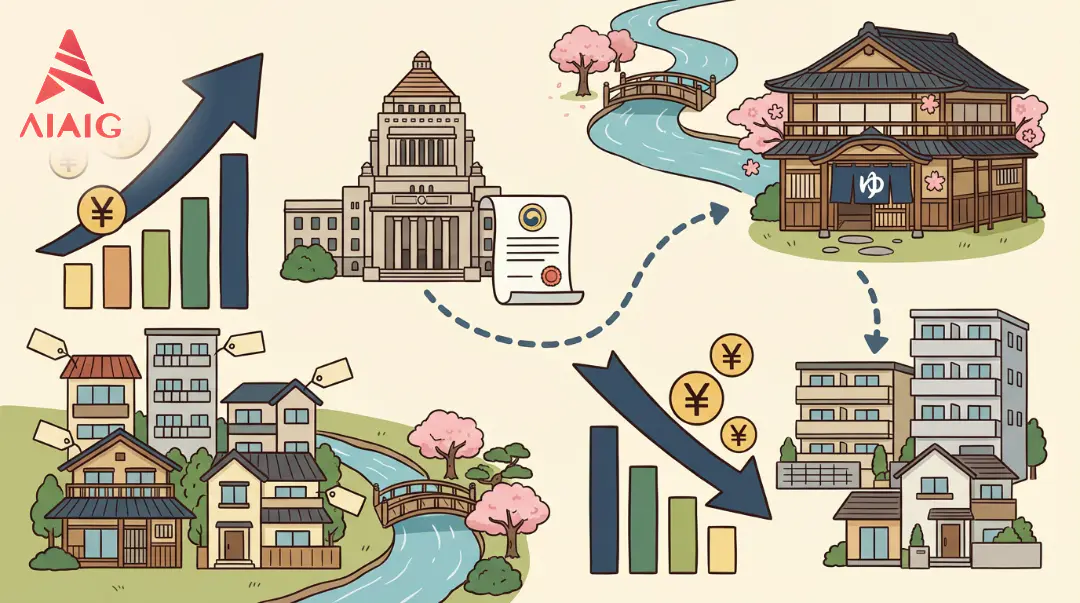
1. First, the conclusion: It will have an impact, but not a "nationwide rise/fall together," rather a "local premium revaluation"
To thoroughly explain the issue, the key lies in: the regulation of homestays affects housing prices and rents, primarily by altering asset pricing through changes in "short-term rental cash flow expectations" and by modifying local supply and demand through "switching of properties between short-term and long-term rentals."
The impact on housing prices is more concentrated: it resembles a re-pricing of "which properties have a short-term rental premium."
- Properties in tourist hotspots, near transportation hubs, and suitable for short-term rental operations (e.g., small units/1LDK, easy to maintain, remotely manageable) are more sensitive.
- For apartments (マンション), if management regulations or associations intend to restrict homestays, the short-term rental premium can be directly eliminated.
The impact on rents is more differentiated: it depends on the scale and location of properties returning to long-term rentals.
- If enforcement intensifies, leading to a large number of short-term rental properties "returning to long-term rentals," it could suppress long-term rents locally.
- However, if inbound demand is strong, hotel supply is tight, and compliant short-term rental supply is restricted, the daily rents for compliant short-term rentals may be higher, making "properties still available for short-term rental" more scarce.
II. Transmission Mechanism: How Regulation Transfers from "Homestays" to "Housing Prices/Rents"
You can quickly determine the direction of impact using two pathways:
Pathway A: Discounted Cash Flow → Housing Prices (Re-evaluation of Short-term Rental Premium)
Housing prices are essentially the discounted value of future cash flows.
- Stricter regulation/enforceable penalties → increased compliance costs, higher risk of violations, limited operational days/areas → decreased expected net income → contraction of the "short-term rental premium."
- But if regulatory tightening leads to supply clearance (exit of gray-market operations, higher compliance barriers) and inbound demand remains strong → compliant properties become more scarce → a "compliance license premium" may actually emerge.
Pathway B: Property Switching → Rents (Local Supply and Demand Changes from Short-term Rentals Returning to Long-term Rentals)
The same property can switch between short-term and long-term rental uses.
- Short-term rentals are restricted (days/times/areas/management rules) → some landlords switch back to long-term rentals → increased long-term rental supply → local rents face pressure.
- Short-term rentals are still possible but more scarce → operators are more willing to pay higher lease/management fees for "properties that can be used for short-term rentals" → creating a "management premium" for certain owners.
In a nutshell: ==Regulation does not simply push housing prices or rents in one direction; it compresses premiums from being "generalized" into "concentrated premiums for a few compliant assets."==
III. Why Japan's Influence is More "Local": Vast Differences in Local Regulations + Enforcement Methods
Beyond the national framework for homestays in Japan, local governments have significant room for refinement (e.g., bans on weekdays, bans during peak seasons, restrictions in residential areas, distance requirements for managers, etc.). This directly leads to:
- Within the same city, short-term rental capabilities vary greatly between different wards or zoning areas.
- "Whether continuous compliant operation is possible" has a greater impact on asset pricing than "whether there is a 180-day upper limit."
A clear trend for 2025–2026 is: regulatory authorities are focusing more on "verifiable nuisance complaints" and "enforceable penalties for malicious operators," and are attempting to establish clearer enforcement standards; meanwhile, case-by-case enforcement is also emerging (e.g., pursuing violations of local regulations and ignoring improvement orders). Such changes will significantly increase the risk premium for gray-market operations, thereby affecting buyers'/investors' pricing expectations for short-term rental cash flows.
Four, Landing on "Housing Prices": Which Houses Are Most Likely to Be Revalued? (A Screening Checklist Before Buying a House)
If you're concerned about 'whether short-term rental regulation will affect the house I bought,' the key isn't to focus on news headlines, but to conduct a three-step screening:
1) First, assess the 'short-term rental attribute weight' of this property
- The higher the proportion of short-term rental cash flow in your valuation, the more sensitive the property price is to regulatory changes.
- Conversely, if you bought the asset purely for self-occupation or long-term rental logic, the impact is typically weaker.
2) Then, evaluate the 'compliance certainty'
- Apartment management regulations/management association stance: Is short-term rental explicitly prohibited? Is reporting required? Is on-site management mandated?
- District/land use zoning/ordinance restrictions: Are there restrictions on weekday operations? Is it only allowed during off-peak seasons? Are there stricter operational conditions?
3) Finally, judge the 'strength of alternative supply'
- Is hotel supply in the surrounding area tight? Is inbound demand strong? If a 'lodging gap' truly exists, compliant short-term rentals are more likely to form a scarcity premium.
Conclusion: ==The properties most likely to be revalued are those 'originally purchased as short-term rental assets'==; the stricter the regulation, the more uncertain the compliance, and the more likely the valuation is to be cut. Conversely, if regulation clears out gray-market operations and compliant supply becomes scarce, compliant assets may see a 'licensing premium.'
Five, Landing on "Rent": Will Long-Term Rent Rise or Fall? Use Three Scenarios to Judge
The direction of long-term rental rents depends on the scale and location of 'short-term rental units returning to the long-term rental market.' You can quickly assess this using a scenario framework:
Scenario A: Enhanced enforcement + a large number of short-term rentals returning to long-term rentals (local rent pressure)
- Common in: Areas with many gray-market operations, undergoing concentrated crackdowns, or where regulations make short-term rentals unsustainable.
- Outcome: Long-term rental supply increases in the same area, shifting bargaining power back to tenants.
Scenario B: Enhanced enforcement + gray-market operations cleared out, but compliant short-term rentals become scarcer (minimal impact on long-term rentals, short-term rentals become more expensive)
- Common in: Areas with strong inbound demand, tight hotel supply, and higher compliance thresholds.
- Outcome: Long-term rental rents may not change significantly, but compliant short-term rental ADR may become more resilient.
Scenario C: Specific forms restricted (e.g., new permits for a certain type suspended) → capital shifts to alternative assets (price structure differentiation)
- Outcome: New supply of a certain type of 'short-term rental-capable asset' is restricted, making existing stock scarcer; while assets that cannot be used for short-term rentals or have uncertain compliance revert to long-term rental pricing.
In a nutshell: ==The impact of Japan's short-term rental regulation on 'long-term rental rents' is more like local supply-demand fluctuations; its impact on 'short-term rental prices' is more like scarcity driven by a contraction in compliant supply.==
- Will tightening regulations on homestays definitely suppress Japanese housing prices?
- Not necessarily. It typically does not determine the 'national housing price direction,' but rather reassesses the 'short-term rental cash flow premium.' Assets with high short-term rental exposure may face valuation pressure; however, if gray market supply is cleared and compliant supply becomes scarcer, compliant assets might even see a 'license premium.'
- Does it have a greater impact on long-term rents or short-term rents?
- Generally, it has a more direct impact on short-term rents. This is because regulations often directly restrict operational forms and penalty pathways; whereas long-term rents require 'scale of property returns' to see significant changes, and these are mostly localized phenomena.
- If I buy a property for both personal use and occasional short-term rentals, what should I check first?
- Prioritize checking three things: 1) Whether the apartment management rules allow homestays; 2) Whether the district/land use zone/regulations restrict operations on weekdays or during peak seasons; 3) The minimum requirements for compliant operations (e.g., manager proximity, complaint handling, fire and safety standards). These three factors determine whether you can 'operate stably and compliantly.'
- What are the regulatory trends after 2026?
- The trend leans more toward 'enforceable standardization': enhancing the enforceability of penalties for nuisance and malicious operators, making it easier for local authorities to take administrative actions based on verifiable facts; simultaneously, with the demonstration effect of case-by-case enforcement, the risk premium for gray market operations will rise.
Last updated Feb 10, 2026