Japan 2026 Work Visa Overhaul: B2 Japanese Required for Engineer Visas, Fees Soar to ¥70,000, SSW Restaurant Sector Suspended
Japan implements sweeping work visa reforms in 2026: from mid-April, Engineer/Specialist in Humanities visa applicants must prove CEFR B2 (JLPT N2) Japanese proficiency; visa renewal fees shift to tiered pricing reaching ¥70,000 for 5-year stays; PR application fees jump from ¥10,000 to approximately ¥200,000; the Specified Skilled Worker (SSW) restaurant sector suspends new applications due to capacity limits. This article provides a comprehensive analysis of these reforms for Chinese professionals seeking to work in Japan.
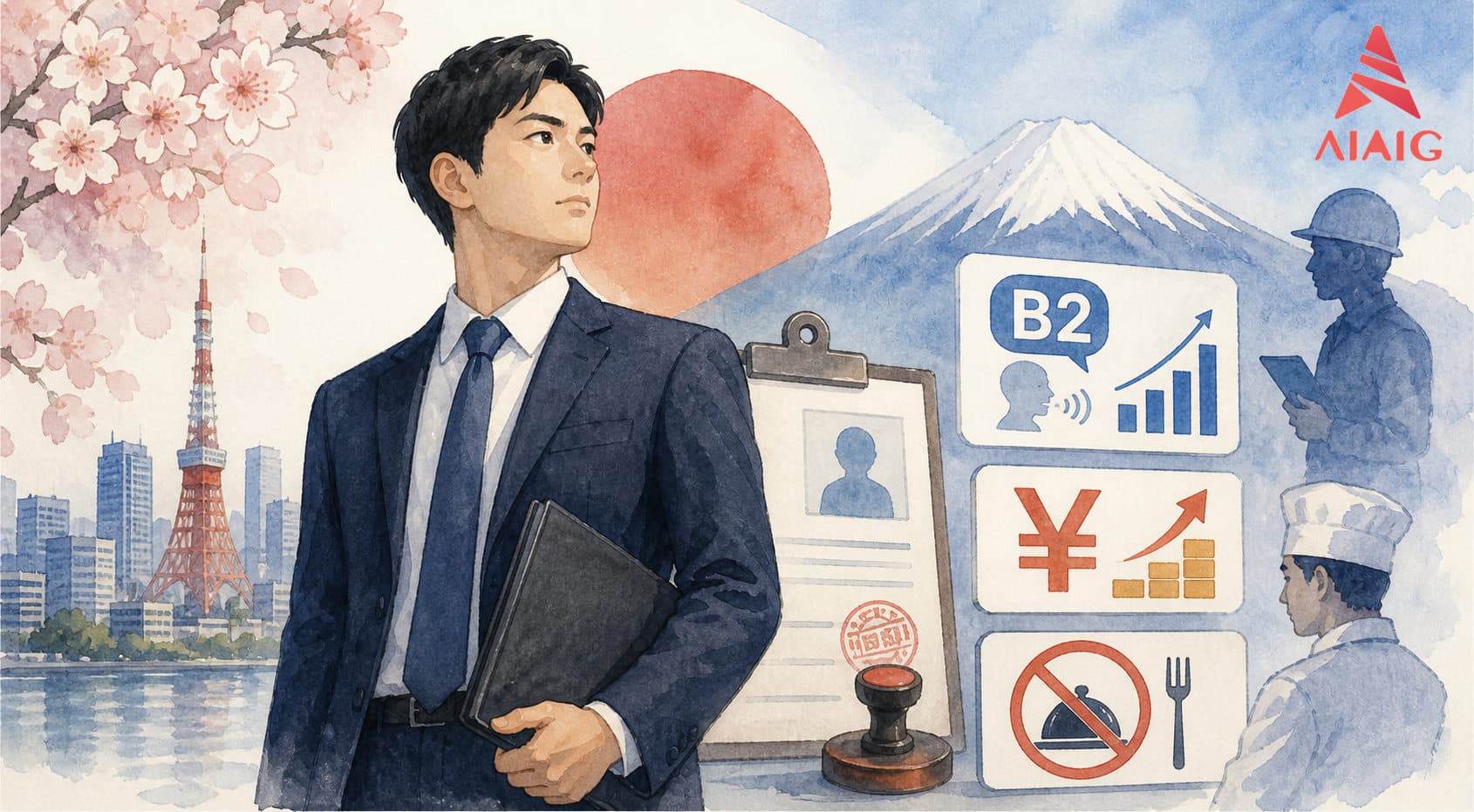
Japan is implementing its largest work visa reform in nearly a decade in 2026. The changes span multiple areas: new Japanese language requirements for the Engineer/Specialist in Humanities/International Services visa (commonly known as the 'engineering visa'), tiered visa renewal fees, a massive increase in permanent residency application fees, and suspension of new SSW applications in the restaurant sector. These adjustments reflect the government's balancing act between expanding foreign labor intake and strengthening compliance management and talent quality.
Key highlights of the 2026 work visa reforms:
B2 Japanese requirement for Engineer visas. From April 15, 2026, applicants for this visa category must prove CEFR B2 proficiency (equivalent to JLPT N2). Previously, only a vague 'work requires Japanese' condition applied; now it is a clear, hard requirement.
Tiered visa renewal fees. Fees now vary by visa duration: approximately ¥20,000 for under 1 year, ¥40,000 for 3 years, and up to ¥70,000 for 5-year stays. This is Japan's first fee differentiation by visa length.
PR application fee surge. From the current ¥10,000 (approximately 500 yuan) to approximately ¥200,000 (10,000 yuan) — a 20-fold increase.
SSW Type 1 restaurant sector suspension. Due to capacity saturation, the Immigration Services Agency suspended new SSW applications for the restaurant sector effective April 13, 2026.
As the number of foreign workers in Japan continues to increase, ensuring they possess adequate Japanese language proficiency and understanding of Japanese social norms is essential for realizing a harmonious society. The enhanced language requirements and fee restructuring are designed to select individuals with greater willingness and ability to integrate, while providing the necessary fiscal foundation for strengthening the residence management system.
| Reform Item | Previous Policy | New Policy | Effective Date |
|---|---|---|---|
| Engineer Visa Japanese Requirement | No clear language threshold | CEFR B2 (JLPT N2) | April 15, 2026 |
| Visa Renewal Fee (5-year) | Flat ~¥4,000 | ~¥70,000 | FY 2026 |
| PR Application Fee | ~¥10,000 | ~¥200,000 | FY 2026 |
| SSW Restaurant New Applications | Open | Suspended (capacity reached) | April 13, 2026 |
| Language School Entry Screening | Study hours certificate accepted | Must have JLPT or equivalent score | October 2026 |
| Student Part-time Work Monitoring | Annual spot check | Quarterly verification | FY 2026 |
This reform has multi-dimensional impacts on overseas Chinese professionals planning to work in Japan.
First, the language threshold is the most significant change. For Chinese engineers and technical professionals seeking the Engineer/Specialist visa, JLPT N2 (equivalent to 600+ hours of systematic study) is now a hard requirement. The previous strategy of 'learning Japanese after starting work' is no longer viable. We recommend that Chinese technical professionals begin systematic Japanese exam preparation 6-12 months in advance, prioritizing the JLPT N2 certificate. For those starting from zero Japanese, consider enrolling in a language school (student visa first), then converting to a work visa after reaching N2.
Second, fee increases significantly raise long-term residence costs. With a 5-year visa renewal at ¥70,000 plus a future PR application at ¥200,000, administrative fees alone could exceed ¥300,000 (approximately 15,000 yuan). This is a non-trivial additional cost for overseas Chinese planning long-term development in Japan.
Third, the SSW restaurant sector suspension sends an important signal. Other sectors (construction, agriculture, nursing care, etc.) remain open, but quotas are gradually decreasing. Applicants planning to use the SSW pathway should act early.
Fourth, language school entry screening has tightened. From October 2026, applicants without a bachelor's degree must provide formal test scores (JLPT or NAT-Test) rather than study-hour certificates. This directly impacts Chinese applicants planning to use language school as a bridge to employment.
AIAIG Insight: Japan's 2026 work visa reform is essentially a 'quality upgrade, quantity control' adjustment — using language thresholds and fee increases to select genuinely qualified talent willing to integrate, while suppressing low-skilled labor inflows. For Chinese applicants with educational and technical backgrounds, the N2 requirement increases upfront preparation costs but also means a more regulated future work environment (reduced communication barriers, stronger rights protection). We recommend overseas Chinese planning to work in Japan: 1) Plan Japanese language study early with N2 as minimum target; 2) Monitor SSW sector quota dynamics; 3) Budget for increased visa fees; 4) Prioritize mid-sized and larger companies that typically have better visa management and compliance systems.