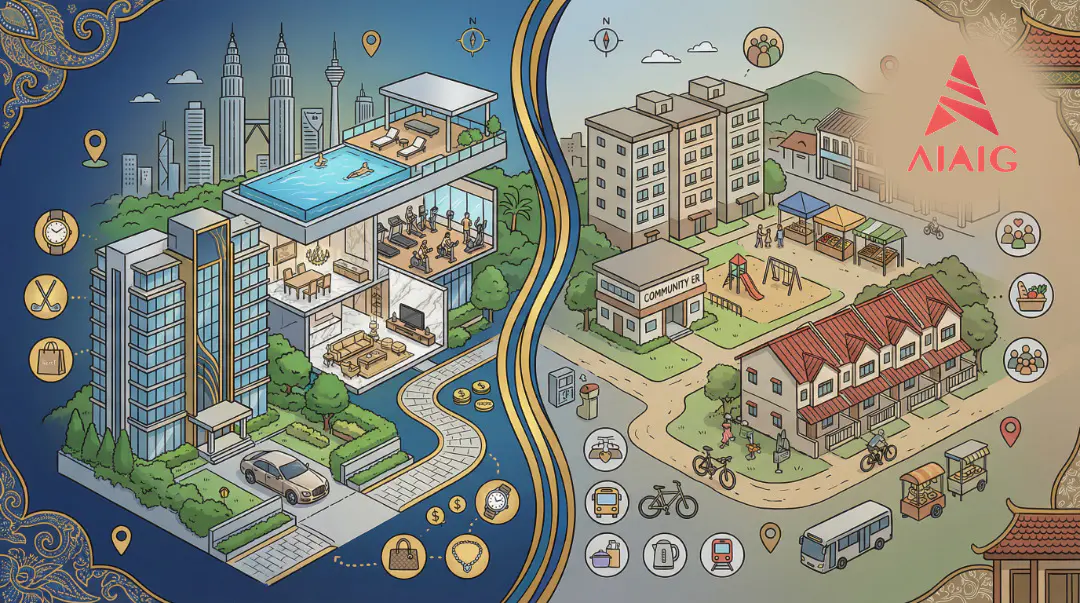
1. First, the conclusion: Kuala Lumpur's "affluent areas" are not a single concept, but 5 lifestyles
When categorizing Kuala Lumpur's high-end residential circles by "real lifestyle," they typically fall into these 5 categories (even at the same price point, experiences can be completely different):
- International Family Type: Mont Kiara / Sri Hartamas (high density of international schools and expat families, convenient living but also high traffic and density).
- Urban Social Type: Bangsar (one of the strongest in dining, nightlife, social density, convenience, and "playability").
- Old Money Low-Density Type: Damansara Heights (Bukit Damansara) / Bukit Tunku (mainly low-density villas, strong privacy and status sense, less reliance on "walkable commercial areas").
- Core Business Type: KLCC / Ampang Hilir (close to CBD, concentration of luxury apartments and serviced apartments, extremely strong commuting efficiency but also significant premium).
- Community Park Type: Desa ParkCity (self-contained system, strong community atmosphere, family-friendly, more reliant on road and time choices for external commuting).
The real "difference in affluent areas" is not about which is more expensive, but about your daily routines: where your children go to school, where you work, where you socialize on weekends, and how much community sense and security you need.
II. Comparison Framework: Viewing "Real-Life Differences" Through 6 Dimensions
It is recommended that you quickly score each area based on the same set of dimensions (more effective than looking at promotional slogans):
A. Residential product type: High-rise apartments / Serviced apartments / Townhouses / Detached villas / Low-density gated communities.
B. Commute and urban connectivity: "Real commute time range" to KLCC, TRX, Mid Valley, Bangsar South (varies greatly during peak hours/rainy days).
C. Education and family scenarios: Density of international schools, pick-up/drop-off routes, after-school activity radius.
D. Commerce and social life: Density of dining options, nightlife, social circles (expatriate/local/mixed).
E. Sense of security and governance: 24/7 guard, community closure, daily walkability, perceived safety (also influenced by overall city crime situation).
F. Asset attributes: Liquidity (easy to sell/rent), tenant structure (expatriates/local high-income/student families), resilience to cycles (premium from "scarcity" or "marketing concepts").
Three, Five Major Sections "Real Life Portrait": How Would You Spend a Day?
1) Mont Kiara / Sri Hartamas: The "Efficiency Lifestyle" for International Families
- How you might live: Morning school drop-off → daytime work (city center/remote/surrounding offices) → evening dining and shopping in community commercial areas.
- Core advantages: High density of expat families, English-friendly environment, numerous international schools and family-friendly facilities, stable rental demand.
- Real costs: Traffic and road congestion are more common; many "conveniences" rely on driving and short-distance travel.
- More suitable for: Expat/international families with school-age children, needing an international school ecosystem, and wanting to be "surrounded by similar people."
2) Bangsar: The "Urban Lifestyle Zone" with the Highest Social Density
- How you might live: More flexible daytime commuting, dense restaurants/bars/cafes at night, and rich weekend activities.
- Core advantages: Strong radius for dining, entertainment, and socializing, with both mature residential areas and continuously updated commercial vibes.
- Real costs: Closer to popular dining spots, nighttime noise, parking, and traffic pressure become more noticeable; suitable for "social butterflies," not for families seeking extreme quiet.
- More suitable for: Singles/newlyweds, frequent socializers, urban dwellers who value convenience and "playability."
3) Damansara Heights (Bukit Damansara) / Bukit Tunku: Low Density, Privacy, and a Sense of Status
- How you might live: More activities at home and in private spaces, socializing tends to be "by appointment," with more stable social circles.
- Core advantages: More concentrated low-density villas and high-end low-density properties, stronger privacy and living comfort.
- Real costs: Walkable commercial areas and "bustling feel" are weaker than Bangsar; greater reliance on drivers/vehicles is evident.
- More suitable for: Those who value privacy, want to stay away from tourists and nightlife, have higher budgets, and have more stable family structures.
4) KLCC / Ampang Hilir: Close to CBD, Maximum Efficiency but Maximum Premium
- How you might live: Walk or take short trips to core commercial and office areas, high living convenience, with a large proportion of serviced apartments and high-end condos.
- Core advantages: Extremely friendly for "people working in the CBD"; richer short-term and high-end rental demand.
- Real costs: Premium comes from "core location"; for long-term self-living, you're buying time and location rather than space; some properties are more suitable for investment holding.
- More suitable for: Those frequently working/traveling in the city center, pursuing commuting efficiency, and accepting high-rise condo living.
5) Desa ParkCity: The "Park Life + Family Life" Model with Strong Community Feel
- How you might live: Complete exercise, child-rearing, socializing, and consumption within the community, resembling a "town with its own lifestyle."
- Core advantages: Strong community atmosphere, prominent public spaces and park life, family-friendly.
- Real costs: External commuting relies more on road conditions and travel time choices; if you need to cross the city to the CBD daily, peak-hour experiences can reduce happiness.
- More suitable for: Families who highly value community feel, parenting, and daily leisure, and are willing to "keep their life radius within the community."
Four, Public Security and "Sense of Security": Are Wealthy Neighborhoods Safer? Distinguish Between "Data" and "Perception"
Many homebuyers take 'affluent area = absolute safety' as a default premise, but the more realistic logic in Kuala Lumpur is:
- Crime situation at the city level affects all areas (especially property-related crimes). Official statistics show that Malaysia's overall crime index fluctuates in certain years, and property crimes account for a high proportion in the structure.
- The sense of security in affluent areas comes more from community features: guarded & gated, access control, property management, road network structure (whether there is a lot of through traffic), and the 'difficulty of entry' for suspicious individuals.
- Perceived safety is also influenced by the 'walking environment': sidewalks, lighting, and whether there are 24-hour commercial activities and pedestrian flow.
Practical suggestions (more actionable than asking 'is this area safe?'):
- Schedule property viewings during evenings and weekends;
- Verify access control, visitor management, and parking routes;
- Clarify property fees and security configurations;
- If someone in the household often walks or runs at night, prioritize viewing areas with 'lighting + pedestrian systems + community vibrancy'.
Five, From "Content Topic Selection" to "Investment Decision": How Can Your Website Be Written More Like a "Real-Life Guide"?
Regarding the 'real-life differences in affluent neighborhoods', the most effective entry point for creating highly convertible content is not to provide general introductions, but to compile a comparative checklist of the issues users care most about:
- Actual Commute Times: Mont Kiara→KLCC (peak/off-peak), Desa ParkCity→TRX, Bangsar→Bangsar South, etc. (expressed as 'time ranges + route options').
- Family Routines: Routes for international school drop-offs, radius for after-school activities, weekend family destinations (parks/malls/sports fields).
- Social Styles: Bangsar's Telawi/café culture vs. KLCC's business networking vs. Damansara Heights' private social circles.
- Residential Product Comparison: Pros and cons of serviced apartments, branded condominiums, low-density villas, and gated communities, along with 'long-term holding costs'.
- Tenant Profiles: Which areas are concentrated with expat families, international school families, local high-income professionals, and short-term business travelers.
By thoroughly covering these 5 points, your article will transform from an 'introduction' into a 'decision-making tool', and SEO will more easily capture long-tail keywords (e.g., 'Is Mont Kiara suitable for families?', 'Bangsar nightlife noise', 'Desa ParkCity commute to KLCC').
Last updated Jan 22, 2026