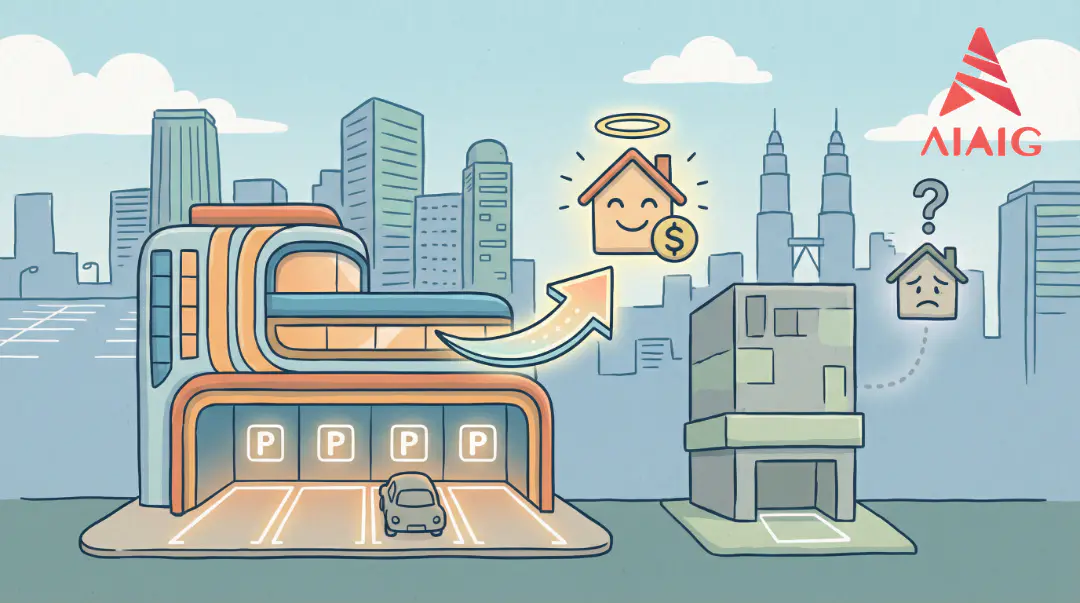
The Impact of Kuala Lumpur Parking Space Configuration on Rental Value: From 'Package' to 'Cash Flow Component' (2026 Update)
In the KL rental market, parking space configuration directly affects three things:
Rental ceiling: For the same unit type, whether there is "a fixed parking space/double parking spaces/parking location and availability" often determines whether you can ask for higher rent.
Vacancy period: Properties with insufficient parking spaces filter out not just "picky tenants," but a large number of key tenants such as "commuters with essential needs/families/employees of foreign companies."
Tenant structure: High-end tenants often look not only at the house but also at the "parking experience" (ramps, access control, tandem parking, visitor parking management, EV charging, and movement flow to elevator lobbies).
This is why, within the same property, units with double parking spaces usually attract more stable, longer-term tenants, while units with "no fixed parking space/uncontrollable parking" often have to rely on price reductions or short-term rentals to fill vacancies (though short-term rentals are also affected by building management and local enforcement intensity).
1. Why Have Parking Spaces Become the "Hard Currency" for Renting High-End Apartments in KL?
When treating parking spaces as a 'rental value factor,' it is recommended to score them using four dimensions:
A. Whether it is fixed (Allocated / Dedicated)
- Fixed parking space: Tenants expect stability, with fewer management disputes.
- Non-fixed/first-come, first-served: Extremely unfriendly to tenants with cars, and the rent ceiling will be suppressed.
B. Quantity (0/1/2+)
- 0 parking spaces: Directly excludes a large number of commuters and family tenants.
- 1 parking space: Covers most singles/couples/light families.
- 2 parking spaces: More likely to attract families and high-net-worth tenants ('two-car families' or 'main car + spare car/visitor car').
C. Availability and experience
- Tandem parking: Nominally 2 spaces, but the actual usage experience may be close to 1.3~1.6 spaces (due to moving costs causing tenant dissatisfaction).
- Distance from the parking space to the elevator lobby, steepness of ramps, whether curves scrape the chassis, nighttime lighting and security, stability of access control systems.
D. Management and supply
- Whether visitor parking is sufficient, time-limited, charged, and whether security enforcement is strict.
- Whether there is a historical reputation of 'external vehicle occupancy/loose management' (this significantly reduces the willingness of tenants with cars).
The table below can serve as a 'quick template' for your rent estimation and property selection (specific premiums vary based on property location, tenant structure, and parking scarcity):
| Parking Configuration | Common Tenant Profile | Impact on Rent Ceiling | Impact on Vacancy Period | Common Risk Points |
|---|---|---|---|---|
| 0 fixed parking spaces | Car-free/only use Grab, students, short-term rental tendency | Ceiling significantly limited | Longer vacancy periods (except during peak seasons) | Can only rely on price, furniture, or short-term rentals as a fallback |
| 1 fixed parking space | Foreign company white-collar workers, couples, small families | Rent ceiling more stable | Shorter vacancy periods | Parking far from elevator/poor ramp experience can lead to price pressure |
| 2 fixed parking spaces (non-tandem) | Families, expatriate management, high-end tenants | Easier to achieve premiums | Usually shorter vacancy periods | Clarity on parking ownership/whether included in the lease is essential |
| 2 tandem parking spaces (Tandem) | Price-sensitive families/with two cars but willing to accept moving | Premium limited or unstable | Depends on tenant tolerance | Must 'demonstrate moving on-site' during viewings |
| 1 fixed + EV charging convenience | New energy vehicle users, long-term tenants | Easier to negotiate long-term leases/higher rents | More stable | Charging space permissions, electricity billing, and management rules |
| Parking can be rented separately (subject to management rules) | Additional parking for tenants in the same building | Can serve as 'additional cash flow' | Generally limited help with vacancy periods | Legally, 'separate external rental' may not always be allowed |
In summary: In KL high-end rentals, 'the number and controllability of parking spaces' often determine cash flow quality more than 'having an extra balcony.'
II. Property Rights and Compliance: Who Actually Owns Your Parking Space? (Accessory Parcel vs Common Property)
Many investors overlook a crucial point:
In Malaysia's stratified property system, a parking lot may be an "Accessory Parcel (accessory lot/accessory stratified unit)" or belong to "Common Property (common property/common area) allocated by the management."
This leads to two entirely different outcomes:
- Accessory Parcel (commonly seen in: written into the stratified title/stratified plan, exclusive to a specific unit)
- Core characteristic: It is a property part that is "bundled and bound" with the main unit.
- Practical impact: Typically, the parking lot cannot be treated as an "independent asset" to be sold or rented separately to third parties not associated with that unit (subject to regulations and case law constraints).
- Common Property parking (commonly seen in: visitor parking, monthly rental spots allocated by management)
- Core characteristic: It is not the exclusive property of any unit; usage rights come from the rules of the management body (JMB/MC).
- Practical impact: Allocation methods such as "monthly rental/lottery/queueing" may exist, but controllability is weak, and changes in management rules can affect your commitments to tenants.
Key points for investment:
- When buying a property, you must clarify: In your S&P/stratified documents, is the parking lot "permanently bound" or "allocated by management"?
- When renting out, you must clarify: Does the lease specify "includes a fixed numbered parking lot (Lot No.)" or "provides parking usage rights (subject to management rules)"?
- If you want to engage in the value-added strategy of "additional rental of parking lots," be sure to confirm whether the parking lot is an Accessory Parcel and whether the management bylaws permit it, otherwise disputes may easily arise (or you may even be required to stop by the management).
A very realistic tenant perspective:
Tenants don't care about legal terms; they only care: 'Will I have a spot to park when I get home? Will I get a ticket/wheel clamp? Can visitors park?'—so you must include "parking availability" in your rental delivery standards and risk disclosures.
III. Converting "Parking Space Allocation" into Rent: An Executable Strategy for Property Selection and Pricing
You can use the following 'Parking Space → Rent/Vacancy' strategy to directly guide property selection and listing:
1) First identify your target tenants, then decide on parking space requirements
- Corporate white-collar workers (commuting + stability): At least 1 fixed parking space; prioritize access routes and security.
- Families/expatriate management: Prefer 2 fixed parking spaces (non-tandem is better); visitor parking and weekend parking experience are crucial.
- Students/car-free individuals: Parking is not a core concern, but confirm if the 'proportion of car-free tenants' is sufficient to support the rental depth of the property.
2) In listing descriptions, present parking as a 'product feature,' not just a phrase like 'with car park'
Suggested wording (can be directly applied):
- '1 assigned covered car park (Lot No. XXX), near lift lobby'
- '2 assigned car parks (non-tandem), suitable for family/expat'
- 'Tandem 2-car park (requires tandem parking) — best for 2 cars with flexible schedule'
- 'Visitor parking available (subject to management rules)'
3) Lease clause recommendations (to reduce disputes)
- For fixed parking spaces: Specify the parking space number/location/whether it's covered/whether it can accommodate an SUV.
- For management-allocated parking: State 'subject to management rules,' and include in the handover list the parking application process, sticker/access card procedures, and violation penalty rules.
- Clarify visitor parking: Whether there are time limits, registration requirements, or fees.
4) 'Parking inspection checklist' during property viewings (recommend standardizing for your team)
- Parking space dimensions: Can it fit large SUVs/MPVs? Are there restrictions on opening doors on both sides?
- Access routes: Distance from the parking space to the elevator lobby, nighttime lighting, blind spots in surveillance.
- Entry/exit experience: Steepness of ramps, turning radius, frequency of congestion or queues.
- Visitor parking: Quantity, distribution, weekend availability.
- Enforcement: Strictness of security, common occurrences of illegal parking/space occupation (this greatly affects reputation).
5) Treat parking spaces as 'sellable value-added items'
- For tenants with cars: You are selling 'certainty.'
- For tenants without cars: You can use 'parking space for discount' to reduce vacancy periods (e.g., lower rent without parking; higher rent with parking).
The purpose of this method is to transform 'parking configuration' from 'something to glance at when buying a property' into a core variable that you can quantify, price, and include in delivery standards.
- Q1: Why are units with double parking spaces easier to rent out in the same building with the same layout?
- Because double parking spaces directly expand the target tenant pool (families/expatriate management/two-car households) and significantly reduce the probability of lease termination and disputes due to 'parking uncertainty.' For high-end tenants, parking experience is part of their living experience, and they are willing to pay for certainty.
- Q2: Does a tandem parking space count as a 'double parking space'? Does it help with renting?
- It nominally counts as two spaces, but the user experience depends on the tenant's schedule and the cost of moving cars. It helps with renting, but the premium is usually not as high as for 'side-by-side double parking spaces.' When listing, it is recommended to clearly state 'tandem parking' to avoid disputes and lease terminations later.
- Q3: Can parking spaces be rented out separately to others for additional cash flow?
- First, confirm whether the parking space is an Accessory Parcel (subsidiary lot/dedicated parking space) or a public area allocated by the management. Accessory Parcels are usually tied to the main unit, and separate disposal/rental may be subject to regulations, management bylaws, and legal precedents; for monthly rental spaces in public areas, it depends on the management's rules and enforcement. The safest approach is: first review the strata documents and management rules, then decide whether to use 'additional parking space rental' as a strategy.
- Q4: Can apartments without fixed parking spaces still be used for long-term rentals?
- Yes, but you need to redefine the target tenants (car-free/light commuters/students, etc.) and accept the realistic constraints on rent ceilings and vacancy periods. If the building has tight visitor parking or weak management enforcement, long-term stability will be worse.
- Q5: How to quickly determine if parking configuration will hinder renting when buying a property?
- Three steps:
1) Clarify 'whether it is a fixed-numbered parking space, whether it is written in the strata documents/whether it is an Accessory Parcel';
2) Walk through the garage flow on-site (ramps/turns/congestion/distance to elevator lobby);
3) Check visitor parking and illegal parking on a weekend evening (this best reflects real supply-demand and management enforcement).
Last updated Jan 26, 2026