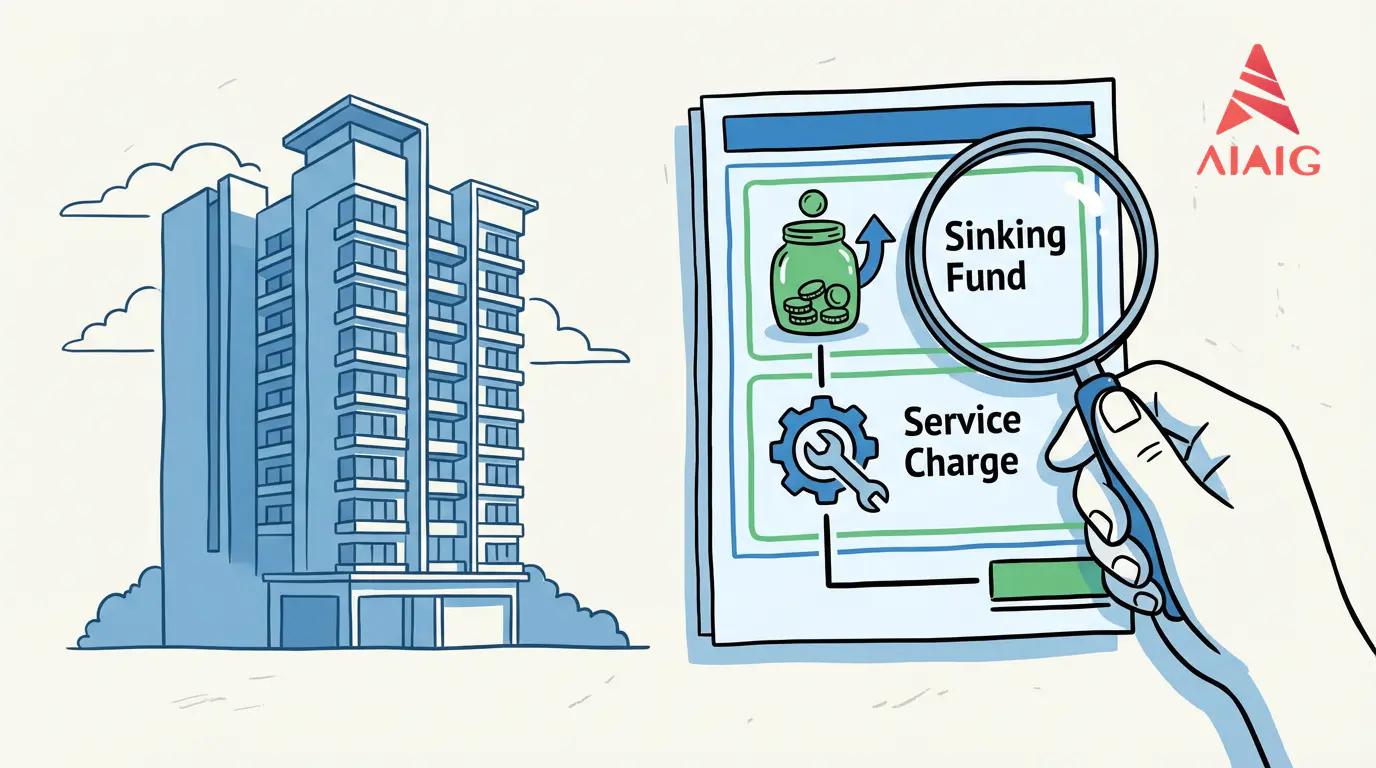
How to Read a Management Fee Bill: What is Sinking Fund / Service Charge? (2026 Update)
Start with the Conclusion: Understanding These Two Items Helps You Determine "Whether Holding Costs Are Controllable" and "Whether the Building Will Suddenly Impose Special Levies"
In the common fee structure for Malaysian apartments (including high-rise residences in Kuala Lumpur), the two most critical items are:
- Service Charge (Management Fee/Service Fee): Used for ==daily operations== (security, cleaning, utilities for common areas, landscaping, pool maintenance, management company fees, etc.).
- Sinking Fund (Maintenance Fund/Reserve Fund): Used for ==major repairs and replacement of large equipment== (elevator overhauls, exterior wall repairs, waterproofing projects, roofs, fire system upgrades, public pipelines, etc.).
Many people think "whether property fees are expensive" is just a matter of numbers, but the structure is actually more crucial:
- If Service Charge is too low and Sinking Fund is too low, it may seem cheap in the short term, but in the long run, it could lead to insufficient maintenance, eventually resulting in a ==special levy (Special Levy)== being charged to owners all at once.
- If Service Charge is too high, but service delivery and maintenance results are not visible, it can also affect the willingness of second-hand buyers and tenants to pay.
This article is for educational and tool purposes only: teaching you how to read bills, ask the right questions, and obtain the evidence that should exist.
1. Concept Clarification: What is the Difference Between Service Charge and Sinking Fund?
1) Service Charge (Management Fee/Service Fee) = Money for Daily Operations
You can think of it as "the cost to keep the building running normally every day." Common expenses include:
- Security and access control systems
- Cleaning, waste removal (common areas)
- Utilities for common areas (corridor lighting, pump rooms, clubhouse electricity, etc.)
- Daily maintenance contracts for pools/gyms/elevators (not major repairs)
- Landscaping, pest control, routine fire safety inspections
- Management company service fees, administrative costs
2) Sinking Fund (Maintenance Fund) = Money for Future Major Repairs/Replacements
It is more like "the building's long-term maintenance reserve fund." Typical uses include:
- Elevator overhauls or replacements
- Exterior wall/curtain wall repairs and repainting
- Roof/basement waterproofing, structural repairs
- Upgrades to public pipelines/pump rooms/electrical distribution systems
- Large-scale fire system updates
Important: The two funds have different purposes. Using the Sinking Fund to cover daily expenses may look good on paper in the short term, but it can create maintenance debt in the long run.
II. How to Read a Bill: Most Common Structure, Billing Units, and Abbreviation Dictionary
1) Bill Structure (You Will Typically See These Fields)
| Bill Field | Meaning | What to Check |
|---|---|---|
| Billing Period | Billing cycle (monthly/quarterly/semi-annually) | Whether it matches the management office's announcement |
| Built-up Area / Parcel Area | Billing area (usually based on built-up area) | Whether the area matches the SPA/title documents |
| Rate (RM/sqft) | Unit price (RM per square foot per cycle) | Whether it includes tax/whether it is itemized |
| Service Charge Amount | Service charge amount | Whether the calculation is correct |
| Sinking Fund Amount | Sinking fund amount (commonly a fixed percentage of the service charge) | Whether the percentage matches the announcement |
| Arrears / Outstanding | Outstanding fees/unsettled amounts | Whether there are historical disputed amounts |
| Interest / Late Payment | Late payment fees | Whether triggered by overdue payments |
| Credit / Adjustment | Credits/adjustments | Whether there is an explanation for offsetting |
2) Most Common Billing Formulas (You Can Directly Write These into the Tool Page)
- Service Charge = Billing area (sqft) × Unit price (RM/sqft/cycle)
- Sinking Fund = Service Charge × Percentage (many projects are around 10%, but refer to the building's announcement/budget)
Note: Different projects have different billing cycles (monthly/quarterly), so to compare "whether it's expensive," first convert to the same cycle.
3) Abbreviation Dictionary (Common but Easily Misunderstood)
- SC: Service Charge
- SF: Sinking Fund
- JMB: Joint Management Body (management organization typically before full transfer of stratified title)
- MC: Management Corporation (management organization after establishment of stratified title)
- AGM / EGM: Annual General Meeting/Extraordinary General Meeting (decides budgets, fee adjustments, major projects)
- Special Levy: Special levy (additional charge to owners for specific projects/funding gaps)
- Arrears: Outstanding fees
- Outstanding: Unsettled balance
When writing KL tool content, it is recommended to create a separate educational page for "JMB/MC" with internal links: this determines account transparency and bargaining space.
Three, How to Determine if This Bill is "Healthy or Unhealthy"? — 10 Reconciliation Questions (Can Be Directly Copied)
You can confirm the following items one by one with the management office/agent. The more complete the answers, the more mature the governance of this building usually is.
A. Regarding Service Charge (Operational Quality)
- In this year's budget, what are the respective proportions for security/cleaning/utilities in common areas?
- What is the contract fee for the managing agent? Is the contract publicly available?
- Has the security/cleaning contractor been replaced in the past year? What was the reason?
- Are there regular maintenance contracts and records for common area equipment (pool/gym/elevator)?
B. Regarding Sinking Fund (Long-term Maintenance Capability)
- What is the current balance of the Sinking Fund? Are there annual audits or financial statements?
- Has the Sinking Fund been used in the past 2–3 years? What projects were undertaken with it?
- Has there been a Special Levy? Was it due to insufficient funds or a temporary major project?
- Is there a "future renewal plan/quote assessment" for major equipment (elevator/roof waterproofing/exterior walls)?
C. Regarding Arrears and Governance (Hidden Risks)
- Is the arrears ratio high? High arrears can lead to cash flow strain, affecting service delivery.
- Were fee adjustments approved through AGM/EGM? Are there announcements and meeting minutes?
If the other party cannot provide budget/statements/meeting minutes, it usually indicates insufficient transparency—this is not necessarily "problematic," but it amplifies the information risk for you as a foreign buyer.
Four, Most Common Misconceptions: Why "Low Management Fees" Aren't Always a Good Thing?
Misconception 1: Only comparing monthly costs, ignoring service delivery
At the same RM0.xx/sqft, some buildings have proper security, clean hygiene, and timely equipment maintenance; others have frequent elevator breakdowns, dim common areas, and chaotic waste management.
Misconception 2: A Sinking Fund that is too low turns "future costs" into sudden special levies
When major projects like elevator/waterproofing come due, insufficient funds will trigger a Special Levy. For second-hand buyers, this is a typical "hidden liability."
Misconception 3: Using the Sinking Fund as daily expenses
This creates structural issues in financial statements: short-term cash flow looks good, but long-term maintenance plans are overdrawn.
Misconception 4: High arrears rates can drag down the service quality of the entire building
High arrears mean cash flow strain, contractors may downgrade services or terminate contracts, forming a vicious cycle of "the worse it gets, the less willing people are to pay fees."
Five, Turn This Article into a "Reusable Module for Project Pages": AIAIG's Recommended Presentation Method
If you want to reuse it for each property/project center page, it is recommended to fix a module:
- Management Fee Structure for This Project: Billing cycle, unit price, whether it includes Sinking Fund, additional charges for parking/facilities
- Fund and Governance Evidence: Whether budget/financial reports/audits/AGM minutes can be provided
- Risk Warnings: Whether there has been a Special Levy, arrears ratio, recent major project plans
This way, users will see AIAIG as a site that "provides tools and evidence standards," not just introductory content.
- Do I have to pay both Service Charge and Sinking Fund?
- Usually yes. Service Charge is for daily operations, and Sinking Fund is for long-term major repairs and replacement of large equipment. Both often appear together on the bill (subject to the building's management system and announcements).
- What is the typical proportion for Sinking Fund?
- Many projects charge it as a fixed percentage of the Service Charge (often around 10% is seen), but this is a project-level rule, subject to management announcements, budgets, and AGM/EGM resolutions. When comparing different buildings, look at "proportion + fund balance + maintenance plan," not just the proportion.
- What is Special Levy?
- When major projects or funding gaps arise (e.g., elevator overhaul, waterproofing exterior wall work), if existing funds are insufficient, the management organization may impose an additional one-time fee on owners. It is a potential "hidden liability," and during due diligence for second-hand transactions, it should be a key focus to ask if it has occurred or might occur in the future.
- Why is the billed area on the bill different from what I perceive as the area?
- Bills are usually calculated based on the billing area used by the management (commonly built-up/parcel area), which may differ from the "usable area" perception. The correct approach is to compare the area measurement in the SPA/strata title documents with the bill to confirm consistency.
- What documents can I request from the management to justify the fees?
- Priority requests include: annual budget, financial statements/audit reports (if available), Sinking Fund balance and usage records, AGM/EGM meeting minutes, and major contractor contracts and service scopes (subject to building regulations on disclosure).
Last updated Feb 22, 2026