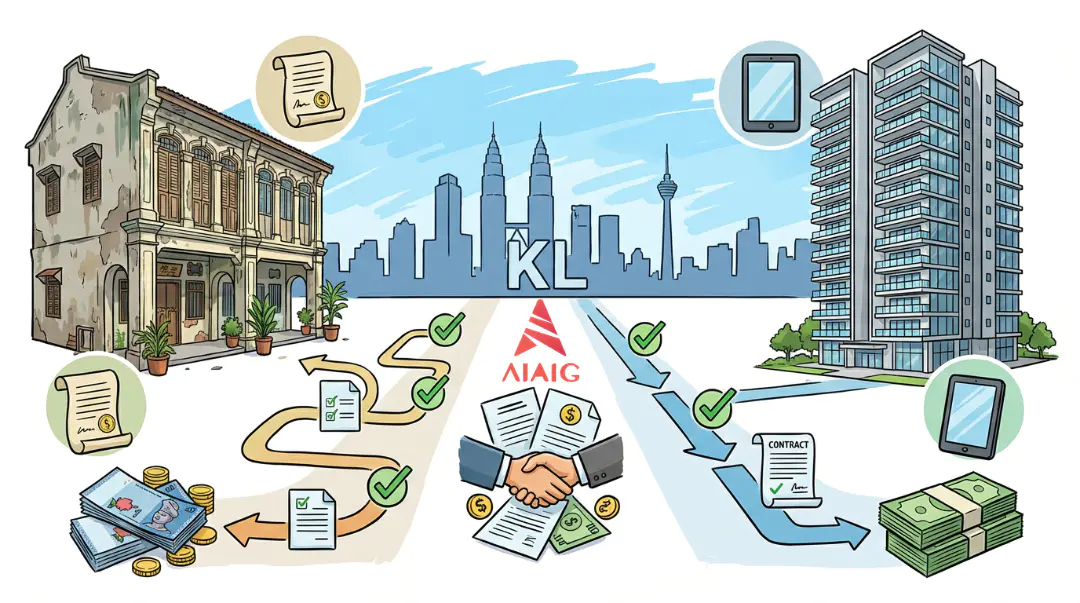
1. First, the conclusion: The difference between new and second-hand houses is essentially a difference in the "delivery chain"
For foreign buyers, the difference between buying a new home and a second-hand home in Kuala Lumpur can be summarized in one sentence:
- New Home (Developer Sale): You sign a contract with the developer, with the core process being "construction progress → installment payments → handover (VP) → completion of property rights/transfer perfection (Perfection)".
- Second-hand Home (Subsale/Resale): You transact with the current owner, with the core process being "due diligence → state government foreigner consent (Foreigner Consent) → completion of settlement → transfer (MOT/DOA) → handover".
Therefore: new homes are more like "project management + milestone payments", while second-hand homes are more like "document/approval-driven transaction settlement".
II. Common Preconditions: Foreign Investment Thresholds, State Government Approval, and Which Properties Cannot Be Purchased
Whether it's a new or second-hand property, foreign buyers typically need to clear three 'common hurdles' first:
1) Minimum Transaction Price Threshold (Commonly starting from RM1,000,000 in Kuala Lumpur)
The threshold is set and may be adjusted at the state/federal territory level. Practical advice for foreign families is: treat the 'threshold price' as a hard condition to avoid spending time viewing properties only to be unable to get approval due to insufficient price.
2) State Government/Land Office Approval (Foreigner Consent)
Foreign purchases usually require approval from the relevant state government/land authority (requirements may vary by project/location/property type). This step can affect the transaction timeline.
3) Prohibited/Restricted Types (Common pitfalls)
- Low-cost / medium-low-cost housing categories
- Malay Reserved Land
- Bumiputera quota units in development projects
In practice: Before placing a deposit, you should have a lawyer or agent use 'project/deed information' to verify these three items clearly, otherwise it can easily get stuck later on.
Three, New Home Purchase Process (Developer): Node Payment + Handover (VP) + Property Perfection (Perfection)
Break down the new home process into 6 key nodes (foreign buyers should focus on "payment schedule" and "post-delivery document chain"):
- Property Selection and Deposit/Booking
- Check: whether foreign purchase is allowed, whether the minimum price threshold is met, and whether the unit involves Bumiputera quotas.
- Signing SPA (Sale & Purchase Agreement)
- New homes are typically subject to standard contracts and regulatory frameworks (with clear constraints on payment and delivery nodes).
- Loan (if applicable) and Payment Method Confirmation
- Common for new homes: pay an initial down payment (e.g., 10%), followed by progressive payments based on construction milestones.
- Construction Progress → Progressive Payments (the most common "cash flow pitfall")
- Progressive payments are not "pay upon completion," but rather made as construction nodes progress, such as structure/wall/electromechanical/finishing stages.
- Foreign families should pay special attention: exchange rate timing and fund transfer speed to avoid missing nodes and incurring default risks.
- Delivery (Vacant Possession, VP) and Defect Liability Period (DLP)
- VP is a key node for "receiving keys/moving in," but it does not mean all property documents are completed.
- Delivery inspection is recommended to be "checklist-based": record items such as leaks, hollow spots, doors/windows, drainage slope, air conditioning provisions, electrical panels, and network wiring one by one.
- Property Document Chain: From DOA to Perfection of Transfer/Charge
- Common in new home scenarios: initial use of "deed of assignment/assignment of rights" documents (especially during incomplete property title processing), followed by formal transfer and mortgage registration after documents like land titles/strata titles are perfected.
One-sentence advice for new homes: You should buy with a "project management perspective"—monitor nodes, monitor cash flow, monitor delivery quality, and monitor whether subsequent transfer documents can be smoothly completed.
Four, Subsale Property Purchase Process: Driven by Approval and Transfer, Timeline Depends on "Consent + Document Completeness"
The process for second-hand properties is also broken down into 6 key nodes (foreign buyers should focus on "due diligence quality" and "transfer document pathways"):
- Offer/Letter of Intent (Offer/LO) + Deposit
- Before depositing, confirm: whether it meets the foreigner minimum price threshold, property type, and any restrictions (lease, mortgage, seizure risks).
- Due Diligence is the decisive factor for second-hand properties
- Check: owner identity and title chain, whether there are loan mortgages (charges), arrears (property/land tax/utilities), lease and delivery conditions, renovation and maintenance history, leakage/structure/pipeline issues.
- Apply for Foreigner Consent
- Second-hand properties often rely more on the timing of this step; the approval period will significantly affect the transaction cycle.
- Sign Sub-sale SPA and arrange "Completion"
- Second-hand properties are more like "completion payment": common practice is funds entering the lawyer's client account, released to the seller only after conditions are met.
- Transfer pathway: MOT vs DOA (depending on whether the title/strata title is already available)
- If the title/strata title is complete: more likely to proceed with MOT (Form 14A) for formal transfer.
- If property documents are not yet perfected: may still involve DOA and subsequent "transfer perfection."
- Handover and risk settlement
- Second-hand property handover is closer to "immediate living": you need to include the "handover timing" in the completion conditions (keys, access cards, parking spaces, furniture and appliance list, repair commitments, etc.).
One-sentence advice for second-hand properties: You should buy from a "legal and due diligence perspective"—the more thorough the due diligence, the more stable the transaction; the clearer the approvals and transfer documents, the more controllable the cycle.
- For foreign families, which is more 'hassle-free': new homes or second-hand homes?
- If you care more about 'new decoration, less maintenance, and newer community facilities,' new homes are more hassle-free, but you have to bear the burden of installment payments and delivery uncertainties; if you care more about 'immediate move-in, what you see is what you get, and negotiable transaction prices,' second-hand homes are more suitable, but you must conduct thorough due diligence, otherwise repair and dispute costs can backfire.
- What are the most common pitfalls foreign buyers encounter with second-hand homes?
- Three most common types: 1) Not checking property restrictions before deposit (low-cost housing/indigenous quotas/reserved land); 2) Insufficient due diligence (mortgages, arrears, leases, hidden leaks); 3) Misunderstanding the transfer process (thinking it can always be immediately transferred via MOT, but ending up going through DOA and extending the cycle due to incomplete title documents).
- Why do many new homes have been delivered, but the 'title transfer' is not fully completed?
- VP addresses 'habitability/useability,' while the title document chain may need to wait for the completion of strata title/related registrations before entering the final transfer and mortgage registration. Foreign buyers should treat this step as a crucial compliance milestone in the project's final phase, not something to ignore after delivery.
- How to make the transaction cycle more controllable?
- First, do three things: 1) Confirm foreign investment thresholds and prohibited/restricted categories before deposit; 2) Have a lawyer assess the transfer document path in advance (MOT or DOA/Perfection); 3) Include 'approval and document readiness' as key conditions, and allocate time for currency exchange and fund arrival.
Last updated Feb 4, 2026