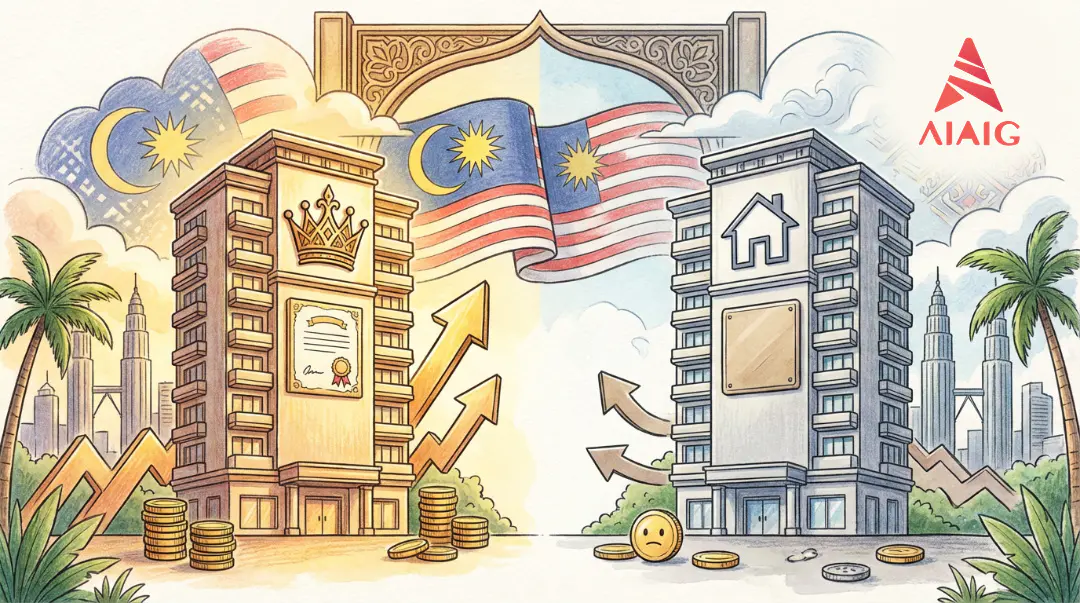
Kuala Lumpur High-End Apartments: Long-Term Value Retention Differences Between Branded and Non-Branded Developments (2026 Update)
Conclusion First: Value retention is not about "brands always win," but about "verifiable delivery + controllable costs + strong liquidity"
In the prime/luxury segment of Kuala Lumpur's high-end apartments, so-called "branded residences" typically refer to residential products that are tied to well-known brands (often hotel groups, but may also be fashion/automotive/lifestyle brands) in design, service, and operations, usually accompanied by certain service systems and brand standards. Their "value retention advantage" comes from trust and standardization: buyers can more easily understand the product, reduce information asymmetry, and have more stable expectations for operational management.
However, branded residences inherently have two mechanisms that can "drag down value retention in the long term":
- Heavier cost structure: Higher management/service fees related to the brand, with risks such as contract periods, brand changes, and service level gaps.
- More fragmented buyer pool: Buyers in the secondary market for branded residences are often more selective (requiring "brand + service fulfillment"), and once service/maintenance/reputation weakens, price pressure can come faster.
Therefore, this article does not make predictions or recommendations, but only does one thing: provides you with a practical "comparison table + due diligence checklist" to help you judge whether a specific project (whether branded or non-branded) is more likely to have stronger or weaker value retention over the next 5–10 years.
Definition reference: Savills' definition of Branded Residences emphasizes "ties to well-known brands in design and service," and typically offers services and rental solutions through brand/operational systems; this is also one of the core sources of brand premium.
I. Concept and Boundaries: What Exactly Does 'Brand Plate' Refer to in the Kuala Lumpur Context?
1) Three Common Forms of Branded Residences (Varying in Strength)
In the actual market, "brands" vary in strength, and differences in value retention often stem from this:
Type A: Co-located with hotel (Co-located with hotel)
Typically has stronger brand standards and more sustainable services (concierge/cleaning/maintenance/security/facilities, etc.), but also higher costs.Type B: Brand licensing + third-party operation (Stand-alone / licensing + operator)
May involve brand participation in design standards, but long-term service fulfillment heavily depends on the operator, falling into the "look at contracts and execution" category.Type C: Marketing-oriented "light brand" (limited brand involvement)
Often only includes naming/design elements, with service and management not part of the brand system; this type is prone to facing issues of "difficulty proving brand premium" in the secondary market.
2) Non-branded Prime Condos Do Not Equal "Weak"
Many truly strong non-branded condos in Kuala Lumpur have even "harder" sources of value retention:
- Scarce location (core commuting areas, mature commercial districts, density of international schools/medical facilities/offices)
- Strong property management (transparent MC/JMB governance, healthy maintenance funds, continuous public area upkeep)
- Product suitability for stable demand (family self-occupancy/international tenants/high-end long-term rentals)
When creating your page, it is recommended to clearly state the "brand strength": co-located with a hotel? What services does the brand provide? Who actually delivers the services? Otherwise, users may lump all "branded names" together, leading to increased bounce rates.
II. Comparison Table: Branded vs. Non-Branded Drives—Which Dimensions Truly Determine Long-Term Value Retention?
Comparison Table (Bias Towards "Verifiable/Quantifiable" Dimensions)
How to use: Don't just look at the "branded/non-branded" labels; fill in each item you're concerned about. The more specific you can answer, the less uncertainty there is in long-term value retention.
| Dimension (Value Retention Drivers) | Common Performance of Branded Developments (Branded) | Common Performance of Non-branded Developments (Non-branded) | What You Should Verify (Tool-based Questions) |
|---|---|---|---|
| Brand Binding Strength | Brand standards and service systems can create premiums and trust (especially when co-located/integrated with hotels) | Mainly relies on location/product/management reputation | Is it co-located with a hotel? Does the brand handle operations? Brand contract duration/renewal mechanism? Terms for brand exit/replacement? |
| Sustainability of Service Delivery | If service delivery is stable, secondary buyers are more willing to pay for "certainty"; otherwise, reputation backlash is faster | More reliant on MC/JMB and property management governance capabilities | Is the service list and SLA clear? Who is responsible for complaint response, maintenance, cleaning, security? Can historical operation records be viewed? |
| Fee Structure (Long-term Holding Costs) | Typically higher service/management fees; if rent doesn't cover costs, it may reduce holding willingness | Costs are relatively controllable, but may lead to depreciation due to insufficient maintenance | History of management fees/maintenance fund/special levy? Fee increase mechanism? Parking/facility fee structure? |
| Common Area and Equipment Depreciation (CapEx Pressure) | High amenities mean higher depreciation and renewal costs; insufficient funds can drag down value | Amenities are more "essential," maintenance pressure may be lower | Renewal plans and fund coverage for major items like elevators, air conditioning, pools, clubhouses? Have there been large levies? |
| Secondary Buyer Pool and Liquidity | Buyers are more concentrated (seeking brand/service), may be pickier in a cold market | Buyers are broader (location/school district/commute/value for money), may be more cycle-resistant | Secondary transaction cycle (DOM), negotiation space, density of similar competing products? |
| Rental Demand Stability | If stable service and "managed hosting" are provided, it's more friendly to expatriate/business long-term rentals | Relies on location and unit suitability; stable management can also form an advantage | Tenant structure: expatriates/white-collar/families? Rent fluctuations and vacancy rates? Are there rental rule restrictions? |
| Compliance and Short-term Rental Risks | Branded developments are often mistakenly thought "more suitable for short-term rentals," but it actually depends on building rules and management policies | Similarly depends on management regulations and local enforcement | Does the building allow short-term rentals? Are there clear minimum rental period rules? Management's attitude towards Airbnb? |
| "Supply Scarcity" vs. "Homogeneous Competition" | Top brands are scarce, but "light brands" are highly homogeneous | Non-branded developments may have lower competition if location/product is scarce | Future supply in the surrounding area (similar-grade apartments/serviced apartments)? Does the project itself have irreplicable selling points? |
Key Understandings (Avoid Misconceptions)
- The value retention advantage of branded developments comes from "reducing information asymmetry," but the premise is: ==brand and service delivery are consistent long-term==.
- The value retention advantage of non-branded developments comes from "hard location + strong governance," but the premise is: ==MC/JMB governance and maintenance fund are healthy==.
Market report level: JLL continuously updates cycle and supply-demand changes in Kuala Lumpur's residential market, suitable for providing users with an "entry point to view macro and supply" at the end of the text; for the expansion and premium logic of branded residences in Asia-Pacific, refer to Savills/Knight Frank's global research as a "conceptual baseline."
Three, Directly Actionable "Value Preservation Due Diligence Checklist": 5-Minute Screening + 30-Minute Deep Dive
A. 5-Minute Screening (Quickly eliminate projects not worth in-depth exploration)
- For brand projects, ask 3 questions first:
- What type of brand form is this? (A/B/C: same-site hotel/authorization + operation/light brand)
- Who actually delivers the operational services? Does the brand take responsibility for service quality?
- Could the fee structure potentially keep the "net rental return" low in the long term?
- For non-brand projects, ask 3 questions first:
- Does the location have "irreplaceability"? (Mature amenities/commuting/office/schools/medical facilities)
- How is the reputation of property management and governance transparency?
- Is the supply of comparable competing products dense? (Especially with new projects continuously entering the market nearby)
B. 30-Minute Deep Dive (Turn value preservation from a "feeling" into "evidence")
1) Contracts and Governance (Determining long-term certainty)
- Brand projects: Brand contract duration, renewal and exit clauses, service standards (SLA), brand replacement mechanisms.
- Non-brand projects: Availability of MC/JMB meeting minutes, transparency of budgets and expenditures, fund balance and usage records.
2) Fees and Maintenance (Determining long-term discount/premium)
- Have management fees increased significantly in the past few years? Have there been any special levies?
- Are there planned updates for major common area items (elevators/pools/air conditioning/security)? Is there a tendency to "delay repairs"?
3) Secondary Market and Leasing (Determining liquidity and buyer pool)
- Transaction cycles and negotiation margins for secondary listings in the same community/building over the past year.
- Is rental demand more inclined towards "short stays/business/family"? Different structures correspond to varying rent stability.
4) Rules and Compliance (Determining "operational boundaries")
- Does building management allow short-term rentals? Minimum lease term? Registration/visitor management rules?
- Is it friendly to foreign tenants/corporate leases? (Procedures, deposits, repair reporting mechanisms)
- Are branded properties always more value-retaining?
- Not necessarily. Branded properties are more likely to gain 'brand premiums,' but value retention depends on: strong brand binding, stable service delivery, and controlled fee structures. If it's a 'light brand' or has poor service delivery, the secondary market may discount it more quickly.
- How to judge if a non-branded property is 'strong in the long term'?
- Look at three points: location scarcity (mature commuting and amenities), governance and maintenance (transparent MC/JMB, healthy funds, timely repairs), and breadth of buyer pool (covering both owner-occupier and long-term rental demand). The strength of non-branded properties comes from 'hard conditions,' not marketing narratives.
- What is the biggest long-term risk for branded properties?
- Commonly, there are three types: 1) long-term increase in service/management fees leading to compressed holding costs; 2) changes in brand contracts (exit/replacement/downgrade) causing 'premiums to be hard to justify'; 3) high amenities bringing greater depreciation and CapEx pressure, which can trigger special levies if funds are insufficient.
- How does the 'supply homogenization' of high-end properties in Kuala Lumpur affect value retention?
- When new properties of similar standards continuously enter the surrounding market, second-hand properties need to offset competition through 'stronger living experiences/better maintenance/more stable rental demand,' otherwise, longer transaction cycles and larger negotiation margins may occur. This is especially evident for 'light-brand homogeneous products.'
- I only want to write tool-type content; how to make it a 'reusable module for project pages'?
- Break this article into fixed modules embedded in each project center page: brand strength assessment (A/B/C) → fee structure verification → maintenance funds and CapEx → secondary market liquidity → rental demand profile → compliance boundaries. Each module provides 'questions to ask,' making users feel it's 'actionable and verifiable.'
Last updated Feb 14, 2026