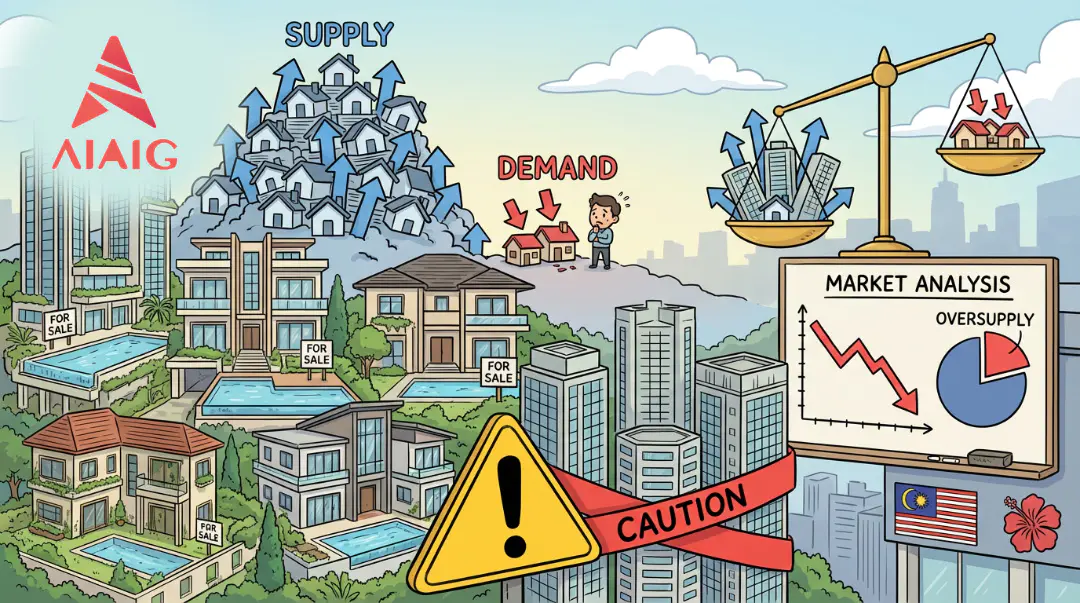
Is There a Risk of "Over-Supply" in the Malaysian Luxury Property Market? (2026 Update)
Conclusion First: There is a 'structural oversupply risk,' but not a one-size-fits-all situation for the entire luxury property market
If you're asking, 'Is there definitely an oversupply of luxury properties in Malaysia?'—a more accurate answer is:
- National Dimension: High-rise residential/service apartments (including some high-price segments) still show signs of inventory pressure: NAPIC (JPPH) disclosed a rebound in 'completed unsold residential units (overhang)' in Q3 2025, with media and institutional interpretations generally pointing to high-rise (condos/service apartments) as the main source of pressure.
- Kuala Lumpur Prime Dimension: Institutional reports emphasize 'controlled supply + demand favoring quality/location': Even if there is overall market inventory pressure, the Prime (high-end core locations) may exhibit a 'more stable' sub-market performance.
Therefore, this article does not make predictions or call for price movements; it only does two things:
- Provide a data framework for judging 'oversupply' (which you can update quarterly).
- Break down 'luxury properties' into verifiable segments: which are more prone to oversupply, and which are more like controlled supply.
1. First, clarify "luxury/high-end": Why does the same market see "some lacking supply, while others can't sell"?
In the Malaysian context, 'luxury/prime' properties are often used interchangeably, but they correspond to different supply-demand logics:
- High price segment ≠ necessarily Prime: Even among high-priced condos, there are significant differences in buyer pools, rental demand, and resale liquidity between core locations (e.g., KLCC, TRX, Bangsar, parts of Mont Kiara) and non-core locations with 'high-priced new developments.'
- Product type is crucial: High-end high-rise (condos), service apartments, and branded residences often target different buyer/tenant profiles; they also frequently diverge in inventory pressure.
- The luxury market is more prone to 'structural mismatches': When development pace outpaces real occupancy/rental absorption rates, or supply concentrates on homogeneous products, a situation arises where 'total volume may not explode, but a certain type of product clearly doesn't sell.'
When creating content, it's recommended to use a fixed definition: The 'oversupply risk' discussed in this article mainly refers to a state where completed unsold inventory (overhang) + new market entry pace > absorption rate, not simply 'many new developments.'
II. Data Foundation: Is "Inventory Pressure" Rising from NAPIC/JPPH?
1) National Inventory Signal: Overhang rebounds, with high-rise/service apartments often highlighted
Based on NAPIC (JPPH) public market materials and media-cited data:
- In Q3 2025, the national 'completed unsold residential units (overhang)' was widely cited as 28,672 units, with a total value of approximately RM17.25 billion (this is one of the core indicators for measuring supply-demand mismatches).
- Multiple media/research interpretations mention that inventory pressure is mainly concentrated in high-rise residential (condos/service apartments).
This information does not directly equate to 'luxury property oversupply,' but it provides an important context:
- If inventory pressure primarily comes from high-rise units, then high-end high-rise properties (especially those in non-core areas, with strong homogeneity, and reliant on investor absorption) are typically more susceptible.
2) Kuala Lumpur Perspective: 'Condo inventory' and 'Prime stability' can coexist
In practical judgment, you should allow for two facts to coexist:
- Macro/total level: The rebound in inventory (overhang) indicates insufficient absorption rates in certain segments.
- Prime sub-market level: Institutions may judge Prime supply as 'more controlled, emphasizing product quality,' leading to more stable prices and transactions.
This is why you need to write the article as an 'updatable framework page': Update NAPIC overhang quarterly, update supply-demand descriptions for Kuala Lumpur Prime, and then conclude by identifying 'which segments have higher risks.'
III. Instrumentalizing "Over-Supply Risk": 6 Indicators + 1 Decision Table
You can use the following set of indicators to turn 'risk assessment' from a feeling into verifiable evidence.
6 Core Indicators (Can Be Updated Quarterly)
| Indicator | What You're Looking At | Typical Signs of Oversupply | Where You Can Get Information |
|---|---|---|---|
| 1. Overhang (Completed but Unsold) | Whether inventory is accumulating | Continuous rise, with value/quantity increasing | NAPIC/JPPH market reports, media references |
| 2. High-rise/Serviced Apartment Proportion | Whether pressure is concentrated in high-rises | High proportion of high-rise inventory, slow absorption | NAPIC/JPPH breakdown tables, industry analysis |
| 3. New Project Launch Pace (Launch) | Whether supply continues to accelerate | Continuous dense launches, promotions becoming normalized | Market dynamics reports, developer announcements |
| 4. Absorption Speed (Absorption) | How fast it's selling | Lengthening transaction cycles, increased bargaining in secondary market | Agent data/listings, market reports |
| 5. Rental Absorption and Vacancy Perception | Whether it can be absorbed by tenants | Weak rental growth, longer vacancy periods | Rental platforms/agents, institutional rental research |
| 6. Degree of Supply Homogeneity | Whether products are too similar | High repetition of same location, positioning, and unit types in the same area | Project comparisons, planning/construction lists |
1 Judgment Table: What Do Segments Where Luxury/High-end Properties Are 'More Likely to Be Oversupplied' Look Like?
| Segment | Conditions More Likely to Have Structural Oversupply | Conditions More Tending Toward 'Controlled Supply/Relative Resilience' |
|---|---|---|
| High-priced High-rises in Non-core Areas | Reliant on investors, high homogeneity, dependent on promotions for volume | Strong surrounding demand (office/schools/medical), stable pool of owner-occupier buyers |
| Serviced Apartments (Some) | High supply, ambiguous positioning, intense competition with hotels/long-term rentals | Clear support from business/expatriate demand, strong property management, unit types suitable for long-term rentals |
| Light-brand/'Concept Luxury' Properties | Brand premium difficult to verify, heavy fee structure, secondary buyers more selective | Strong brand binding (service delivery verifiable), mature on-site amenities, stable reputation |
| Core Prime Residential | May still face cycles, but supply is usually more restrained | Scarce location + strong product quality + broad buyer pool (owner-occupiers + long-term rentals) |
You'll notice: There's not a single statement like 'a certain location will definitely rise/fall.' It's a 'conditional judgment' tool, particularly suited to your preferred 'popular science + instrumental' content style.
4. Where Do the 'Excess Risks' of Kuala Lumpur Luxury/High-End Properties Typically Emerge? (Not Making Predictions, Only Providing Verifiable Signals)
You can treat the following 'signals' as a fixed checklist in your pages (applicable to any specific project):
Promotions Shift from 'Periodic' to 'Normalized': Long-term reliance on high discounts, zero down payment, rental guarantees, etc., to move volume usually indicates insufficient real purchasing power or severe product homogeneity.
Secondary Listings Significantly Outnumber Transactions: Long-term accumulation of listings in the same building/area, with Days on Market (DOM) noticeably lengthening.
Rental End Cannot Cover Holding Costs (Especially High Service Fee Structures): When tenant willingness to pay is insufficient, but management/service fees keep rising, holders are more likely to sell, further amplifying secondary market pressure.
Same-tier Supply Continuously Enters the Market in the Same Circle: For example, new projects with similar positioning keep emerging nearby, diverting buyers and tenants, making older projects more prone to price cuts.
Unclear Product Positioning and Target Audience: Neither suitable for owner-occupation (unfriendly unit layout/living flow) nor for long-term rentals (insufficient amenities/management), ultimately relying only on price competition.
Applying this to content production, you can create three types of 'tool subpages' to capture long-tail traffic:
- 《Kuala Lumpur High-end Condo Promotions and Absorption Signals Explained: Which Promotions Indicate Structural Pressure?》
- 《Serviced Apartments vs. High-end Residential: Differences in Rental Absorption and Holding Costs (Tool Comparison Table)》
- 《How to Use NAPIC Overhang + Project Surrounding Supply Lists to Determine If an Area Is Heading Toward Homogeneous Oversupply?》
- Are oversupply and overhang the same thing?
- They are not the same thing, but are highly related. Overhang (completed but unsold inventory) is a quantifiable metric; oversupply is more of a judgment on outcomes: it occurs when new supply consistently exceeds absorption rates over the long term. For content recommendations, use overhang + absorption rate to describe risks, rather than relying solely on emotional terms.
- Does an increase in overhang from NAPIC/JPPH necessarily mean that luxury properties are oversupplied?
- Not necessarily. It signals a mismatch between supply and demand and inventory accumulation in the market, but within the 'luxury/high-end' segment, there will be differentiation. Core prime areas may be more stable, while non-core homogeneous high-rises may face more pressure. The correct approach is to use overhang as a macro background and then make segmented judgments based on regional and product dimensions.
- Why are serviced apartments often considered more prone to inventory pressure?
- Serviced apartments often fall between 'residential and hotel/short-stay': if there is insufficient business demand in the area, unstable short-stay compliance/management, or high product homogeneity, it can easily lead to insufficient rental absorption and compounded secondary market pressure. Judgment should return to: whether demand sources are stable + whether the management fee structure is sustainable.
- What data should I track to turn this article into a 'continuously updated page'?
- It is recommended to consistently track: 1) NAPIC/JPPH overhang (quantity/value/type); 2) property price indices and transactions (volume/value); 3) institutional commentary on the Kuala Lumpur prime market (supply and demand); 4) new project launch lists and absorption rates in your areas of interest. Update with a 'page update summary + update log' each quarter.
- Is there a simplest way to judge whether a project is at risk of oversupply?
- You can use the 'dual verification of secondary and rental markets': lengthening secondary market transaction cycles + increasing rental vacancy periods, combined with ongoing new supply of similar positioning in the surrounding area. Such combined signals are usually more reliable than single indicators.
Last updated Feb 14, 2026