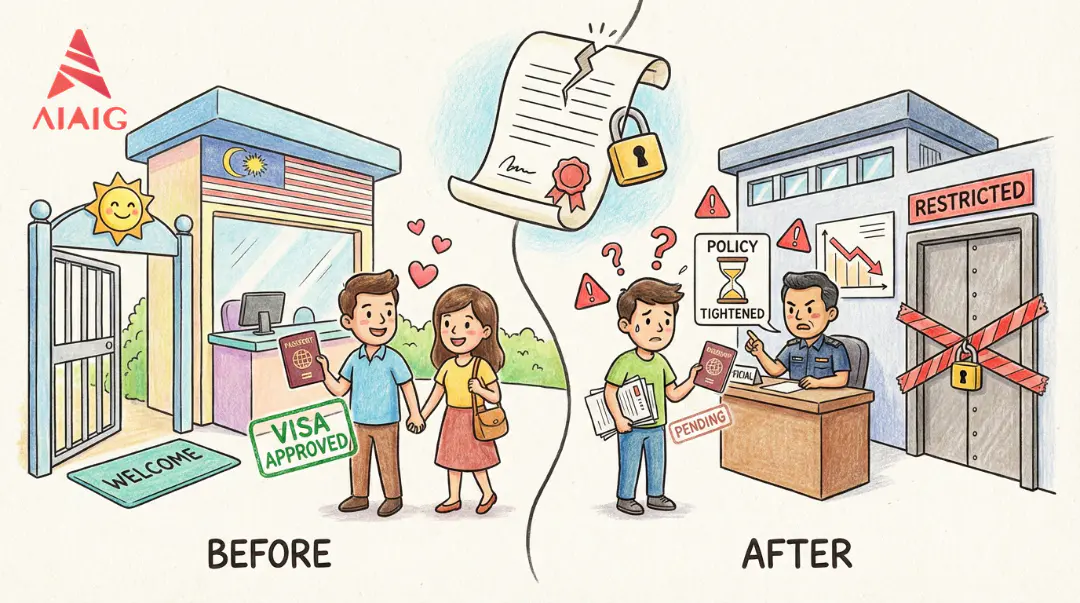
Is the Malaysia Spouse Visa Being Tightened? (2026 Update)
Conclusion First: More Like "More Detailed Scrutiny + More Standardized Process," Not a Uniform Public Increase in Thresholds
So far, based on the publicly available Long Term Social Visit Pass (LTSVP) page and document checklist from the immigration department, there hasn't been a simple, single-point change like an "official announcement: spouse visa thresholds comprehensively raised/tightened." What's closer to the real experience is:
- More Detailed Scrutiny of Documents and Authenticity: The immigration department's public checklist clearly requires ==Statutory Declaration (marriage still valid)==, income proof, address proof, wedding photos, etc., and retains the space to "request additional documents."
- More Systematic Renewal Process: Renewals can be processed through online systems like ePLSI (but often still require subsequent submission of physical documents/offline steps), and applicants will feel that "formats are stricter, and incomplete documents are more easily rejected."
- Background of Overall Stricter Compliance Enforcement: Even if not specifically targeting spouse visas, the immigration system's strengthened enforcement against overstays, false information, and illegal stays makes actual reviews emphasize verifiability and accountability.
So, this article avoids emotional judgments and directly answers the three questions you truly care about:
- What changes count as "tightening"?
- What are the most common "signals of tightening" for spouse visas?
- How should you prepare to reduce the probability of rejection/requests for additional documents?
1. What Exactly Is the Spouse Visa (LTSVP)? What "Scope" Are You Applying For/Renewing?
In practice, the Malaysia spouse visa typically refers to: Long Term Social Visit Pass (LTSVP), applied for by a Malaysian citizen spouse as the sponsor/spousal relationship.
You'll encounter two types of actions:
- First-time Application (New application): Usually requires an appointment and submission at the immigration counter; review focuses more on "relationship authenticity + document completeness."
- Renewal (Extension / Renewal): Can be submitted through online systems (e.g., ePLSI), but common practices still include subsequent verification/physical document submission steps.
The immigration department also clearly states on the LTSVP introduction page: Spouses meeting requirements can obtain a social visit pass for up to 5 years (subject to eligibility and review), and renewal depends on whether qualifications and conditions are met.
2. What Counts as "Tightening"? Breaking Down the Feelings into 5 Verifiable Types of Changes
Many people say "it's stricter," but it could actually be any of the following:
- More Detailed Document Requirements: New or more emphasis on certain proofs (e.g., income, address, statutory declaration, photos, full-page passport copies, etc.).
- Stronger Authenticity Scrutiny: More frequent requests for interviews, additional evidence of cohabitation, or stricter checks for document consistency.
- More Standardized Process: Online system upload fields are more fixed, and format mismatches are more easily rejected by the system/counter.
- More Conservative Issuance: Shorter validity periods, requiring more frequent renewals (not equivalent to rejection, but increases friction).
- More "Zero Tolerance" for Non-compliance: Overstays, false information, or visa status gaps more easily trigger negative outcomes.
When creating content pages, it's recommended to use this section as an "interpreter" to significantly reduce user misunderstandings: they might think the policy changed, but it could actually be stricter material/process and enforcement standards.
3. Spouse Visa "Tightening Signals" Comparison Table: Which Ones You Encounter Indicate More Conservative Review
| Change You Feel | What It Might Mean | How You Should Respond (Actionable Steps) |
|---|---|---|
| Required to provide ==Statutory Declaration: marriage still valid== | Strengthening marriage authenticity and legal responsibility | Prepare notarized/declaration documents in advance; ensure consistency in names, ID numbers, marriage registration info |
| Income proof requirements more explicit (payslips/bank statements/Form J, etc.) | Strengthening sponsor capability and life stability | Use "last 3 months" as a unified standard; self-employed prepare company registration/tax/business documents |
| Address proof repeatedly checked (utility bill, etc.) | Strengthening cohabitation/groundedness | Standardize address writing; prepare recent bills/lease/property documents (add explanation letter if necessary) |
| Passport "all printed pages" copy/scan requirement | Strengthening entry-exit record verification | Copy/scan all pages and number them in order; avoid missing pages causing rejection |
| Request for more wedding/marriage photos, family photos | Strengthening relationship authenticity and cohabitation evidence | Prepare a "timeline photo package": wedding, family photos, key life milestones together |
| Online renewal (ePLSI) fields stricter, prone to format errors | Process standardization, lower tolerance for errors | Standardize English name writing per passport MRZ; unify date formats; ensure uploaded file names and sizes meet requirements |
| Shorter validity periods issued/more frequent renewals | More conservative review, or documents not "stable" enough | Strengthen stability evidence (income, address, child birth certificate, etc.); ensure submission within renewal window |
The "material items" in the table above are not rumors, but key items that have long existed on the immigration department's public pages and most commonly trigger rejection/additional document requests in practice (especially statutory declaration, income, and address proof).
IV. Material Preparation Checklist (Can be directly copied into your AIAIG tool page module)
Organized according to "Common Immigration Bureau Checklist Requirements + Points Most Easily Missed by Applicants":
A. Relationship and Identity (Determines if you are a spouse category)
- Marriage certificate/marriage registration proof (for overseas marriages, provide relevant proof as required by the immigration bureau)
- Both parties' identification documents: Malaysian spouse IC, both passports (recommended to prepare copies/scans of ==all printed pages== of the passport)
- Marriage/life photos (recommended to create a "timeline package")
- ==Sworn declaration: marriage is still valid== (used as key material by many states/counters)
B. Sponsorship and Landing (Determines the verifiability of "whether you can reside long-term")
- Sponsor/spouse income proof (payslips/bank/tax forms/self-employed company materials, etc.)
- Address proof (utility bill, lease, property documents, etc., key is consistency in writing)
C. Family Structure (when there are children/stepchildren)
- Child's birth certificate (if applicable)
- Stepchild/guardianship-related documents (if applicable)
D. Renewal Path Tips (to reduce unnecessary trips)
- Renewal can be submitted through online systems like ePLSI (different states/cases may still require offline verification/submission of paper materials)
- Before online submission, scan materials into standard formats (PDF/JPG), name them by categories like "identity/marriage/income/address/children", significantly reducing rejection probability
When creating your page, you can add a fixed reminder: 'Different states/different counters may have additional requirements, it is recommended to confirm the latest checklist with the local immigration bureau before applying'—this sentence is important to avoid being "called out" by users with specific cases.
- So, has the Malaysian spouse visa policy really 'tightened'?
- From publicly available information, it's more common to see more detailed reviews and standardized processes rather than a single announcement of 'across-the-board higher thresholds.' The 'tightening' felt by applicants often stems from material verification (income/address/validity of marriage declaration) and the low tolerance for errors due to standardized online procedures.
- Why is the declaration statement (that the marriage is still valid) so crucial?
- It turns 'the marital relationship still exists' into a legally accountable statement, while also helping to reduce the risk of sham or formal marriages. Many rejections come from: not providing it, incorrect format, or information that doesn't match the marriage certificate/identification documents.
- Does ePLSI online renewal mean you don't need to go to the immigration office at all?
- Not necessarily. The online system is used for submission and pre-screening to reduce queuing at counters, but in practice, it's common to still require subsequent verification or submission of paper documents (depending on the state/case). Therefore, a safer strategy is: treat online submission as 'reducing friction,' but don't assume '100% zero offline steps.'
- Which situations are most likely to lead to requests for additional documents or cause delays in processing time?
- Common ones include: inconsistent address formatting, unclear income proof standards (especially common for self-employed individuals), missing passport pages, inconsistent marriage registration information, insufficient photo materials, or inability to establish a timeline of cohabitation.
- Can a spouse visa holder work?
- A spouse holding an LTSVP can apply for a 'work permit/endorsement for the spouse of a Malaysian citizen' under certain conditions, requiring submission according to the immigration office's specified materials and procedures (it is not automatically granted).
Last updated Feb 15, 2026