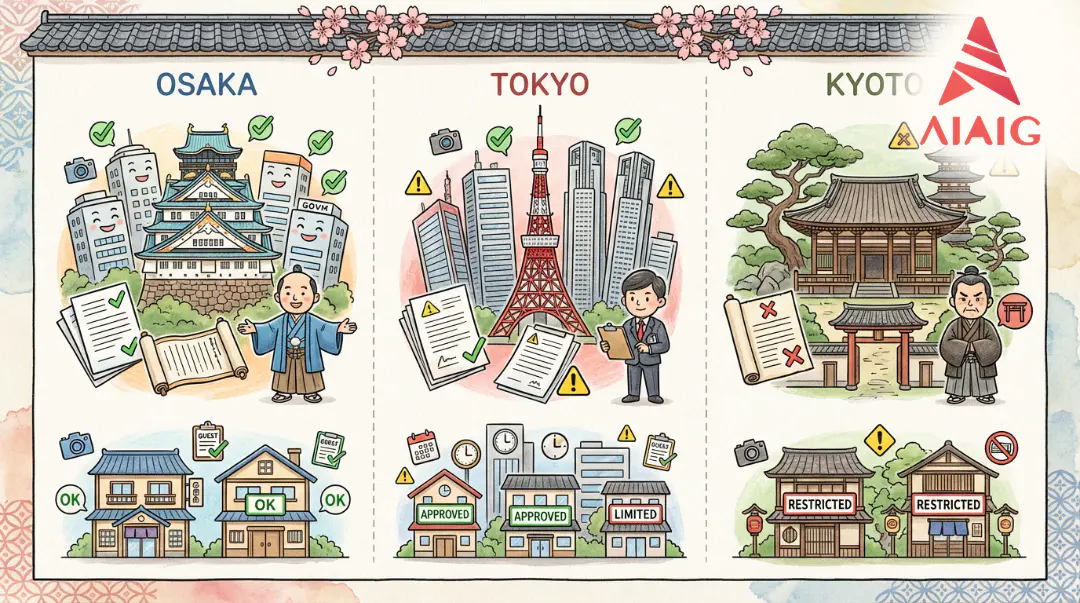
Osaka vs Tokyo vs Kyoto: Comparative Table of Minpaku Regulations (Analyzed by "Ordinance Restriction Items")
Pre-reading Note: Why Use "Ordinance Restrictions" for Comparison?
Japan's short-term rental/homestay regulation typically follows a "national law framework + local ordinance enhancements + enforcement interpretations." The same property may have completely different operational windows and compliance thresholds in different cities (or even different wards within Tokyo).
To avoid turning the discussion into "generalizations," this article adopts three principles:
First, provide the national baseline: The Residential Accommodation Business Act (New Minpaku Law) requires notification and sets an annual maximum of 180 nights, while allowing local governments to impose stricter restrictions through ordinances.
Tokyo, using "Shinjuku Ward" as an example: Tokyo operates on a "ward-level decentralization," with Shinjuku Ward serving as a representative sample—most typical, with the clearest information disclosure and explicit restrictions on "residential exclusive zones" (but not equivalent to all wards).
Osaka distinguishes two paths simultaneously: In Osaka's short-term rental practices, besides "Residential Accommodation (180 nights)," the "Special Zone Minpaku (Tokku Minpaku)" path under the National Strategic Special Zones is common, with different mechanisms and restrictions, especially regarding minimum stay requirements.
When creating content and pages, it is recommended to include the "city/path" in the title: e.g., "Kyoto City Residential Accommodation," "Osaka City Special Zone Minpaku," etc., which can significantly improve search intent matching.
1. National Common Baseline: The "Minimum Compliance Chassis" of the Residential Accommodation Business Law (Minpaku New Law)
The following are the "national law foundation" that all three regions must adhere to (establish a unified understanding before creating tables):
- Annual Maximum (180 nights): The Residential Accommodation Business Act sets an annual maximum for "days/nights of accommodation provided" and requires mechanisms that reflect regional conditions (local governments can further tighten restrictions).
- Notification/Supervision Authority: In principle, notification is made to prefectural governors, etc.; but "special wards" like Tokyo's 23 wards can handle supervision and ordinance-related tasks (resulting in significant ward-level rule variations).
- Periodic Reporting and Records: In practice, there are typically requirements for periodic operational performance reports and obligations such as guest registers/identity verification (different cities specify "how often to report, what fields to include, and how to retain records").
When creating tool pages, you can make the "national baseline" a fixed module, with each city page only detailing: what additional restrictions have been added locally beyond the baseline, to what extent, and how they are enforced.
II. Comparison Table of Ordinance Restrictions: Osaka (including Special Zone Minpaku) vs. Tokyo (Shinjuku Ward Example) vs. Kyoto City
Comparison Table (by "Regulation Restriction Items")
Notes:
- The "Tokyo" column uses the publicly available rules of Shinjuku Ward as a representative sample; other wards may be stricter or more lenient.
- "Osaka" lists both: A) Residential Lodging (180-night path) and B) Osaka City Special Zone Minpaku (Tokku) key differences.
| Dimension (Regulation Lever) | Osaka (Osaka City/Osaka Prefecture) | Tokyo (using Shinjuku Ward as an example) | Kyoto (Kyoto City) |
|---|---|---|---|
| Main Compliance Path | A) Residential Lodging (Notification) | ||
| B) Special Zone Minpaku (Tokku) (Certification) | Residential Lodging (Notification), with ward ordinance additions | Residential Lodging (Notification), with city ordinance significant additions | |
| "Operable Period/Days" Restriction (Most Critical) | A) Subject to national 180-night upper limit | ||
| B) Special Zone Minpaku itself can be closer to "year-round operation," but Osaka City clarifies: if the same residence simultaneously does Residential Lodging notification + Special Zone Minpaku certification, then both sets of constraints are combined (reverting to the 180-night upper limit) | In "Residential Exclusive Zones," there is a clear weekday operation ban window: Shinjuku Ward stipulates that operation is prohibited from Monday noon to Friday noon in Residential Exclusive Zones; non-Residential Exclusive Zones follow the national law upper limit (180 nights) | In "Residential Exclusive Zones," a "seasonal window" restriction is adopted: in principle, operation is only allowed during the period from January 15 noon to March 16 noon (while still complying with the national 180-night framework and city rules) | |
| Minimum Stay | Special Zone Minpaku: 2 nights 3 days (3 days) minimum, explicitly prohibiting 1 night 2 days; and requires setting on platforms as "2 nights 3 days or more" | The Residential Lodging path generally does not use "minimum stay" as a core regulation lever (more common are area/time restrictions and neighborhood management) | The Residential Lodging path generally does not use "minimum stay" as a core regulation lever (more common are area/time restrictions and on-site management requirements) |
| Area Restrictions (Land Use Zones/Residential Exclusive Zones) | Osaka Prefecture/Osaka City combine urban planning and land use zones to restrict or review operable areas (especially areas related to "residential environment protection") | Shinjuku Ward clearly distinguishes: Residential Exclusive Zones vs. non-Residential Exclusive Zones, and sets a weekday operation ban window for the former | Kyoto City clarifies: Residential Exclusive Zones implement seasonal window restrictions for the purpose of "good residential environment protection" |
| Neighbor Notification/Prior Explanation (Neighbor Briefing) | Both Special Zone Minpaku and Residential Lodging in practice highly value "neighborhood explanation/record retention"; Osaka City also has a document system around regular reporting and compliance guidance | Shinjuku Ward explicitly requires: written notification to neighbors before notification, and reporting to the ward (the ward will also publicly disclose notified residence information for resident identification) | Kyoto City clarifies: prior explanation to neighbors is required, and regular reporting/document submission must be done as specified |
| On-site Management/On-site Requirements (10 minutes/800m, etc.) | Special Zone Minpaku and Residential Lodging have strict requirements for "emergency contact and on-site response systems" (Osaka City has specific guidance document systems, projects must match the path) | Shinjuku Ward's system design emphasizes "prevention of deterioration of surrounding living environment," and strengthens levers such as complaint handling, record keeping, waste disposal in ordinances/implementation (on-site response systems are usually required or linked with management operator arrangements) | Kyoto City's guidelines and explanations clearly state "10-minute arrival (approximately 800m)" and other management systems (especially in owner-absent operations) |
| Regular Reporting (Operation Performance) | Under the "Residential Lodging (Notification)/Special Zone Minpaku (Certification)" system, Osaka City has clear guidance on lodging day management and regular reporting, and emphasizes legal risks of non-reporting/exceeding limits | Shinjuku Ward emphasizes identifiability and supervision: including information disclosure, neighbor notification, waste disposal, and complaint records (combined with statutory reporting obligations to form levers) | Kyoto City clarifies: periodic reporting to the mayor, etc., on lodging days, number of lodgers, etc., is required (and enforced alongside Residential Exclusive Zone seasonal window restrictions) |
| Typical "Enforcement Trigger Points" (Lever) | Violation of minimum stay (Special Zone Minpaku), violation of 180 nights (especially prone to pitfalls when combined), failure/omission of regular reporting, complaints and waste/noise issues triggering inspections | Operation during ban windows in Residential Exclusive Zones, inadequate neighbor notification/reporting, improper waste disposal, lack of complaint record and retention obligations | Operation outside restricted windows in Residential Exclusive Zones, insufficient on-site management systems in owner-absent operations, lack of regular reporting, complaints and living environment issues |
How to Use This Table (Practical Advice: Toolization)
- When creating a "city entry page": First have users select "city + path" (Residential Lodging/Hotel Business/Special Zone Minpaku), then provide the corresponding Checklist.
- When creating a "project evaluation/property purchase page": Make this table a fixed module, informing users: the operable window for the same property varies greatly across cities, avoid misjudging based on experience from other regions.
- When creating "0-click high-display news today keywords": Write updates as "This week's update: Osaka City re-emphasizes 2-night 3-day rule / Kyoto Residential Exclusive Zone seasonal window / Shinjuku Residential Exclusive Zone weekday operation ban"—such "actionable change points" are more likely to drive clicks than writing news.
III. Detailed Analysis of Three Regions: Which "Regulatory Levers" Are Most Prone to Pitfalls?
1) Osaka: Choosing the Wrong "Path" or Misunderstanding "Overlapping Restrictions"
- The Core Lever of Special Zone Minpaku (Tokku): Minimum Stay Duration. Osaka City clearly stipulates that Special Zone Minpaku must be 2 nights 3 days (3 days) or more, not 1 night 2 days; and requires intermediary platforms to set the minimum bookable duration in accordance with this rule.
- "Overlapping" is Osaka's Most Hidden and Common Pitfall: Osaka City's explanatory document explicitly states—if the same residence is used for both Residential Accommodation (notification) and obtains Special Zone Minpaku certification, then all restrictions from both sides apply, resulting in the need to simultaneously comply with:
- The 180-night annual limit for Residential Accommodation
- The 2 nights 3 days minimum for Special Zone Minpaku
- And obligations such as periodic reporting under both systems
You can phrase it as a "red text warning":
- "Tokku does not mean unlimited; overlapping restrictions can actually make it easier to fall into pitfalls."
2) Tokyo: Significant Differences Within the Same City (Taking Shinjuku Ward as an Example)
- Shinjuku Ward has made its levers highly "enforceable":
- Residential Exclusive Zones set clear prohibited operation windows (Monday noon to Friday noon).
- Requires neighborhood notification (in writing) and reporting to the ward.
- The ward will publicly disclose notified residence information, reducing the space for "anonymous operation."
- Imposes clear requirements on waste disposal and other living environment issues.
For content production, the most suitable approach for Tokyo is:
- First create "Tokyo Minpaku Regulation: Quick Check of 23 Ward Differences (2026 Update)"
- Then produce 3–5 "Ward Sample Pages" (Shinjuku, Shibuya, Setagaya...), each following the same template output:
- Area restrictions
- Period/time restrictions
- Neighborhood notification
- Public disclosure/reporting
- Penalty triggers
3) Kyoto: The "Seasonal Window" for Residential Exclusive Zones is Extremely Strong
- Kyoto City adopts a "only open during off-peak seasons" approach for Residential Exclusive Zones: in principle, restricted to January 15 noon to March 16 noon.
- Also emphasizes: annual calculation cycle, 180-night framework, and bi-monthly periodic reporting (number of accommodation days, number of guests, etc.).
- For owner-absent operations, Kyoto City documents also clarify management system points such as "10-minute arrival (approximately 800m)."
Tool-oriented writing suggestions for Kyoto content:
- Provide users with a "calendar-style" module:
- Allowed operation window (bookable)
- Prohibited operation window (only long-term/monthly rentals allowed)
- Then include a "Residential Exclusive Zone Self-Check" process:
- Confirm land use zone → Check if it falls under Residential Exclusive → Verify if exceptions apply (e.g., certified Kyoto Machiya) → Management on-site system
- Why is 'Osaka' divided into two paths: Residential Lodging and Special Zone Minpaku?
- Because the 'regulatory levers' for the two paths are completely different: the core lever for Residential Lodging is 180-night limit + notification/reporting/management obligations; while one of the core levers for Osaka City Special Zone Minpaku is minimum 2 nights 3 days stay (and if the two paths overlap on the same residence, constraint stacking occurs, requiring simultaneous compliance with both the 180-night limit and the 2-night 3-day stay requirements, among others).
- Is the entire city of Tokyo like Shinjuku Ward with 'prohibition of operation from Monday to Friday'?
- No. Tokyo has a structure with significant ward-level differences. This article uses Shinjuku Ward as a sample with clear public information and representativeness to explain how 'regulatory levers' are implemented. When selecting a property or writing a page, you should always refer to the official rules of the ward where the target property is located.
- Does Kyoto's 'January 15 to March 16' restriction apply to all properties?
- It primarily applies to Residential Exclusive Zones and Residential Lodging under general circumstances; Kyoto City also has exceptions (e.g., certified Kyoto Machiya businesses meeting certain conditions, etc.). Therefore, the first step in judgment is always: whether the property's land use zone falls within a Residential Exclusive Zone, and then check if it meets exception conditions and management system requirements.
- What are the 'common points' most likely to trigger inspections/penalties?
- Common high-risk points across cities typically include: exceeding permitted operating windows/days, missing or inaccurate periodic reports, inadequate neighborhood notification and complaint handling, accumulation of environmental issues like garbage/noise. Local ordinances often turn these points into 'verifiable' levers (public notices, record-keeping, on-site requirements, etc.).
- I just want to create a 'comparison table page' to capture search traffic, how should I design the structure?
- It is recommended to place on the first screen: comparison table + last updated time + 3 key changes this month summary. Use a fixed template for the main content: national baseline → three-area table → detailed breakdown for each area → Checklist → FAQ. Include synonyms in the title: Osaka/Tokyo/Kyoto + Minpaku/Airbnb + ordinance/regulation/restrictions + 2026 update.
Last updated Feb 14, 2026