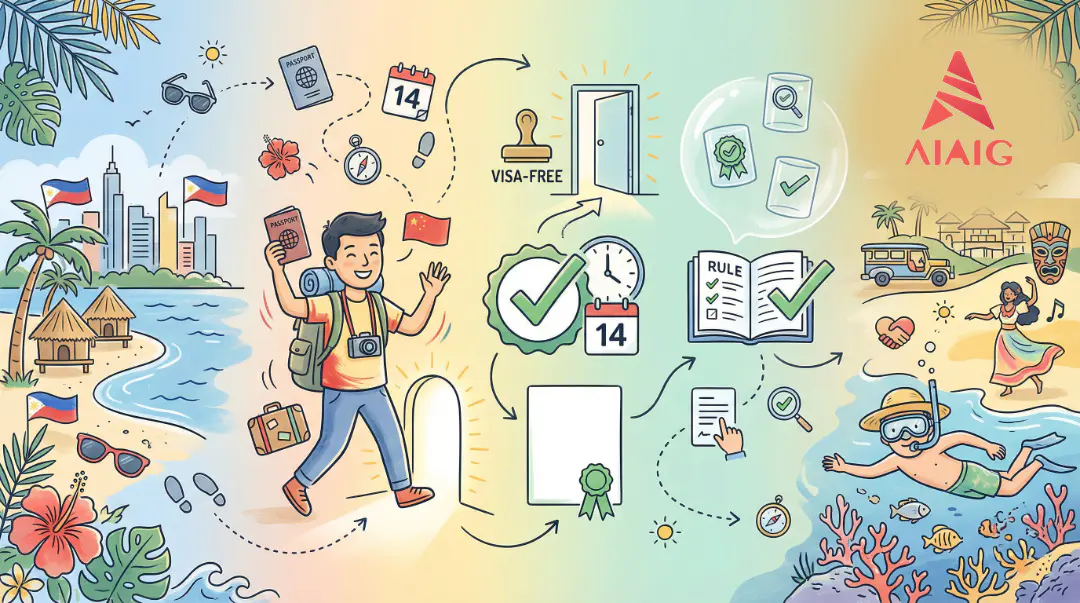
1. Latest Visa-Free Policy for China: Key Clauses (Subject to Official Announcement by the Philippines)
The official announcement from the Philippines clearly states:
- Effective date: Starting from January 16, 2026
- Applicable individuals: Chinese citizens
- Applicable purposes: Strictly limited to "tourism or business purposes"
- Duration of stay: 14 days
- Key restrictions: The stay period is non-extendable and cannot be converted to other visa types within the Philippines
- Entry ports: Limited to Ninoy Aquino International Airport (NAIA) in Manila and Mactan-Cebu International Airport (MCIA) in Cebu
- Policy duration: Trial period of one year, with an evaluation before expiration to decide on continuation or adjustment
AIAIG reminder: Visa exemption lowers the "travel threshold," but it does not equate to "zero entry review." Border control and airlines typically pay more attention to the verifiability of materials and consistency of the itinerary (accommodation, departure tickets, funds, and purpose).
The visa-free privilege will be valid for entry only through the Ninoy Aquino International Airport (NAIA) in Metro Manila and the Mactan-Cebu International Airport (MCIA)... allows for a non-extendable 14-day stay, which is non-convertible to any other type of Philippine visa category... in effect for one year and will be reviewed accordingly before it expires.
II. What Does It Mean for China-Philippines Exchanges: More Suitable for Which Chinese? What Things Should Not Cross the Line?
- More suitable "usage scenarios" (more aligned with the official "tourism/business" boundaries)
- Tourism: island vacations, diving/island hopping, city short stays, family parent-child travel
- Business: short-term conferences and exhibitions, client visits, supply chain/channel communication, short-term inspections (including market/project scouting)
- Policy value for "frequent travel"
- Visa exemption minimizes "processing time and costs," making it more conducive to short-term multiple entries (especially for exhibitions, channels, and project scouting personnel)
- However, since entry is limited to NAIA/MCIA, itinerary planning should prioritize Manila or Cebu as the "first entry/exit point in the Philippines"
- Clear red lines and practical risks
- No extensions: do not schedule trips at the 14-day boundary; it is recommended to leave a 1-day buffer (flight cancellations/weather delays are common on islands)
- No visa conversion: do not expect to "directly change to work/long-term stay/other visas" locally; this is explicitly excluded in the announcement
- Purpose inconsistency risk: if entering with visa exemption but showing obvious signs of "long-term work/long-term relocation" (e.g., large amounts of luggage, long-term leases), it may lead to requests for additional documentation or even denial of entry
AIAIG recommendation: treat visa exemption as a "low-friction ticket to enter the market," using it for tourism and short-term business is the safest strategy; if the goal is long-term stay/work/study, plan compliantly according to the corresponding visa pathways.
Three, Philippine Tourism Resources: Destination Combinations for a "High Cost-Effectiveness Itinerary" with 14-Day Visa-Free Entry
The Philippines' archipelago structure, with over 7,600 islands, is suitable for 'island resort + island-hopping experiences'. Under the premise of this visa-free policy with 'limited entry via NAIA/MCIA', it is recommended to design itineraries based on the 'Manila hub' or 'Cebu hub'.
A) Using Cebu (MCIA) as a hub: More aligned with visa-free ports
- Cebu: Transportation and supply center, can serve as a starting point for island-hopping; nearby diving spots, waterfalls, and marine activities
- Bohol: Chocolate Hills, tarsiers, and island resorts, suitable for combination with Cebu
- (Optional) Siargao: Surfing and slow-paced lifestyle, more suitable for experienced travelers
B) Using Manila (NAIA) as a hub: More suitable for 'city stays + shopping and supplies + flying to islands'
- Manila: High flight frequency and convenient transfers; suitable for 1-2 days of city stay and supplies
- Boracay: Mature resort destination, suitable for first-time Philippine island experiences
- Palawan: Known for natural landscapes (marine karst/lagoons/diving), more suitable for nature and photography enthusiasts
14-day sample (more conservative, including buffer):
- Option 1 (Cebu-Bohol loop): Cebu 4-5 days + Bohol 5-6 days + Cebu/Manila 1-2 days buffer
- Option 2 (Manila-Boracay/Palawan): Manila 2 days + island 9-10 days + Manila 1-2 days buffer
AIAIG reminder: Island transportation is more affected by weather; it is recommended to schedule cross-island/return flights in the early to middle part of the itinerary, and keep the last 1-2 days in the hub city to reduce the risk of 'getting stuck on day 14'.
Four, How to Use Tax-Free/Tax Refund: VAT Refund + Duty-Free Shop Purchases + Customs Restrictions (Don't Let Saving Money Turn into Paying Taxes)
- VAT Refund ("Shopping Tax Refund Mechanism" for Non-Resident Tourists)
The Philippine Department of Finance (DOF) has released information: the Implementing Rules and Regulations (IRR) for VAT refunds targeting non-resident tourists have been passed. The key actionable points in the public rules include:
- Applicable Individuals: Non-resident tourists/foreign passport holders (as defined by the IRR)
- Purchase Threshold: Purchases made at recognized/registered stores, with a single transaction or combined transactions (subject to system rules) reaching at least PHP 3,000 for eligible goods
- Departure Requirement: Goods must be taken out of the Philippines as carry-on/checked luggage within 60 days from the purchase date
Duty-Free Shopping Rules (Not the same as "Tax Refund")
The Philippine Customs' duty-free shopping rules page mentions: Arriving international travelers (except minors) can enjoy certain duty-free purchase allowances/frequency limits after arrival (e.g., only once after arrival), with caps on "unit quantities" for items like tobacco and alcohol.Customs Carrying/Declaration: Common Risk Points
- Tobacco/Alcohol/Cigarettes: Typically have quantity limits (different sources may distinguish between "duty-free purchases" and "passenger-carrying into the country"), exceeding which may require declaration and tax payment
- Value and Quantity: High-value goods, bulk identical items, or obvious commercial use may trigger stricter inspections
AIAIG Practical Advice (Prepare Before Travel)
- Tax Refund Trio: Confirm if the store is within the recognized system, ensure invoice elements are complete, and retain payment receipts and original product packaging
- Departure with Goods: Place refund-eligible goods in easily accessible locations for inspection to avoid rummaging through luggage at the departure site
- Duty-Free and Carrying: First check "duty-free purchase rules," then review "customs passenger carrying and declaration rules," and do not mix them up
- What exactly is 'waived' in this visa exemption?
- It waives the visa application before entry (under certain conditions). However, entry still requires border inspection, and it is recommended to prepare verifiable materials such as passport validity, accommodation proof, and departure flight ticket.
- Can the 14-day stay be extended? Can I switch to another visa in the Philippines?
- No. The official announcement states: non-extendable and non-convertible.
- Which ports of entry must be used to avail of the visa exemption?
- Only entry through Manila NAIA and Cebu MCIA is allowed (as specified in the official announcement).
- What is the most critical threshold for VAT refund in the Philippines?
- Key points from the public IRR include: purchases at approved stores, a minimum amount of PHP 3,000, and bringing the goods out of the Philippines within 60 days (subject to the final implementation details in the official system).
- How to arrange the 14 days more safely?
- It is recommended to set aside 1-2 days as a buffer in hub cities like Manila/Cebu to avoid being stuck on the 14th day due to island weather and transportation delays.
Last updated Jan 16, 2026