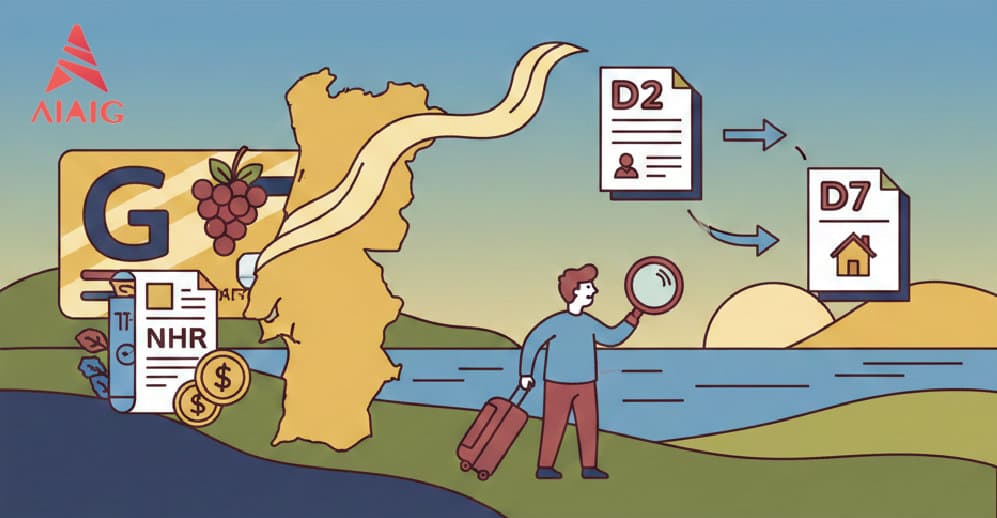
2025 Portugal Visa Policy for Chinese Residents: Schengen, D-Type, Family...
A systematic overview of main visa types for Chinese residents going to Portugal: Schengen short-term (tourism/business/family visits), long-term D-type (study/work/high-tech research/remote and passive income), family reunion D6, and the latest rules and considerations for residence permit renewals.

1. First, clarify the framework: Portuguese visas are divided into two main categories
1) Short-term: Schengen short-stay visa (Type C)
- Applicable purposes: Tourism, business visits, visiting family/friends, short-term training/conferences, cultural/sports activities, medical treatment, etc.
- Core rule: Stay no more than 90 days in any 180-day period (90/180 rule).
- Applicable groups: Most Chinese residents who "go to Portugal for a trip/work for a few days/visit family for a few weeks".
2) Long-term: Portuguese national long-stay visa (Type D/Residence Visa)
- Applicable purposes: Study, work, research/high-skilled work, family reunification, long-term residence (e.g., passive income, remote work, etc.).
- Core features: Allows stays exceeding 90 days in Portugal, generally requiring further processing or connection to a Residence Permit after entry.
Important reminder: Short-term Type C visas address "short stays", while long-term Type D visas address "long-term residence". Many misunderstandings arise from mixing the two (e.g., wanting to live long-term in Portugal but entering with a short-term tourist visa).
II. Quick Overview of Visa Types (Choose the Right Category by Purpose)
| Category | Typical Uses | Key Points | Suitable For |
|---|---|---|---|
| Schengen Short-term C (Tourism) | Sightseeing, short vacations | 90/180 rule; requires itinerary, accommodation, insurance, financial proof | Pure tourism, short-term visits |
| Schengen Short-term C (Business/Conference) | Business visits, exhibitions, conferences | Invitation letter/dispatch proof is more critical; other materials same as short-term | Corporate business trips, exhibitions |
| Schengen Short-term C (Visiting Family/Friends) | Visiting relatives/friends in Portugal | Invitation/guarantee, relationship proof, accommodation proof | Family visits, short-term companionship |
| Type D (Study) | Medium to long-term study/study abroad | Admission/enrollment proof, funds, accommodation, insurance; apply for residence after entry | International students, language schools |
| Type D (Work/High-Skilled) | Employed work, research/high-skilled positions | Employment contract/work offer; apply for residence after entry | Expatriates, technical talents, researchers |
| D6 (Family Reunification) | Reuniting with legal residents in Portugal | Sponsor has legal residence; relationship proof, accommodation and income/security capability | Spouses, minor children, dependent parents, etc. |
III. Schengen Short-Stay Visa (Type C): "General Rules" for Tourism/Business/Family Visits
1) What "General Materials" You Typically Need to Prepare (System Level)
Different embassies and visa centers may have variations in their lists, but short-stay Schengen visas are generally reviewed based on the following logic:
- Identity and Travel Purpose: Why you are going, where you are going, how long you will stay, and who is covering the costs.
- Ties to Return Home: Evidence of binding factors in your home country, such as work/studies/family/assets.
- Financial Capacity: Sources and stability of funds to cover costs during the trip (common practices: recent bank statements, salary/tax/social security records, etc.).
- Itinerary and Arrangements: Round-trip transportation, accommodation bookings, travel plans.
- Risk and Medical Coverage: Travel medical insurance that meets Schengen requirements.
2) How to Understand the 90/180 Rule (Avoiding "Overstaying")
- It is not "up to 90 days per trip," but "no more than 90 days in any rolling 180-day window."
- If you travel frequently to Europe, you must calculate based on the rolling window.
3) Can a Short-Stay Visa Be "Extended Once" to Stay Longer in Portugal?
- Generally, short-stay Schengen visas do not offer 'extension' as a regular option.
- If you plan to reside long-term, you should apply for the corresponding Type D Long-Stay Visa before leaving, and do not rely on extending a short-stay visa for long-term residence.
4) Key Review Points for Short-Stay Visas (More Practical for Chinese Residents)
- Authenticity and Consistency of Travel Purpose: Itinerary, invitation letters, hotels, flights, and funding sources should align with each other.
- Ties to Return Home: Stable employment, proof of enrollment, family members, assets, and long-term plans.
- Quality of Materials: Translation, stamps, and verifiability (especially for employer certificates/invitation letters/bank documents).
IV. Schengen Short-Term "Business/Short-Term Professional Activity" Visa: Key Points of the System
1) Essential Differences Between Business Visa and Tourist Visa
- Still falls under the Schengen Short-Term Category C, also subject to the 90/180 rule.
- The difference lies in: business visas place more emphasis on verifiability of invitation and purpose (inviting party, conference/exhibition information, relationship between parties, cost coverage).
2) What Common "Business-Related Proof" Looks Like
- Invitation letter issued by a Portuguese enterprise/institution: includes purpose of visit, time, location, contact person, cost coverage, etc.
- Dispatch/employment certificate issued by the Chinese unit: position, salary, purpose of business trip, leave approval information.
3) Common Misconceptions for Investors
- Property viewing/project inspection: usually still possible through short-term visas (depending on specific activity arrangements and document preparation).
- However, if you actually intend to reside in Portugal long-term (e.g., long-term asset management/long-term stay), you should consider the D category path, rather than repeatedly making short-term round trips that risk exceeding stay duration limits.
V. Long-Term Residence Visa (Type D): Main Channel for Study, Work, High-Skilled, and Long-Term Residence
Note: Portugal's long-term visa is commonly referred to as the "National Type D/Residence Visa." Different purposes correspond to various subtypes (often called D1/D2/D3/D4/D5/D6/D7/D8, etc.), with slight variations in classification, but the core system is consistent: first obtain a long-term visa for entry, then transition to a residence permit.
1) Common Logic of Type D Visas (System Level)
- You must prove:
- Legal and sustainable long-term stay purpose in Portugal (e.g., work contract, admission letter, family reunification eligibility).
- Sufficient means of subsistence (funds/income sources/guarantees).
- Accommodation arrangements and necessary background materials such as insurance/no criminal record (based on official lists).
2) Common Validity of Type D Visas and "What to Do After Entry"
- Type D visas are typically used for entry and transition: after entry, you often need to complete the residence permit application/appointment and document submission as required.
- In practice, many Type D visas are commonly annotated in forms similar to "can be used to stay in Portugal for a period and process residence" (refer to the visa page and official instructions).
3) Who Type D Visas Are Suitable for Among Chinese Residents
- Those planning to study, work, or live long-term in Portugal (including remote work, passive income, etc.)
- Those needing a legal long-term residence status for purposes such as opening bank accounts, renting housing, children's education, and accessing the healthcare system.
VI. Key Categories Breakdown: Study, Work/High-Skill, Family Reunification
A) Study Category (Commonly Corresponding to D4/D5 Criteria)
- Core Document Logic: Admission/Enrollment Proof + Financial and Living Support + Accommodation + Insurance/Background Materials.
- Key Institutional Points: After entry, it typically requires transitioning to a residence permit; the clearer the study plan and the more stable the funding source, the more favorable for review.
B) Work/High-Skill/Research (Commonly Corresponding to D1/D3 Criteria)
- Core Document Logic: Employment Contract/Job Offer (including position, salary, duration, employer information) + Qualification and Experience Proof + Financial/Accommodation/Insurance/Background Materials.
- High-Skill/Research: Generally emphasizes more on the match between position and qualifications, employer or institution credentials, and clarity of contract terms.
C) Family Reunification (D6)
- Institutional Prerequisite: The sponsor must have a legal residence status in Portugal and possess certain accommodation and support capabilities.
- Eligible Reunification Objects (Common Scope): Spouse, minor children (including adoption/guardianship situations), dependent parents, etc. (subject to official definitions).
- Core Document Logic: Proof of Family Relationship (marriage certificate/birth certificate, etc.) + Sponsor's Identity and Residence Proof + Accommodation and Support Capability Proof + Applicant's Background Materials.
Common Scenario for Investors: One party first obtains legal residence through study/work/long-term residence pathways, then applies for family reunification for spouse and children, which is one of the clearer institutional paths.
7. Latest Rules on Residence Permit Renewal and "Expired Documents" (Strongly Related to Visas)
1) AIMA and the Renewal System
- Portugal's immigration management system has undergone institutional adjustments in recent years, with the processing, renewal, and appointment of residence permits handled by corresponding agencies/platforms.
2) Validity and Transition Policies for "Expired Residence Permits/Visa Documents"
- Portugal has long addressed post-pandemic validity issues of documents through decrees and transitional arrangements.
- The key point for Chinese residents is: If you are already in Portugal and hold residence-related documents, be sure to pay attention to the latest official announcements on "whether expired documents are recognized," "how long the validity is extended," and "how to enter the renewal process."
3) Practical Advice for 2025 Renewal Actions
- If you hold a residence permit:
- Monitor renewal portals, email notifications, appointment channels, and material requirements in advance.
- Do not rely on "automatic extensions/assumed validity" as a long-term dependency; after the policy window ends, you may need to actively enter the renewal process to be considered compliant.
This section is particularly important for those planning to live long-term in Portugal through a D-type long-term visa: the visa is just the entry point, and subsequent residence permits and renewals are key to long-term compliance.
What type of visa do Chinese residents typically apply for when traveling to Portugal for tourism, visiting family, or short-term business trips?

Can a short-term Schengen visa be 'converted to long-term residence' within Portugal?
What is the most critical threshold for family reunification (D6)?
If I want to both inspect real estate and attend business meetings, should I choose a tourist visa or a business visa?
Does a long-term visa (D category) necessarily equal 'permanent residence'?
Can you provide a simplified version of the application process?
8. Application Methods and Document Strategy (Brief Process, but Key Points at the "System Understanding" Level)
1) Where to Submit
- Usually through Portuguese visa processing channels in China (Visa Center/Visa Application Center system) for appointment and submission.
- First-time applications generally involve biometric data collection (fingerprints/photos), so personal presence is typically required.
2) Document Strategy: Not a "Chronological Account", but "Review Logic"
- All documents should serve three questions:
- What are you going to do (purpose is genuine and verifiable)
- How will you cover the expenses (stable funds, clear source)
- Why will you leave on time/or why do you have a legal basis for long-term residence (ties to home country/legality of long-term purpose)
3) Common Pitfalls for Chinese Residents
- Inconsistencies between itinerary and documents (e.g., stating tourism but arranging many business activities).
- Sudden large deposits in funds without explanation of source.
- Invitation letters are too templated, with contact information that cannot be verified.
- "Credibility loss" due to inconsistencies in translations, stamps, or document information.
IX. One-Sentence Advice for Overseas Asset Allocation/Relocation Planning Groups
- Short-term visits: Prioritize ensuring "document consistency" and "ties to home country" to reduce uncertainty.
- Long-term residence: Do not dwell on "whether to use a tourist visa first and figure it out later"; instead, choose a D-class path from the start and simultaneously consider subsequent residence permits, renewals, and family arrangements.
- Family planning: Typically, the "first party to obtain legal residence status" serves as the main applicant, then includes spouse and children in the same compliant path through family reunification.
If you would like me to further break down each D-class category (e.g., study, employment, high-skilled, remote work, passive income, etc.) into a more detailed list-based explanation (while keeping the process concise), I can also add a comparison table module in the same article.