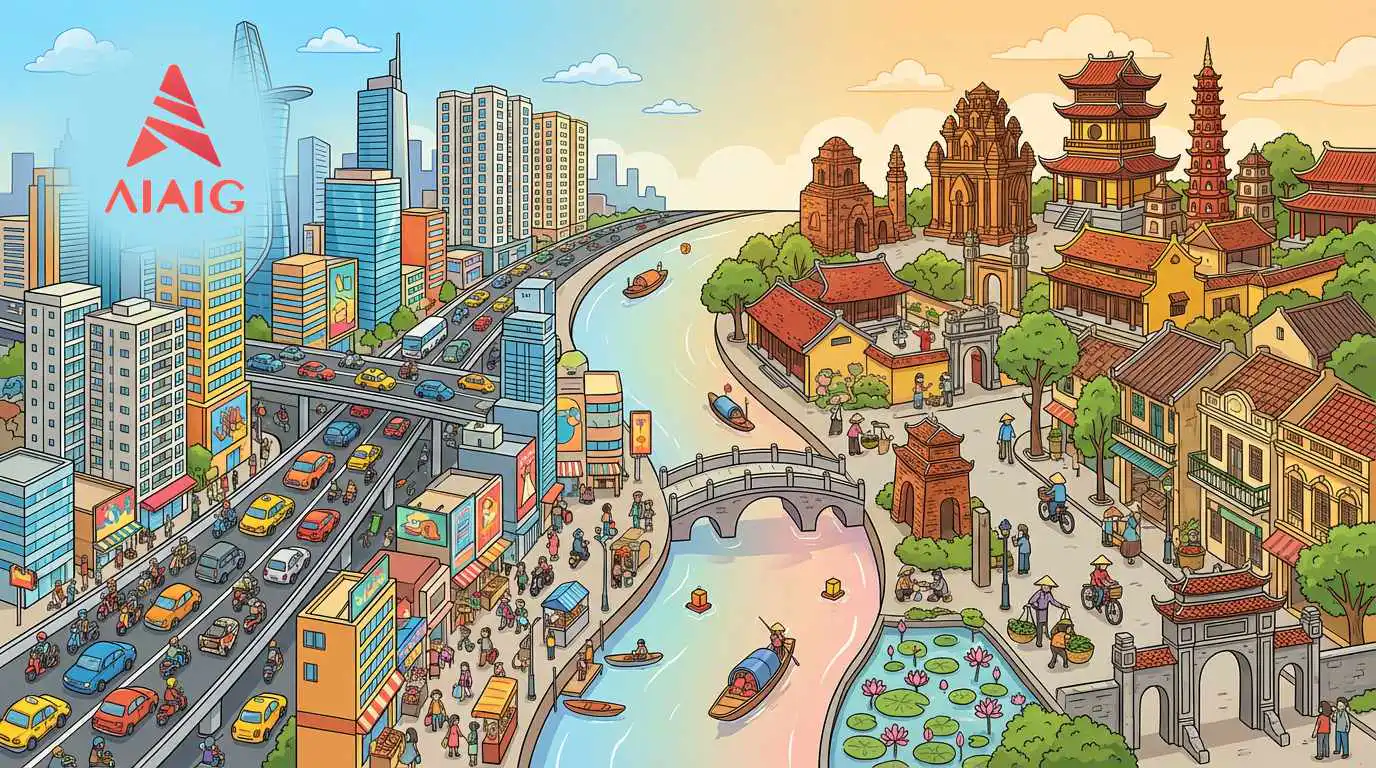
For overseas investors preparing to allocate residential assets in Vietnam, what truly needs to be clarified is not as simple as a phrase like 'buy Ho Chi Minh City' or 'buy Hanoi,' but rather:
In Ho Chi Minh City, which districts are traditional affluent areas, primarily serving local high-net-worth individuals and expatriate executives?
Which areas are emerging middle-class belts, accommodating urban growth and industrial spillover?
Which are high-density commoner districts, with seemingly high rents but also heavy management costs?
In Hanoi, what do the lake-view affluent areas and political core zones look like respectively?
Along which main roads and rail transit lines do the emerging middle-class districts unfold?
Which remote suburbs and old shantytown areas have short-term risks far outweighing opportunities?
This article focuses on popular science and information organization, not constituting any specific buying or selling advice. The key is to help you establish a thinking framework of 'viewing the city → breaking down districts → observing demographics,' using Ho Chi Minh City and Hanoi as specific examples.
1. Overall Framework: Understanding the Residential Sector of Vietnam's Major Cities with the "Three-Tier Structure"
- How can the residential distribution in Ho Chi Minh City and Hanoi be stratified using just one framework?
- Without getting bogged down in administrative district names, a simple yet practical three-tier structure can be used to understand the residential sectors in Vietnam's core cities:
1) Core Affluent Circle
- Typically characterized by proximity to the historic city center or iconic lakes, with financial institutions, government offices, five-star hotels, and high-end shopping malls;
- Residential forms are mostly high-end apartments, renovated old buildings, and a few villas, with transaction prices per unit and total prices at the city's highest levels;
- The population primarily consists of local high-net-worth families, senior civil servants, multinational company executives, and long-term expatriates;
- For investors, it leans more towards "urban core positions" and "value-preserving base holdings," with rental yields not necessarily optimal but offering strong liquidity and resilience to economic cycles.
2) Emerging Middle-Class Belt
- Usually located in the first or second ring outward from the core urban area, along main roads and planned subway or expressway routes;
- Features numerous new mid-to-high-rise residential communities and mixed-use projects, with supporting malls, schools, and hospitals gradually improving;
- The clientele mainly includes urban white-collar workers, entrepreneurs, and young dual-income families, prioritizing education and commuting;
- Appreciation logic stems from industrial spillover, population influx, and infrastructure improvements, with relatively safe price margins, making it a sector with good medium- to long-term growth potential.
3) High-Density Commoner and Suburban Circle
- Mostly situated in outer rings or urban fringes, dominated by self-built houses, small commercial properties, and low-cost rental housing, with high residential density;
- Residents are largely local wage earners, industrial zone blue-collar workers, rural migrants, etc., with significant variations in income and housing stability;
- Infrastructure (drainage, parking, public spaces) and public service levels (schools, hospitals, etc.) are relatively uneven;
- Nominal rental yields may be higher, but management costs and risks increase accordingly, making it less friendly to overseas investors lacking local teams.
Next, we will break down Ho Chi Minh City and Hanoi separately using this structure.
II. Ho Chi Minh City: From the Old Town Core to International Communities, to High-Density Peripheries
- What is the general urban structure and population distribution of Ho Chi Minh City?
- Ho Chi Minh City is the economic and financial center of southern Vietnam, often seen as a Vietnamese blend of "Shanghai + Guangzhou": strong commercial atmosphere, high openness, and a large floating population.
From a spatial structure perspective, it can be roughly divided into three rings:
1) Inner Ring: Old City Business and Administrative Core
- Mainly consisting of District 1 and District 3, gathering bank headquarters, multinational corporate offices, government departments, five-star hotels, and high-end shopping centers;
- Daytime population density is extremely high, serving as the office and consumption center; at night, it maintains a certain residential density with some high-end residents and business apartments;
- Within this ring, housing is more like "high-end residential areas embedded in the business core."
2) Middle Ring: International Communities and Planned New Towns
- Typical examples include Thao Dien and Thu Thiem in District 2, the extension belt of new business districts, and Phu My Hung in District 7;
- These areas have been the main battleground for Ho Chi Minh City's urban expansion and upgrading over the past decade, with concentrated new developments and modern amenities;
- The population mainly consists of middle-to-high-income local families and a large number of expatriates, with education and quality of life being the main selling points.
3) Outer Ring: High-Density Residential and Industrial Support Areas
- Including outer districts such as Tan Binh, Tan Phu, and Binh Tan, with dense streets and alleys, mixed with self-built houses and small apartments;
- Factories, logistics parks, and wholesale markets are widely distributed, with high population mobility;
- These areas are important residential zones for the city's labor force and service industry workers, but from an asset perspective, they have greater volatility and management costs.
- Why are District 1 and District 3 considered the traditional affluent areas of Ho Chi Minh City?
- District 1 and District 3 are the earliest developed core urban areas of Ho Chi Minh City, combining historical and modern financial functions:
- Functional positioning: They concentrate the headquarters of Vietnamese and international banks, insurance companies, regional offices of multinational corporations, large shopping malls, and high-end hotels, serving as the financial and business core of the entire city;
- Lifestyle atmosphere: Daytime activities are dominated by office work and consumption, while nighttime is supported by high-end restaurants, bars, and boutique hotels for high-consumption nightlife;
- Residential forms: High-rise apartments, renovated old buildings from the French colonial era, and a small number of high-end low-density residences, many projects offering cityscape or river views;
- Demographic profile: Local high-net-worth families, multinational corporation executives, lawyers and financial professionals, senior civil servants, and some expatriate professionals looking to settle long-term in Ho Chi Minh City.
From an asset perspective, these areas are more like "city landmark assets":
- Advantages include irreplaceable location, active transactions, price resilience, and relative stability during market fluctuations;
- Drawbacks include high residential density, a business-oriented living environment, limited parking, and rental yields often lower than those in middle-class belts and some international communities. - What are the different characteristics of Thao Dien and Thu Thiem in District 2?
- District 2 can be further divided into two distinct but complementary sub-areas:
1) Thao Dien: Mature International Community
- Lifestyle-oriented: The neighborhood is filled with Western restaurants, cafes, artisanal shops, and small supermarkets, with easy access to fresh ingredients and imported foods;
- Educational resources: Home to multiple international and bilingual schools, making it one of the first areas screened by expatriate families when choosing housing;
- Residential forms: A mix of low-density villa communities and mid-to-high-end apartments, with some streets exhibiting a distinct "Western town" vibe;
- Demographics: Expatriate families from Europe, America, Japan, and Korea, local emerging middle-class and newly affluent families, and some long-term freelancers and digital nomads.
2) Thu Thiem: New Central Business District and Integrated Complex Cluster
- Planning positioning: Viewed as the future financial and commercial center, with dense large-scale integrated projects combining residential, office, and retail spaces;
- Architectural forms: High-rise towers, apartment complexes with office podiums, featuring a modern and dense skyline;
- Demographics: Financial and professional service workers, tech company employees, middle-to-high-income young families, and some local investors and foreign capital attracted by growth potential.
For investors, Thao Dien is better suited as a "stable rental + family residence" type asset, while Thu Thiem resembles a growth asset "betting on the future formation of the city's CBD," with greater sensitivity to price elasticity and policy expectations. - What level does a planned community like Phu My Hung in District 7 occupy?
- Phu My Hung is one of the most typical planned large-scale communities in Ho Chi Minh City, with characteristics that can be summarized as:
- Overall planning: Master-planned and long-term operated by a single developer, featuring wide streets, high greenery coverage, complete pedestrian systems, and public spaces;
- Comprehensive amenities: Includes multiple schools, shopping centers, medical facilities, and community centers, allowing daily life to be largely self-contained within the community;
- Resident structure: High proportions of families of Korean and Chinese enterprise employees, local middle-to-high-income families, and upgrade-seeking clients who value children's education and living environment;
- Asset attributes: Relatively low vacancy rates, with leases often long-term family rentals, smooth price fluctuations, and friendly to holders seeking stable cash flow.
In a three-tier structure, Phu My Hung is neither a traditional "old city core" nor a high-density outer ring, but rather a "family-oriented mid-to-high-end segment" between the two, serving as one of the representative mainstream upgrade communities in Ho Chi Minh City.
- What are the common investment logics for middle-class districts like Binh Thanh District?
- Middle-class districts represented by Binh Thanh District typically share the following common logics:
1) Location in the "layer between the core and new urban areas"
- Binh Thanh District connects the old urban cores of District 1 and District 3 with the new CBD of District 2, serving as a geographical hub;
- For those working in the old city or the new CBD, it offers reasonable commuting times, balancing price and convenience.
2) Rapid product updates
- Numerous mid-to-high-rise residential complexes have been launched over the past decade, with layouts better suited to modern living needs, such as two-bedroom units with a small study or three-bedroom units with two bathrooms;
- Projects often include commercial components (shopping malls, street shops), enhancing service levels within the living radius.
3) Prices in the middle gradient
- Compared to top-tier affluent areas like District 1 and District 3, the total price and down payment thresholds are significantly lower;
- Compared to more peripheral working-class areas, they offer better infrastructure and public services, with more stable tenant quality and payment capabilities.
Overall, middle-class districts are relatively suitable for medium-to-long-term holders looking to invest in Ho Chi Minh City but unwilling to bear the high unit prices and volatility of the old city, offering a balanced choice between "rental yield vs. asset safety." - What are the hidden costs of residential investment in high-density outer rings like Tan Binh, Tan Phu, and Binh Tan?
- The apparent advantages of these high-density outer rings are: cheap housing prices, low total price thresholds, and seemingly good rental yields. However, for overseas investors not based locally and lacking management teams, hidden costs are often underestimated:
- High management difficulty: Frequent tenant turnover, short lease terms, and complex tenant backgrounds increase the likelihood of issues like rent arrears or property damage;
- High maintenance costs: Varying construction quality, with many self-built houses and old residential areas leading to frequent repairs for issues like water leakage, plumbing problems, and electrical safety concerns;
- Security and environmental issues: Poor nighttime security in some neighborhoods, along with noise, parking conflicts, and waste disposal problems, affect living experience and long-term tenant retention;
- Liquidity risk: If local middle-class residents continue to migrate to better-planned communities in the future, these areas may gradually become "marginalized," requiring larger discounts to find buyers when selling.
Therefore, investment in such areas is more of a game for local deep-pocketed players—they can manage high-frequency operations at lower costs. For remote investors, the risk-reward ratio may not be as favorable as imagined. - What are the medium-to-long-term impacts of Ho Chi Minh City's rail transit and urban planning on different districts?
- Ho Chi Minh City is gradually advancing its urban rail transit system construction. Although progress and specific line implementation timelines are uncertain, the general direction is clear:
- Core areas: Stations around District 1 and District 3 will further solidify their status as business and commercial centers, with projects near metro stations having advantages in commuting and passenger flow compared to ordinary neighborhoods;
- Middle-class belt: Once covered by rail transit lines, areas like Binh Thanh District will significantly reduce commuting times to core areas and the new CBD, helping to enhance district attractiveness and price expectations;
- Outer areas: If lacking rail transit or expressway connections, they may be labeled as "low-price districts with inconvenient transportation" in the future, potentially concentrating further on lower-income populations.
For investors, a more feasible strategy is:
- Not relying solely on rail transit planning as the only logic, but prioritizing projects within the "expected walking radius of confirmed or under-construction lines" when evaluating properties;
- For projects completely away from any main roads or rail transit plans, more cautious assessment of their long-term liquidity is required.
III. Hanoi: Lakeside Affluent District, Political Core, and Emerging Middle-Class Belt
- What are the differences in the overall residential sector structure between Hanoi and Ho Chi Minh City?
- As the capital of Vietnam, Hanoi has a distinct urban character compared to Ho Chi Minh City, leaning more towards being a political and cultural center. The residential sectors can be roughly divided into three layers:
1) Lakefront and Political Core Circle
- Represented by affluent lakefront areas like Tay Ho District, and political and historical core areas such as Ba Dinh District and around Hoan Kiem Lake;
- High-end residences overlap significantly with important government institutions and embassies, offering strong symbolic value and preservation attributes.
2) Emerging Middle-Class Belt
- Mainly expanding along Nam Tu Liem, Bac Tu Liem, and Ha Dong directions, with concentrated new residential communities and integrated projects, many of which are sub-centers and new towns in urban planning;
- This is the main battlefield for population influx and housing demand in Hanoi over the next decade, with prices and amenities continuously evolving.
3) Outer Suburbs and Old Shantytown Circles
- Located on the city outskirts or around old industrial zones, with varying residential quality and public services, and uncertain urban renewal planning and execution pace;
- There may be individual opportunities for local deep players, but for remote investors, risks outweigh controllable returns.
Overall, the high-end sectors in Ho Chi Minh City are more "commercialized and internationalized," while those in Hanoi are more "politicized and symbolic"; Ho Chi Minh City has multiple cores with coexisting old and new CBDs, whereas Hanoi features a more prominent single high-end circle formed by the overlay of lakefront and political hubs, with the emerging middle-class belt extending along transportation and new town planning.
- Why has West Lake District become a landmark lake-view affluent area in Hanoi?
- West Lake District possesses several scarce attributes that occur simultaneously:
- Natural scenery: Surrounded by a large inland lake, the lakeshore forms a natural scenic belt, with many residences offering expansive lake views, providing excellent environments for daily walks and exercise;
- International atmosphere: Proximity to multiple embassies, with a high concentration of long-term foreign residents, making the English-speaking environment relatively friendly;
- Educational resources: The area hosts several international and bilingual schools, strongly attracting both expatriate families and local families who value international education;
- Lifestyle: The neighborhood features numerous Western restaurants, cafes, bars, and boutique shops, with a relatively leisurely pace of life and higher consumption levels.
In terms of housing, West Lake offers both low-density villas with yards and modern high-rise apartments with lake views. For investors, its core value lies in the long-term stable demand from foreign tenants and relatively robust rental pricing, making it particularly suitable for holders looking to hedge local currency risks with foreign currency-denominated cash flows. - What are the differences between the high-end sectors in Ba Dinh District and around Hoan Kiem Lake compared to West Lake?
- Ba Dinh District and the area around Hoan Kiem Lake lean more towards political and historical cores, with their differences from West Lake mainly reflected in:
- Different functional positioning: Ba Dinh District is a concentrated area for national government agencies and embassies, emphasizing administrative and diplomatic functions; Hoan Kiem Lake and the surrounding old town serve as windows for tourism and historical-cultural display;
- Very limited developable land: Due to high existing building density and strong historical-cultural value, the number of new residential projects is limited, mostly small-scale or high-end renovation projects;
- Differences in living experience: The old town has narrow streets, dense traffic and pedestrian flow, noise, parking difficulties, and pressure from tourist peaks, posing significant challenges to the living experience;
- Demographic composition: High-income civil servants, traditional wealthy families, and some cultural and academic figures are the main holders here, who place greater emphasis on the symbolic significance and long-term value preservation of the location.
From an investment perspective, these areas are more suitable as "small positions with stable value" to balance the overall portfolio, rather than being the main battleground for betting on high growth.
- What are the common characteristics of Nam Tu Liem, Bac Tu Liem, and Ha Dong as emerging middle-class areas?
- As emerging middle-class zones, these areas generally share the following characteristics:
1) Development along transportation corridors
- Located along major thoroughfares connecting the city center and outer ring roads, they represent the primary direction of "expansion from old to new urban areas";
- Planned or under-construction subways, light rails, or expressways often pass through these areas, gradually reducing commute times.
2) High density of new developments
- Over the past decade, numerous mid-to-high-rise residential projects and mixed-use complexes have been built, featuring relatively modern community planning and generally newer building ages;
- Multiple projects by different developers are common within the same area, offering buyers a wide range of choices and diverse price gradients.
3) Young demographic structure
- The main residents are emerging middle-class families, white-collar workers from tech parks and university towns, and first-time homebuyers or those seeking upgrades;
- Education and commuting are primary considerations in home selection, with housing prices often reflecting proximity to schools and commute times.
In terms of growth logic, price increases in these areas are largely driven by the combined effects of "urban expansion + infrastructure completion + public service improvements." For overseas investors, it is crucial to verify that local plans are actually being implemented, rather than just being promotional. - What are the biggest risks for overseas investors in Hanoi's distant suburbs and old slum areas?
- The risks in distant suburbs and old slum areas can be summarized into three categories:
- Uncertainty in urban renewal:
Many plots are marked on planning maps as future renewal or redevelopment zones, but actual start times, land acquisition plans, and compensation standards are highly uncertain, with potential significant gaps between policy and implementation.
- Complexity in legal and execution processes:
Land acquisition, demolition, and compensation involve extensive administrative and legal procedures. Investors lacking local experience may struggle to determine when a project or plot will actually materialize, easily getting stuck in prolonged deadlocks.
- Cash flow and liquidity risks:
Tenant payment capacity is limited, leases are unstable, and maintenance costs are high. If a sale is needed, buyers are often local speculators or self-users, leading to significant disparities in bargaining power and potential forced deep discounts.
Therefore, for most remote investors, these areas resemble "battlegrounds of policy and execution" rather than ideal places for residential asset allocation. If genuinely interested, it should be based on a thorough understanding of local regulations and project backgrounds, with acceptance of high volatility and long-term uncertainty.
- How should one unify the perspective when making a horizontal comparison between Ho Chi Minh City and Hanoi?
- A simple and reusable method is to start not from administrative divisions, but from three points: "level + population + function":
1) First, identify which level of area this is
- Does it belong to the old city or lakefront core, possessing administrative, financial, or cultural symbolic significance?
- Is it a new city or sub-center, serving functions for population and industrial overflow?
- Or is it a high-density periphery, mainly accommodating low-income groups and industrial support?
2) Then, look at who the main population served is
- Is it local high-net-worth individuals and expatriate executives, emerging middle-class families, or working-class and blue-collar groups?
- Is the population stable, is income sustainable, and what are the requirements for education and commuting?
3) Finally, examine the function and infrastructure
- Does the area have clear and implementable urban functions (business center, education center, industrial center, etc.)?
- What is the completion level of rail transit, expressways, schools, hospitals, and commercial facilities? Are there clear budgets and timelines supporting future construction plans?
Using this perspective to view Ho Chi Minh City and Hanoi:
- Ho Chi Minh City: Wealthy areas are more dispersed (old CBD, new CBD, planned communities with multiple cores coexisting), with stronger commercial and international atmosphere;
- Hanoi: High-end areas are more concentrated (West Lake + Ba Dinh + Hoan Kiem Lake), with political and lakefront resources overlapping, and emerging middle-class belts extending along specific directions.
For overseas investors, rather than memorizing complex district and street names, it is more important to judge "what type of area this property is in, and what role it plays in the city," then match their own needs (focus on value preservation, rental income, appreciation, or balancing living experience) to the appropriate level.
Summary:
- If you prioritize long-term value preservation and liquidity, you can first select suitable products from the core areas of District 1, District 3, and District 2 in Ho Chi Minh City, as well as around West Lake, Ba Dinh, and Hoan Kiem Lake in Hanoi;
- If you hope to pursue certain growth potential under controllable risk, you can focus more on Binh Thanh District, the extended zone of District 2, and planned communities in District 7 in Ho Chi Minh City, as well as emerging middle-class sectors such as Nam Tu Liem and Ha Dong in Hanoi;
- As for high-density peripheral and civilian areas, they are more suitable for investors with local management teams who can accept high volatility and high management intensity. Remote holders should approach them with caution.
Re-emphasis: This article is only an in-depth compilation of urban structure and sector information, aiming to help you establish the cognitive foundation of "viewing the city → viewing the sector → viewing the population," and does not constitute any specific project or target buying or selling advice. Actual decisions still need to be comprehensively judged based on the latest policies, specific project quality, and individual risk tolerance.
Last updated Dec 4, 2025