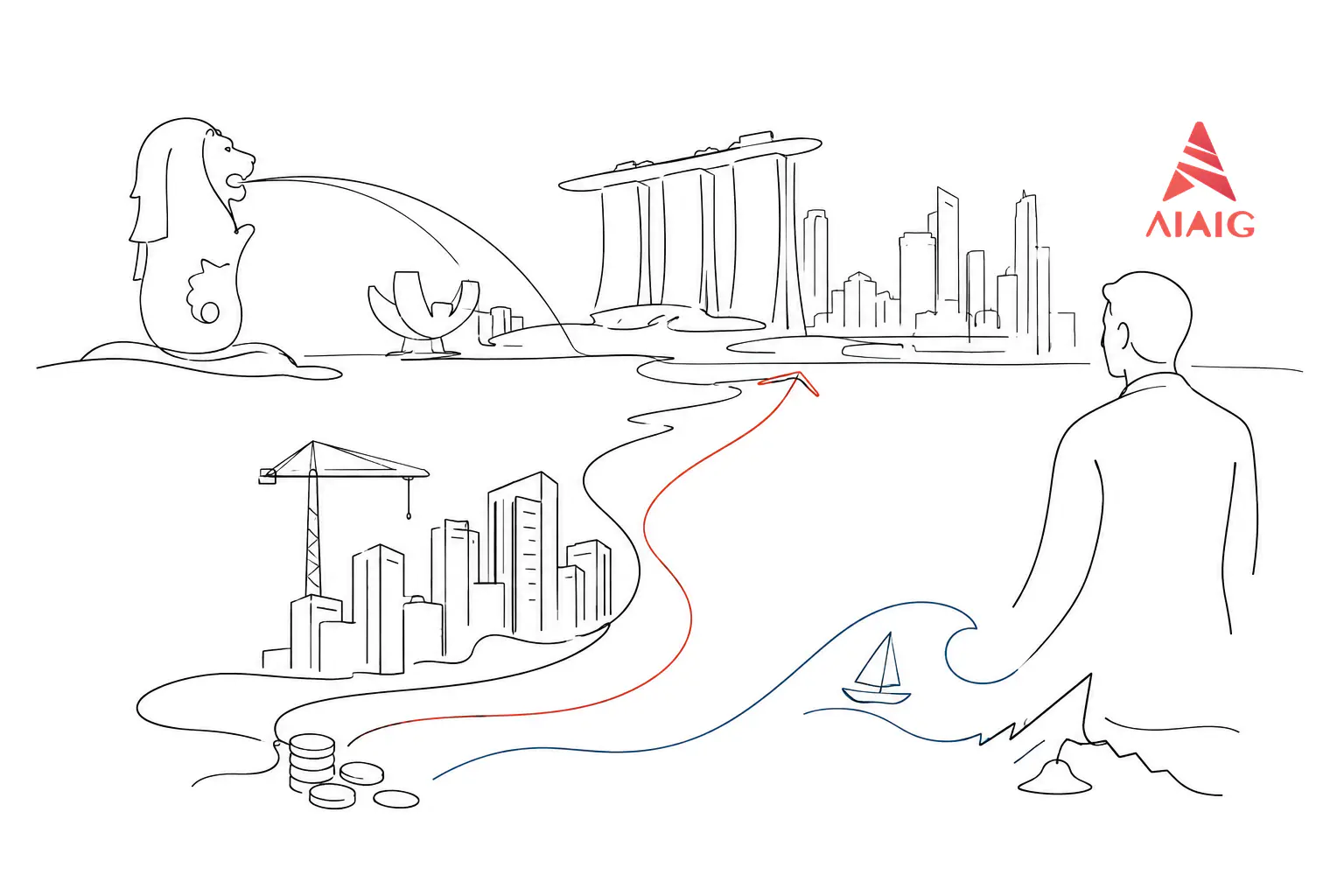
Singapore is attracting a surge of Chinese capital into its property sector. According to the Singapore Economic Development Board's (EDB) February 2026 report, mainland Chinese firms accounted for 21% of total fixed-asset investment in Singapore in 2025, up sharply from 2.5% a year earlier, making China the second-largest foreign investor after Europe (25%) and surpassing the US (17.3%).
Behind this data are several notable land transactions: in Q1 2026, CNQC Realty, Forsea Residence, and Jianan Realty Investments jointly acquired a 145,500 sq ft lot on Dover Drive for S$951 million (US$743 million), expected to yield 625 residential units; in April 2025, Kingsford Group won a tender for a 222,161 sq ft plot at Lentor Gardens for S$429.23 million, followed by a S$918.3 million acquisition of a 147,350 sq ft plot on Telok Blangah Road in November — together expected to yield over 1,240 units.
Alan Cheong, Executive Director for Research and Consultancy at Savills Singapore, noted that China-linked developers have become more active in the market. "Chinese developers who have had experience in Singapore are now familiar with the rules, regulations and market behaviour, and are expected to continue bidding to replenish their landbanks."
[AIAIG Analysis] The influx of Chinese capital into Singapore's property market reflects the city-state's status as a global safe haven, but also signals intensifying competition. For overseas Chinese investors, this means both opportunities — more quality project launches and potential asset appreciation — and challenges — potential price pressure from aggressive Chinese developer bidding.
- What drives Chinese capital inflows into Singapore's property market?
- Three key factors: (1) Singapore's safe-haven status as a financial center and rule-of-law nation amid rising global geopolitical uncertainty; (2) political stability, strong currency (SGD remains resilient against USD), and strong asset preservation attributes; (3) EDB's proactive investment promotion — Chinese firms' fixed-asset investment share surged from 2.5% to 21% in 2025.
- How does this affect Singapore property prices and rents?
- Chinese developer land banking will translate into new supply within 2-3 years, helping ease supply constraints. However, high land costs (Dover Drive land rate ~S$6,537/sqm) will support new launch pricing. Influx of Chinese corporate executives and employees also boosts high-end rental demand, supporting core area prices and rents.
- What should overseas Chinese investors do about this trend?
- Consider participating in early launches of Chinese-developer projects, which often offer competitive pricing and quality standards. However, be wary of market overheating — massive Chinese capital inflow may trigger further government cooling measures. Maintain portfolio diversification and reassess returns given Singapore's 60% ABSD rate.
[Summary] The surge of Chinese capital into Singapore's property sector — from 2.5% to 21% of fixed-asset investment — reflects a structural shift in global capital flows. For overseas Chinese investors, this means a more dynamic market with more project options, but also requires more careful valuation assessment. Given Singapore's 60% foreigner ABSD and tightening credit environment, investors should focus on project quality and long-term value in core Singapore locations.
Last updated May 15, 2026