AIAIG

Global property investment platform, your overseas property investment partner.

Navigation

  • Properties
  • Global Insights
  • Partners
  • About Us
  • Contact

Contact Us

400 6961 622
info@aiaig.com

WeChat

AIAIG 微信公众号二维码

Scan to Follow

WeChat Service

AIAIG 微信客服二维码

Scan to Follow

Call Now 400 6961 622

© 2026 AIAIG. All rights reserved.

公安备案京ICP备13044752号-2

Copyright © 2026 AIAIG. All rights reserved.

公安备案京ICP备13044752号-2
AIAIG - 全球房产投资平台
AIAIG
Home
Global Insights
Partners
Contact
AIAIG观点
Apr 12, 2026
AIAIG Editorial Team

Singapore Private Property Outlook 2026: Tight Supply Meets High Taxation

Disclaimer: The content of this article is for informational reference only and does not constitute investment advice, a solicitation, or a basis for major decision-making. Please make independent judgments and consult professional advisors when needed.

Limited supply, 2.2% GDP growth forecast, easing interest rates. Despite 60% ABSD impacting foreign buyers, Singapore's safe-haven status continues attracting capital inflows
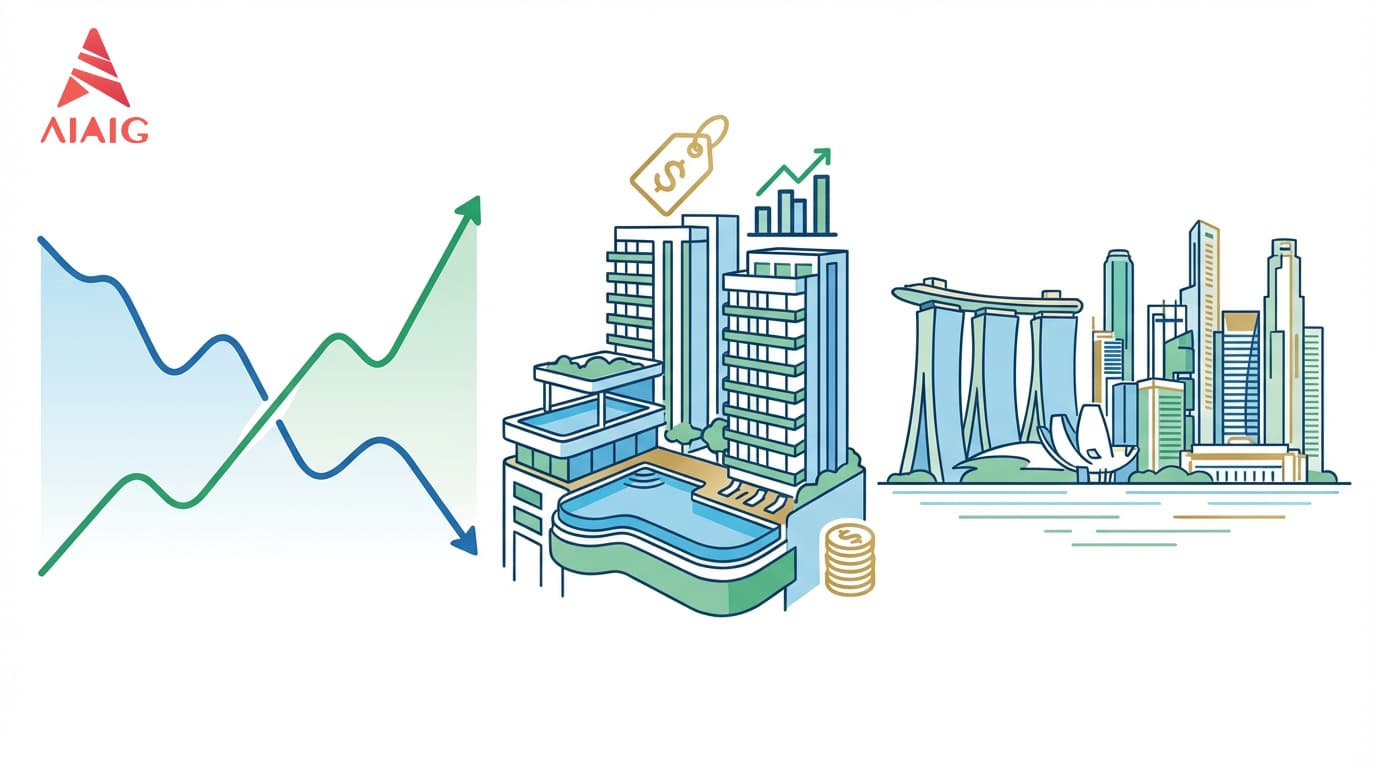
Singapore Private Property Outlook 2026: Tight Supply Meets High Taxation

Singapore's private property market in 2026 unfolds against a complex backdrop of supply constraints, heavy taxation, and stabilizing macroeconomic conditions. Despite the government maintaining a hefty 60% Additional Buyer's Stamp Duty (ABSD) on foreign buyers—significantly dampening high-end residential sales in the Core Central Region (CCR)—the market's fundamentals remain robust. The Monetary Authority of Singapore forecasts 2.2% GDP growth, while easing inflation creates space for interest rate cuts, improving affordability for buyers.

Tight supply conditions continue to be a key factor supporting property prices. With limited land availability, the Singapore government tightly controls land release schedules and carefully approves new private residential projects. This structural supply constraint, combined with Singapore's status as a safe-haven asset hub in the Asia-Pacific financial center, creates a unique market dynamic: while foreign investors are deterred by heavy taxes, capital seeking wealth preservation continues searching for entry opportunities, particularly wealth allocation demand from high-volatility regional markets.

Question

Will Singapore private property prices rise or fall in 2026?

AIAIGAnswer
2026 Singapore private property prices are expected to show 'structural divergence.' Core Central Region (CCR) may see flat or slight adjustments due to dampened foreign buyer demand from 60% ABSD. But other regions (RCR, OCR) supported by tight supply and local demand are expected to remain stable or see moderate increases. Overall, supply constraints are the primary supporting factor, with the government's prudent land policy preventing oversupply.
AIAIG
Question

What does the 60% property tax mean for foreign investors?

AIAIGAnswer
60% ABSD fundamentally changes Singapore's property investment logic: 1) Investment costs rise dramatically, making short-term capital gains difficult to cover taxes; 2) Investment horizon must stretch beyond 10 years, relying on rental income and long-term appreciation; 3) Goal should shift to wealth preservation rather than speculation; 4) Better suited for ultra-high-net-worth individuals for asset diversification and legacy planning. For average investors, Singapore property has lost short-term speculative value.
AIAIG
Question

What impact will falling interest rates bring?

AIAIGAnswer
If interest rates decline as expected, it will create three positive effects: 1) Lower mortgage costs, boosting purchasing power for local buyers; 2) Stimulate release of upgrade demand; 3) Make rental yields relatively more attractive. But for foreign buyers, interest rate improvements cannot offset the impact of 60% ABSD. The interest rate factor mainly benefits local buyers and permanent residents.
AIAIG
Question

Is Singapore property's safe-haven status still worth investing in?

AIAIGAnswer
Yes, but expectations need adjustment: 1) View Singapore property as 'defensive allocation' rather than 'growth investment'; 2) Expect annual returns of 5-7% (rental + modest appreciation); 3) Investment horizon at least 10 years; 4) Choose projects with superior location and scarce supply; 5) Consider legacy planning needs. For ultra-high-net-worth investors seeking asset security and stability, Singapore remains Asia's top choice.
AIAIG
Disclaimer: The content of this article is for informational reference only and does not constitute investment advice, a solicitation, or a basis for major decision-making. Please make independent judgments and consult professional advisors when needed.
Last updated: Apr 12, 2026