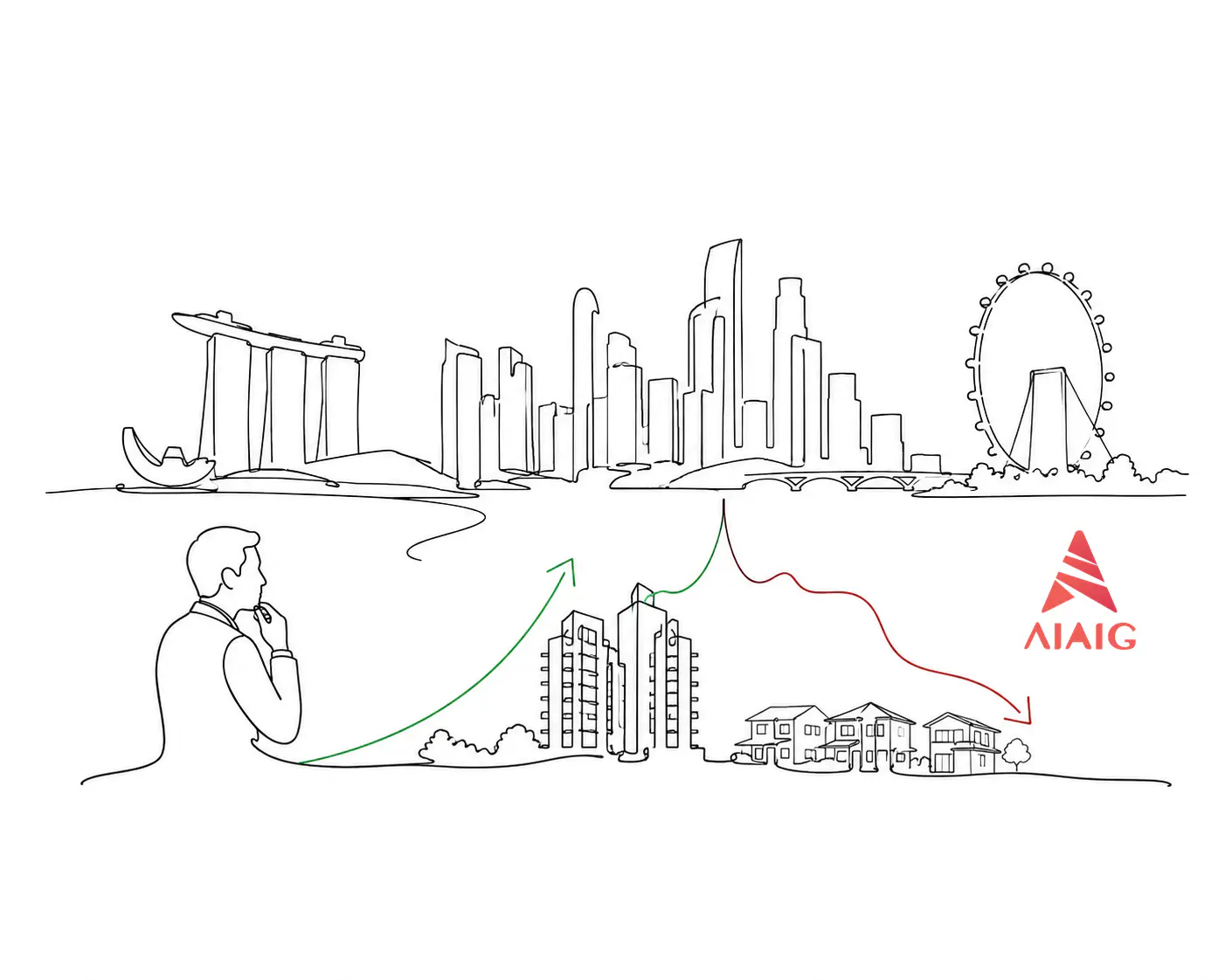
Market Signal Divergence: Singapore’s Property Market Enters a New Phase
Singapore’s Urban Redevelopment Authority (URA) released its Q1 2026 real estate data, painting a complex and diverging market picture. Private home prices rose 0.9% quarter-on-quarter, significantly surpassing the initial flash estimate of 0.1-0.2%, demonstrating remarkable demand resilience. However, in the same quarter, non-landed residential rents declined 1.2% QoQ, ending three consecutive quarters of growth.
Meanwhile, HDB resale prices dipped 0.1% in Q1, signaling a modest market adjustment. Office rents slipped 0.2% overall while prime Grade A indicators strengthened. Industrial rents extended their growth streak to 22 consecutive quarters, though at a slower pace of 0.4%.
This “prices up, rents down” divergence is unique among major global property markets. For overseas Chinese investors with or considering Singapore property exposure, understanding the drivers behind this signal is critical for asset allocation decisions.
According to CBRE analysis, the non-landed segment (condos and apartments) was the primary growth engine in Q1, with both Core Central Region (CCR) and Rest of Central Region (RCR) recording significant appreciation. This was driven mainly by a flurry of new project launches and sustained foreign capital inflows. Bloomberg reported that private home price gains exceeded initial estimates, fueled by a wave of new project sales.
- Will the 0.9% QoQ price increase trigger further cooling measures from the Singapore government?
- Unlikely in the near term, but monitoring is advised. Since 2023, Singapore has implemented multiple rounds of cooling measures. The Q1 0.9% increase, while above expectations, remains moderate. With HDB resale prices declining (-0.1%) and rents falling, the government is more likely to observe policy transmission effects before acting. However, if private home prices accelerate above 2% QoQ in H2 2026, further tightening (e.g., higher ABSD for second homes or tighter LTV ratios) cannot be ruled out.
- Why are condo rents falling, and how long will this trend last?
- Three main factors: First, a large wave of newly completed condos (2023-2025) has increased rental supply. Second, foreign worker quota growth has slowed, especially with EP minimum salary thresholds raised. Third, some tenants are switching to the lower-cost HDB rental market. The adjustment is expected to last 2-3 quarters. Historically, Singapore condo rental correction cycles last 4-6 quarters before stabilization.
- Can overseas Chinese investors still invest in Singapore property under the 60% ABSD?
- The 60% ABSD has significantly increased costs but not closed the investment window entirely. Three viable paths exist: (1) holding via family offices or Singapore-registered companies (note: company purchases face 35% additional stamp duty); (2) obtaining Singapore PR status (PRs pay only 5% ABSD for first homes); (3) investing in commercial and industrial properties, which are ABSD-exempt and open to foreigners. Alternatively, investors can gain Singapore exposure through REITs, which offer average dividend yields of 5-6%.
- What does the 0.1% HDB resale price dip mean for PR homebuyers?
- The modest decline, while small in magnitude, carries significant signal value — it is the first quarterly decline since 2023. For Singapore PRs, this may signal an approaching entry window. PR families purchasing resale HDB flats are eligible for housing grants of S$30,000-80,000. Should HDB prices correct further by 2-3% over the next 2-3 quarters, it would represent a favorable entry point. Note: PRs buying resale HDB flats must divest any private property within 6 months and fulfill a 5-year Minimum Occupation Period (MOP).
- How does Singapore property investment compare with other Asia-Pacific markets?
- At approximately S$20,000/sqm, Singapore private homes are more expensive than Tokyo (~S$13,000/sqm) and Kuala Lumpur (~S$3,000/sqm), but below Hong Kong (~S$26,000/sqm). Rental yields of 2.5-3.5% trail Southeast Asian peers (Bangkok 4-5%, KL 4-6%, HCMC 5-7%). However, Singapore offers unmatched asset protection, legal stability, and long-term capital appreciation. For capital preservation, Singapore remains top-tier. For yield-focused strategies, consider partial allocation to Malaysia or Thailand, leveraging favorable currency conditions.
AIAIG Insights
The Q1 2026 data from Singapore’s URA sends several key signals to overseas Chinese investors:
First, Singapore’s private home market is in a “price-lagging-rent” correction phase. Historically, rents are a leading indicator for home prices — a decline in rents often foreshadows a slowdown or reversal in price growth. However, strong new project sales and foreign capital inflows are temporarily delaying this transmission, creating a price-rent divergence.
Second, the 60% ABSD has not fully extinguished foreign investor appetite. Singapore’s status as a safe haven in Asia remains solid, with Chinese enterprises and high-net-worth individuals continuing to increase exposure to Singapore core assets.
Third, for yield-seeking investors, now may not be the optimal entry point. The downward trend in condo rents means rental yields on newly acquired properties may compress further. For cash-flow-focused strategies, prime Grade A offices and industrial properties show stronger resilience.
Fourth, the modest HDB resale price dip may signal a market top. For Singapore PRs eligible for HDB flats, a potential entry window may open if prices decline further.
Overall, Singapore’s property market is transitioning from a “general upswing” to a “structural divergence” phase. Overseas Chinese investors should focus more on asset class selection rather than betting on broad market growth. Core-area premium condos retain long-term holding value over a 3-5 year horizon, but short-term capital appreciation may narrow.
Last updated May 31, 2026