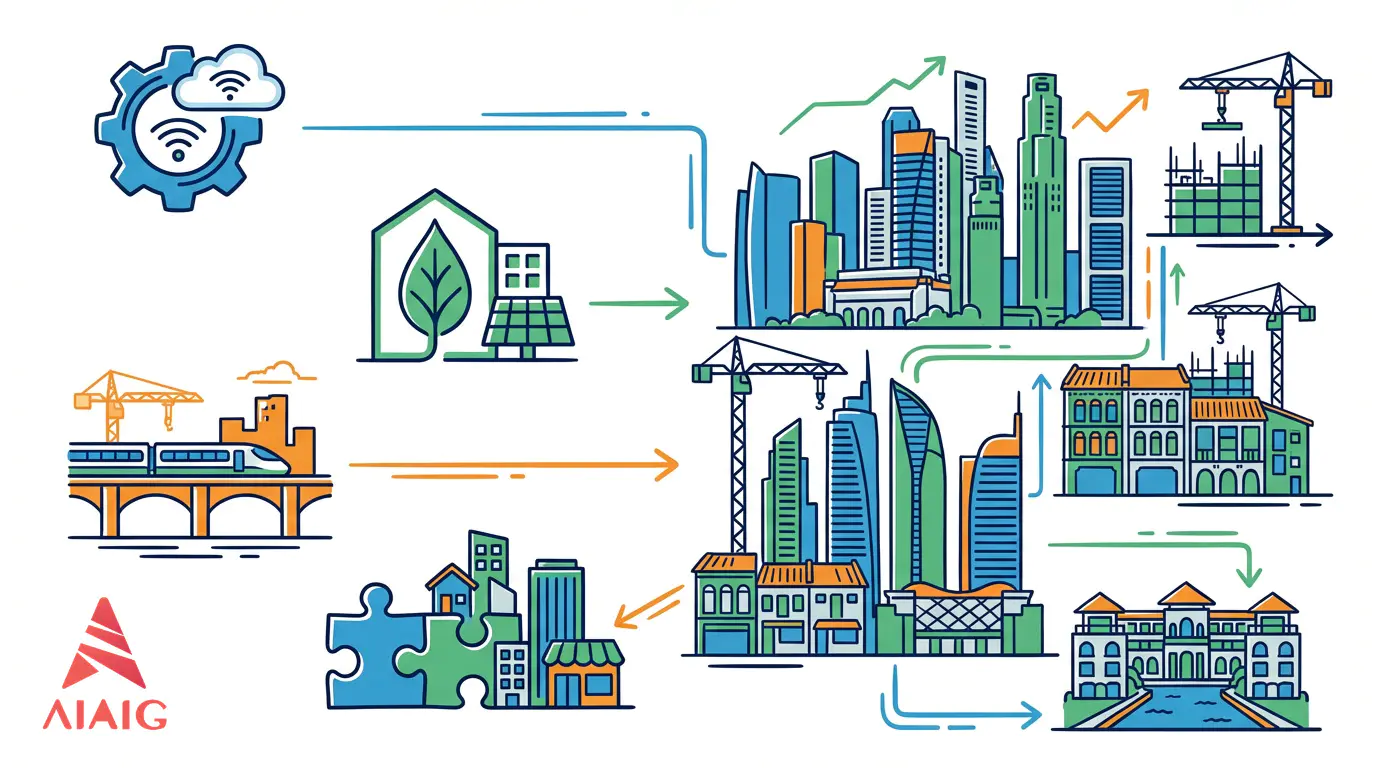
4 Major Structural Trends in Southeast Asia's Real Estate Market for the Coming Years (2026 Update)
Start with the Conclusion: Don't Use "Will It Rise or Fall" to Understand Trends, Use "Who Benefits, Who Gets Eliminated"
In the coming years, the Southeast Asian real estate market is more likely to exhibit "structural differentiation" rather than uniform rises or falls. You can use four trends as filters:
- Remote/Hybrid Work: Changes the radius for family home selection and stratifies the office market.
- Transportation Infrastructure Upgrades: Shifts land prices from a "single-center gradient" to a "multi-center network."
- AI and Data Center Economy: Creates new demand for industrial real estate while introducing constraints on electricity, cooling, land, and compliance.
- Climate Resilience and Energy Cost Reassessment: Determines "which neighborhoods hold value better" within the same city and impacts insurance, maintenance, and financing.
Writing Tone Suggestion: Frame "trends" as verifiable indicators and checklists, not emotional predictions.
Trend 1: Remote/Hybrid Work – "Larger Living Radius, More Differentiated Offices"
Mechanism (You can directly reuse this for AIAIG科普 paragraphs)
- Remote/hybrid work does not mean "offices disappear"; a more common outcome is:
- Residential: Families are willing to accept longer commutes for larger spaces and better schools/environments, with demand spilling over from CBDs to sub-centers and transit hubs.
- Office: Companies reduce space or optimize layouts but are more willing to pay for "better buildings and locations," leading to Fight-to-Quality (migration to high quality).
Impact on Different Asset Classes (Tool Table)
| Asset Class | Points More Likely to Benefit | Points More Likely to Face Pressure |
|---|---|---|
| Residential | Sub-centers accessible by rail transit, mature new towns with amenities, family-friendly communities | Areas with weak amenities and homogeneous tenant profiles, purely for commuting |
| Office | Core areas/high-quality buildings (energy efficiency, amenities, transportation) | Old buildings, lack of renovation potential, poor location and circulation |
| Serviced Apartments/Hotels | Recovery of business travel + short stays, demand for short-term urban stays | Sole reliance on single sources like conventions, weak operational capabilities |
3 Indicators You Should Track
- Corporate site selection and relocation: Whether tenants are "moving from second-tier to first-tier buildings"
- Changes in "area preference" for residential sales/rentals (buying larger within the same budget)
- Whether commercial and educational amenities in sub-centers are being implemented simultaneously (otherwise, spillover is unsustainable)
Trend 2: Transportation Infrastructure Upgrades – Turning "Location Premium" from Point-Based to Network-Based
Mechanism
Many Southeast Asian cities are experiencing an overlapping period of rail transit, intercity rail, highway, and airport expansions. The core impact on real estate is:
- Decreased Commuting Costs → Reshuffling of living and employment spaces
- Multi-Centralization → New office/industrial/residential nodes emerging outside CBDs
- Redrawing of Land Price Gradients → "Station Premium" partially replaces "Administrative District Premium"
Typical Implementation Scenarios (Recommended for writing in this style)
- Urban rail networks evolve from "single lines" to "networks," leading to revaluation of previously overlooked areas due to improved transfer efficiency.
- After intercity transportation improvements, some satellite cities upgrade from "bedroom communities" to "self-sufficient nodes" (with simultaneous employment, commercial, and educational functions).
Checklist for Selection and Avoidance (Very suitable for AIAIG tool pages)
- ✅ Station value should consider "walkability + transfer efficiency + surrounding job-housing balance," not just "distance X km from the station."
- ✅ Focus on the grading of "already operational/under construction/financed," avoiding narratives based solely on planning maps.
- ⚠️ Pure concept stations: If lacking surrounding industry, schools, healthcare, and commerce, they may only see short-term speculation after opening.
Trend 3: AI and Data Center Economy – "New Engine for Industrial Real Estate" and "New Boundaries for Power Constraints"
Mechanism
AI computing power, cloud services, and digitalization will drive the expansion of data centers, server supply chains, industrial parks, and supporting logistics. However, its impact on real estate is a "double-edged sword":
- Demand Side: Brings new demand for industrial land, industrial parks, warehousing logistics, and some office spaces (R&D/sales/operations).
- Constraint Side: Imposes hard requirements on power capacity, electricity prices, supply stability, cooling water resources, carbon emissions, and compliance.
"Investable Nodes" at the Real Estate Level
- Industrial Parks/Industrial Land: Near backbone power grids, substations, and reliable power supply areas; clear compliance and land use.
- Logistics Warehousing: Supports data centers and high-value equipment supply chains, requiring road accessibility, port efficiency, and security standards.
- Talent Housing: Residential demand for engineers and operations personnel formed around new industrial clusters (but scale and stability need verification).
Risk Warnings (Must be clearly written to enhance article credibility)
- Data centers are not "buildable anywhere": Power and permits are often decisive constraints.
- Asset attributes lean toward "operations and compliance-driven," making indirect participation through REITs/funds or industrial parks typically more suitable for individual investors.
Trend 4: Climate Resilience and Energy Cost Reassessment – The 'Value Preservation Gap' Between Different Areas in the Same City Will Widen
Mechanism
In Southeast Asia, extreme weather, flooding, sea-level risks, heatwaves, and energy costs will gradually be reflected in:
- Insurance and maintenance costs (premiums, deductibles, insurability)
- Building standards and renovation costs (drainage, flood control, materials, energy efficiency)
- Financing and valuation (stricter due diligence and risk discounts)
Differential Impact on Residential and Office Properties
- Residential: Terrain/drainage systems/community maintenance capabilities (property management) will become more important.
- Office: Energy efficiency, cooling systems, building management (BMS), and certifications will more significantly determine tenant preferences.
Resilience Checklist You Can Directly Include in Project Pages
- Is it located in a historically flood-prone area? (City public maps/news records)
- Are drainage and sponge city facilities adequate?
- Can building energy efficiency and air conditioning systems be upgraded?
- Can property management sustain maintenance investments? (Are management fees/funds transparent?)
Turning the 4 Major Trends into an 'Actionable Asset Allocation Framework' (AIAIG Tool Version)
You can present it to readers using a '2-layer assets + 1-layer risk hedging' approach:
1) Core Holdings: More Certain 'Urban Core Assets'
- High-quality office spaces in core areas/core rental residential properties/mature commercial district supporting assets
- Logic: Higher liquidity, more financing-friendly, stronger resilience to volatility
2) Additional Holdings: Structural Themes (Aligned with Trends)
- Sub-center residential properties driven by rail transit network development
- Industrial parks and logistics (benefiting from supply chains and the digital economy)
- Operational assets (e.g., hotels/long-term rentals) require emphasis on operational capabilities and compliance
3) Risk Hedging: Treat 'Interest Rates/Exchange Rates/Insurance and Maintenance' as Hard Constraints
- Debt maturity gradient and refinancing risks
- Cash flow currency and liability currency matching
- Insurance availability, premiums, and maintenance fund transparency
It is recommended to break this section into a separate tool page: e.g., 'Southeast Asia Property Selection Quadrants: Remote Work × Rail Transit Upgrades × AI Industry × Climate Resilience'.
- Will remote work lead to a long-term weakening of the Southeast Asian office market?
- A more common outcome is 'differentiation' rather than 'disappearance.' High-quality, well-located, and well-equipped core office spaces are more likely to benefit (as tenants upgrade and relocate), while older office buildings are more likely to face pressure and require renovation or repurposing.
- What is the 'necessary condition' for transportation infrastructure upgrades to most easily bring real estate opportunities?
- It's not 'having a plan,' but 'being deliverable.' It is recommended to check at least three things: whether it is already operational/under construction/financed; whether there are industrial and commercial facilities around the stations; and whether commuting and transfer efficiency has truly improved.
- What does the AI and data center boom mean for ordinary residential investors?
- It primarily involves 'changes in population and rental structures driven by industrial clusters,' as well as indirect impacts on surrounding facilities, talent housing, and logistics nodes. Direct investment in data centers themselves typically has high barriers and complex compliance, leaning more towards institutionalization.
- Why does climate resilience affect 'value preservation'?
- Because it continuously changes holding costs and discount rates through insurance, maintenance, energy consumption, and financing due diligence. Differences in 'livability and insurability' across different neighborhoods in the same city will gradually be reflected in rent, vacancy, and transaction liquidity.
- How can this trend article be made into a 'more real-time' version?
- Create an annual central page + update log: the first screen should have a fixed 'last update time + summary of changes this month (3–5 items)'; the main text should maintain the four major trend frameworks, updating only data points, major project completion milestones, industry investment news, and policy changes each time.
Last updated Mar 3, 2026