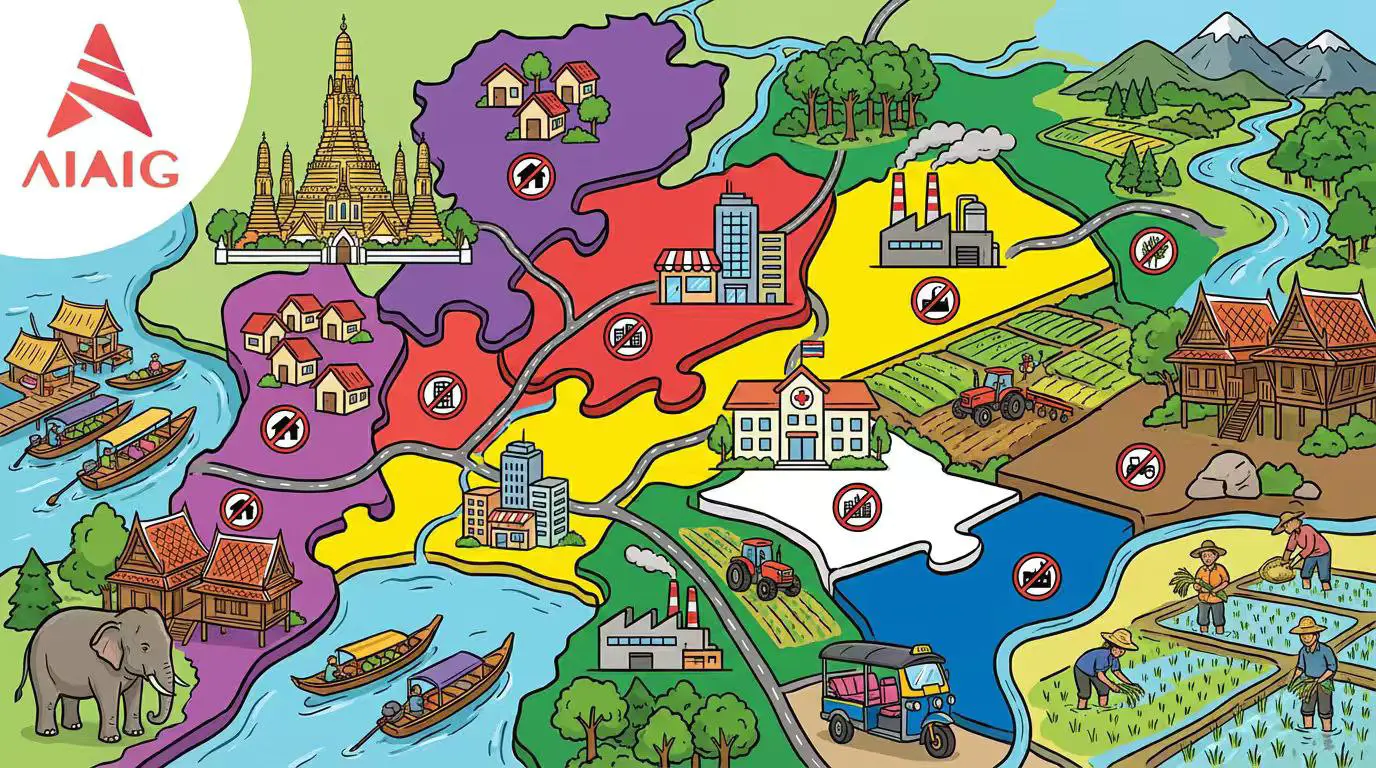
Thailand Land Purchase Pitfall Avoidance Guide: Understanding Land Color Planning (Purple/Red/Yellow/Green/White/Brown/Blue)
Conclusion First: The Biggest Pitfall in Thai Land Investment Isn't Price, but Usage
Many first-time land buyers in Thailand overlook one thing: Land usage is determined by urban planning colors.
In the Town Planning maps of various provinces in Thailand, different colors represent different usage restrictions, for example:
- Purple: Industrial
- Red: Commercial/High-density urban use
- Yellow: Low-density residential
- Green: Agricultural
- White: Reserved or planning land
- Brown: Historical and cultural preservation
- Blue: Government institutions
If the usage doesn't match the planning, for example:
- Building a resort hotel on agricultural land
- Constructing residential buildings on industrial land
- Developing villas on reserved land
Even if the land has been purchased, it may not be possible to obtain a building permit.
Therefore, before buying land in Thailand, the first step isn't to look at the price, but to check the planning color.
1. Purple Land: Industrial Zone
Usage
Purple typically represents industrial use, which is an area designated by the government for industrial development.
Common Construction Types
- Factories
- Warehousing and logistics centers
- Industrial park facilities
- Wastewater treatment facilities
Investment Value
Purple land is more common in industrial belts and special economic zones, such as:
- Rayong Province
- Chonburi Province
- Eastern Economic Corridor (EEC)
These areas attract a large number of manufacturing and supply chain enterprises.
Pitfall Avoidance Reminders
- Construction of ordinary residential buildings is not allowed
- Employee dormitories usually require approval and have area restrictions
- Environmental Impact Assessment (EIA) requirements are relatively strict
2. Red Land: Commercial and High-Density Urban Land
Usage
Red land is typically located in urban core areas, used for commercial and high-density development.
Common Buildings
- Shopping malls
- Hotels
- Office buildings
- High-rise condominiums
Common Areas
For example:
- Bangkok CBD areas (Sukhumvit, Silom)
- Pattaya beachfront areas
- Core tourist areas in Phuket
Investment Characteristics
- Land prices are usually the highest
- Development density is higher
- Suitable for commercial and high-end condominium projects
Pitfall Avoidance Reminders
If red land is purchased for low-density residential development, the land cost may be difficult to recoup.
3. Yellow Land: Low-Density Residential Areas
Usage
Yellow land is primarily used for residential community construction.
Common Buildings
- Villa communities
- Townhouses
- Small apartments
Construction Restrictions
There are usually height and density restrictions, for example:
- Building height limits
- Maximum building coverage ratio
Investment Characteristics
This type of land is common in Bangkok suburbs and residential areas of resort cities.
Pitfall Avoidance Reminders
Yellow land generally does not allow the construction of large commercial facilities or industrial projects.
IV. Green Land: Agricultural Land
Use
Green represents agricultural use.
Common Uses
- Farms
- Orchards
- Aquaculture
Buildable Structures
- Farmhouses
- Agricultural warehouses
Investment Risk
Agricultural land is usually low-priced, but its uses are very restricted.
Pitfall Reminder
Changing the use requires planning change approval, which typically has a long cycle and may not be approved.
V. White Land: Planning Reserve Area
Use
White areas are usually reserved for future urban planning.
Characteristics
- Many development restrictions
- Requires government approval
Investment Risk
This type of land has significant uncertainty.
Pitfall Reminder
If the planning remains unclear for a long time, investors may be unable to develop it for an extended period.
VI. Brown Land: Cultural and Historical Preservation Area
Use
Used to protect historical sites, temples, and cultural areas.
Common Areas
For example:
- Areas around Ayutthaya Historical Park
- Some temple preservation zones in Bangkok
Building Restrictions
- Building height restrictions
- Strict control over uses
Pitfall Reminder
Development of surrounding land may also be restricted by cultural preservation policies.
VII. Blue Land: Government Agency Land
Use
Blue areas are typically used for government agencies, such as:
- Military camps
- Government office agencies
- Public schools
Characteristics
This type of land is usually not available on the market.
Pitfall Reminder
Private investors are basically unable to acquire such land.
- Can foreigners directly purchase land in Thailand?
- Generally, foreign individuals cannot directly own land in Thailand; they typically need to obtain usage rights through corporate structures, long-term leases, or investment projects.
- How can I confirm land color planning?
- You can check the planning maps from the local urban planning bureau or inquire with the land department for official zoning maps.
- Can agricultural land be converted to commercial or residential use?
- In theory, it is possible to apply for a change of use, but the approval process is complex and not guaranteed.
- Why is it necessary to check the planning color before buying land in Thailand?
- Because building permits must comply with urban planning uses; otherwise, even if you own the land, development may not be possible.
Last updated Mar 8, 2026