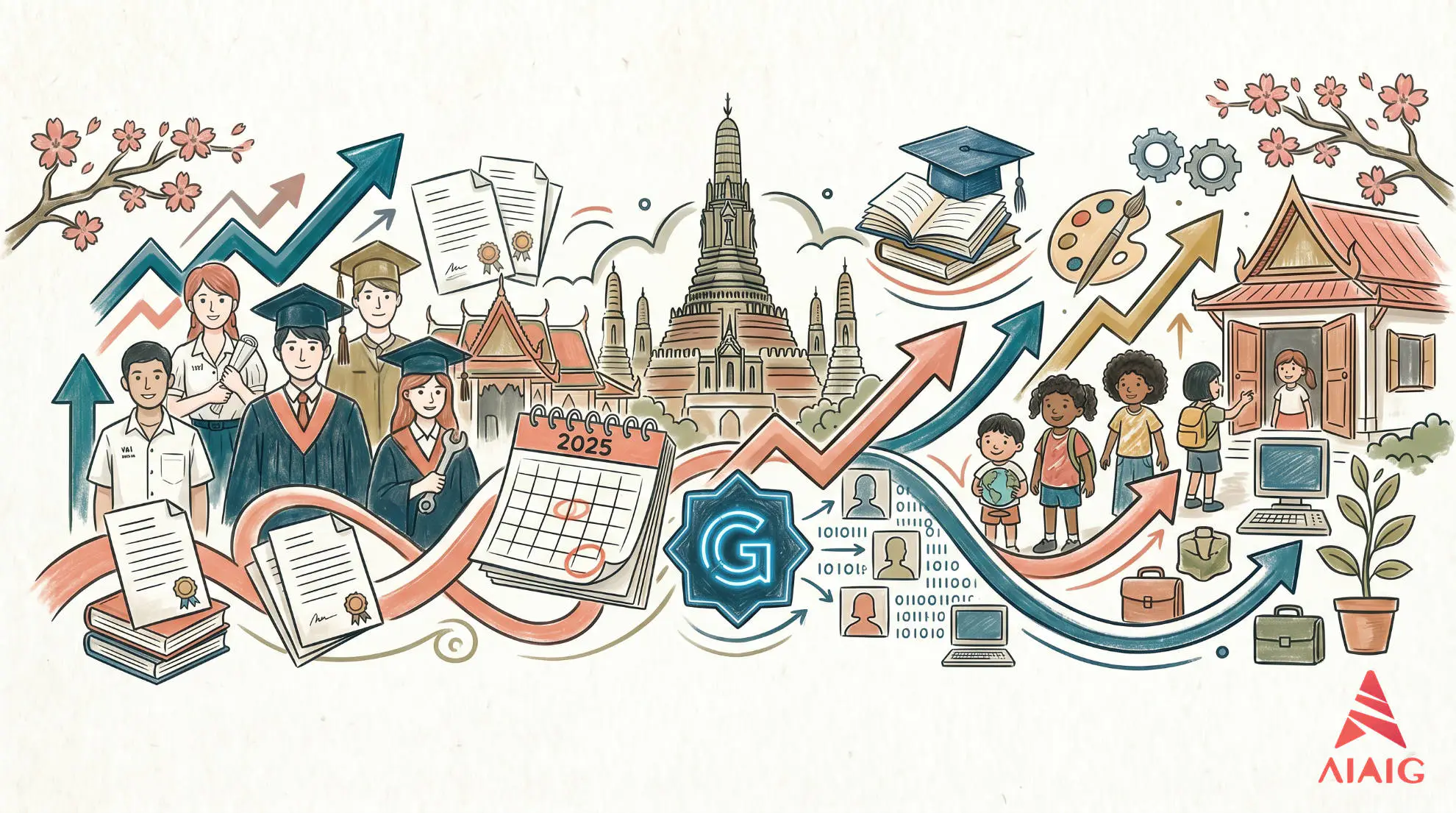
Thailand's Ministry of Education formally reaffirmed in February 2026 that, starting from the 2025 academic year, all schools must accept foreign students regardless of nationality or legal status. This groundbreaking 'Education for All' policy is based on the Convention on the Rights of the Child (CRC) and a landmark 2005 Cabinet resolution, aiming to transform border regions from sites of exclusion into spaces of shared responsibility.
Under the new policy, schools will use a 'G Code' (13-digit specialized identification) to register students lacking official Thai documentation, including stateless, migrant, and refugee children, officially integrating them into the education system and enabling them to receive per-head government subsidies. This initiative addresses the long-standing education gap for marginalized children, particularly amid regional instability from Myanmar border unrest and Thai-Cambodian border tensions that have displaced thousands of families.
G Code System: Core Technical Support for Inclusive Education
What is G Code?
- 13-digit specialized identification for students without Thai official documentation
- Allows migrant and stateless children to be officially counted, enabling schools to receive per-head government subsidies
- Unlike traditional 'temporary student' status, G Code provides formal educational identity
Implementation Scope
- Covers all schools under Ministry of Education, including public and private
- Key beneficiary groups: Myanmar refugee children, Cambodian border area students, stateless persons
- Fully launched in 2025 academic year, expected to benefit tens of thousands of marginalized children
Catholic Church and Civil Society Supplementary Role
Thailand's Catholic Church plays a key supplementary role in education support in border areas. For example:
Bamboo School in Kanchanaburi Province (operated by De La Salle Brothers)
- Serves approximately 500 students, many crossing daily from Myanmar
- Provides language integration: intensive Thai and English programs
- Vocational pathing: skills training aimed at long-term self-sufficiency
- Trauma-informed care: mental health support for children affected by conflict and displacement
Cooperation Network
- Collaborates with international organizations such as UNICEF and International Organization for Migration
- Partners with Catholic groups including Caritas Thailand and COERR
- Transforms 'Education for All' policy from legal framework into practical support
Student Visa and Scholarship Policies
Student Visa (Non-Immigrant ED Visa)
- All foreign students need to apply for ED visa
- Valid for 3 months, extendable to 1 year
- Required documents: valid passport (6+ months), application form, photos, school acceptance letter
- Some students need to apply at embassies in neighboring countries (e.g., Laos, Malaysia)
Thailand Scholarships Programme
- Open to international students of all nationalities
- Covers undergraduate, graduate, and training programs
- May include: tuition waiver, monthly allowance, health insurance
Sources
Sources
- How can Chinese students apply to Thai schools? Does G Code system apply?
- Chinese students apply through regular channels: 1) Choose school and submit application; 2) Obtain acceptance letter; 3) Apply for ED student visa. Chinese students typically have complete documentation and don't need G Code system. G Code mainly targets marginalized children without nationality, refugees, and incomplete documentation. Advantage for Chinese students: high visa approval rate, processing time about 2-4 weeks.
- How is education quality in Thailand? How does it compare with Malaysia?
- Thai education quality varies by institution: Top public universities (Chulalongkorn, Mahidol) rank top 50 in Asia with excellent quality. But Thailand's overall education internationalization lags behind Malaysia. Advantages: 1) Rich cultural experience; 2) Extremely low living costs (USD 600-900/month); 3) Central geographic location. Disadvantages: 1) Lower English proficiency; 2) Slightly lower international recognition than Malaysia; 3) Less policy stability. Suitable for students with very low budget seeking cultural experience.
- Can Thai student visa be converted to work visa or immigration?
- Converting Thai student visa to work visa is relatively difficult: 1) Must find employer sponsor after graduation; 2) Apply for Non-B work visa; 3) Meet minimum salary requirements. Immigration pathways are limited, typically requiring: 1) Continuous work for 3+ years; 2) Investment of at least THB 2 million (~USD 40,000); 3) Or marriage to Thai citizen. Compared to Malaysia, Thai immigration policies are stricter, more suitable for short-term study than long-term immigration.
Last updated Apr 21, 2026