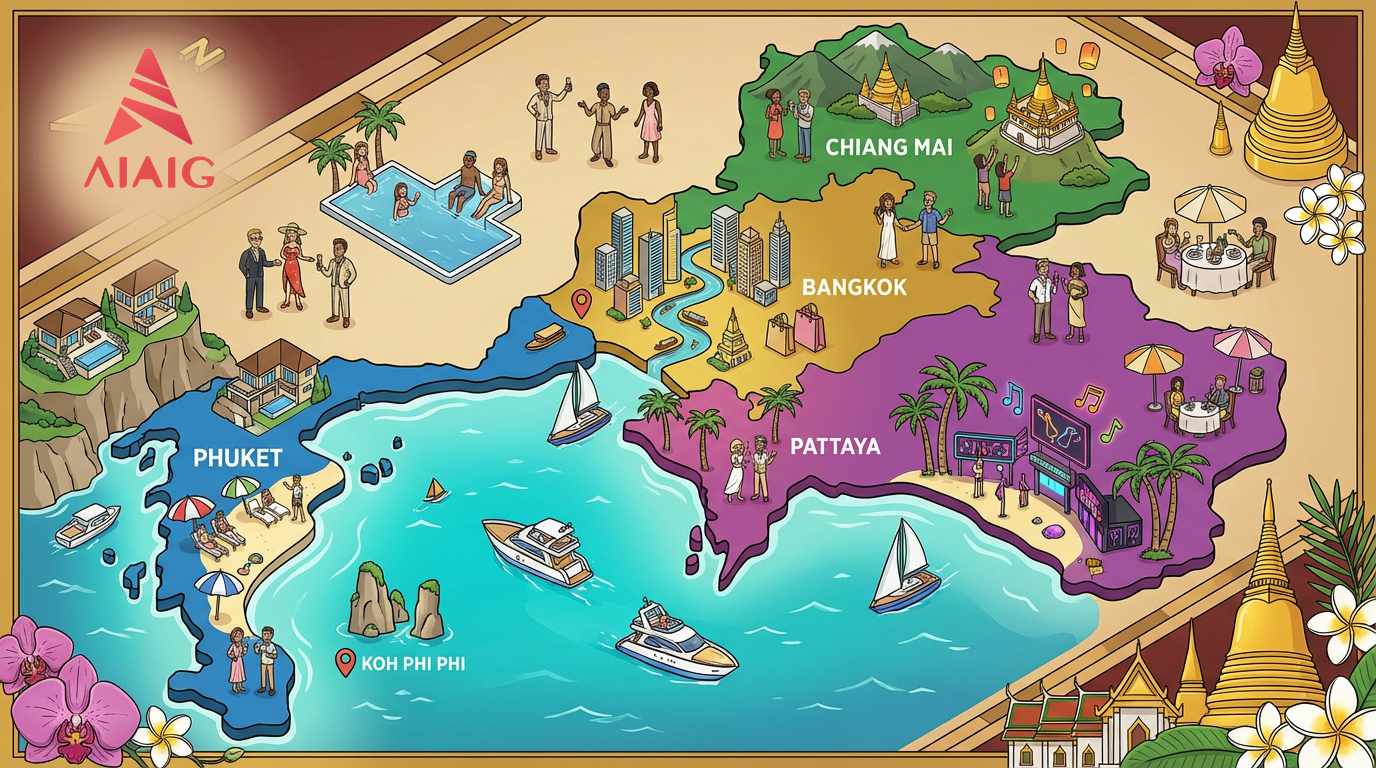
- In Thailand, which cities have a higher concentration of wealthy and high-net-worth individuals? Why does this research focus on Bangkok and Pattaya?
- From a national wealth distribution perspective:
- The capital Bangkok is Thailand's absolute political, economic, and financial center, concentrating the most high-net-worth individuals, multinational corporate headquarters, and high-quality education and healthcare resources, with the highest density of luxury homes, apartments, and Grade A office buildings nationwide.
- Chonburi Province (where Pattaya is located) is a key part of Thailand's Eastern Economic Corridor (EEC), combining a long-standing coastal resort tradition with industrial parks, high-end manufacturing, and port economies, attracting a large number of foreign investors and middle-to-high-income local families to purchase property or vacation long-term.
- Additionally, cities like Phuket and Chiang Mai also have a significant proportion of affluent classes and foreign buyers, but in terms of national influence, population, and transaction scale, they still lag behind Bangkok and Pattaya.
Therefore, this research chooses to:
- Use a "national perspective as background" to explain the positions of Bangkok and Pattaya in Thailand's wealth map;
- Then focus on in-depth exploration of Bangkok and Pattaya within these two cities:
- Affluent areas (where high-net-worth local/foreign families congregate)
- Commercial areas (CBD, shopping, offices, nightlife)
- Working-class areas (where middle-to-low-income, local wage-earners gather)
The goal is not simply to give "where to buy the most expensive properties," but to help investors and tourists understand the relationship between: city structure + regional character + investment/tourism scenarios. - Who is this research primarily aimed at? What core pain points does it aim to address?
- The target audience mainly includes two groups:
1. Overseas real estate investors (especially buyers from China and other Asian countries):
- Want to know which cities/areas in Thailand "are more like certain districts in Shanghai/Shenzhen/Tokyo."
- Need to understand: within the same city, how are affluent areas, commercial areas, and working-class areas actually distributed, and which places are suitable for buying for self-use, long-term holding, or short-term rental.
2. Tourists and potential relocators with medium-to-high spending power:
- Plan to vacation short-term or live long-term in a migratory style in Bangkok or Pattaya.
- Care about "which area is safer, more convenient, and has a better living atmosphere," not just "how close it is to the sea."
This research aims to address the following pain points:
- Many overseas buyers are unfamiliar with Thailand's administrative divisions and living circle concepts, only knowing a few place names (e.g., Sukhumvit, Pattaya Walking Street), but not understanding:
- Which are truly "affluent areas"?
- Which are tourist short-term rental areas?
- Which are traditional communities for local wage-earners?
- The article uses a Q&A format to "translate" Thailand's city structure into more intuitive regional profiles in language understandable to both investors and tourists, making it easier for readers to make decisions.
- At the macro level, how can Bangkok be divided into affluent areas, commercial districts, and common residential areas?
- From an urban structure perspective, Bangkok can be roughly understood as having three tiers:
1. Core Affluent + High-End Residential Circle (Inner City + Along BTS/MRT Main Lines)
- Typical representatives:
- Sukhumvit mid-to-high sections: Thonglor (Soi 55), Ekkamai, Phrom Phong (around Soi 39)
- Around Lumpini Park: Wireless Road, Ploenchit Road, Chidlom area
- Riverside areas along the Chao Phraya River with high-end river-view condominiums
- Characteristics: High-density luxury condominiums, five-star hotels, fine dining restaurants, international schools, and high-end private hospitals.
2. Core Commercial Districts & CBD Areas
- Silom / Sathorn: Home to numerous banks, multinational corporate headquarters, and Grade A office buildings, often regarded as "Thailand's Wall Street."
- Asoke – Ploenchit – Chidlom: Intersection of BTS and MRT, with dense office buildings, shopping malls, and hotels.
- Rama 9 – New CBD: An emerging business district with rapid development of shopping centers and office buildings.
3. Common Residential Areas and Outer Low-to-Middle-Income Regions
- Many traditional neighborhoods and suburban areas outside BTS/MRT lines, such as:
- Some areas along Rama IV Road, near factories and docks
- Parts of traditional residential areas on the west bank of the Chao Phraya River (older neighborhoods in Thonburi)
- Primarily inhabited by local low-to-middle-income residents, factory workers, and traditional small businesses, with a localized living atmosphere and lower housing prices. - Which specific areas are typical affluent districts in Bangkok concentrated in? What are their respective characteristics?
- Bangkok's affluent districts can be understood as several "lifestyle corridors":
1. Sukhumvit Golden Corridor (Sukhumvit Core)
- Core stations: Phrom Phong, Thonglor, Ekkamai.
- Residents: Wealthy Thai families, Japanese/Korean expatriates, some Western white-collar workers, and Middle Eastern high-net-worth individuals.
- Regional features:
- Dense high-end condominiums, many projects positioned as "Japanese/international lifestyle communities."
- Surrounded by Japanese restaurants, cafes, upscale bars, premium supermarkets, and international schools.
- Fast-paced lifestyle but relatively orderly environment, with modern streetscapes.
2. Lumpini–Wireless–Chidlom High-End Axis
- Adjacent to Lumpini Park, near embassy areas and flagship shopping malls.
- Residents: Political and business elites, senior white-collar workers, long-term expatriate executives in Thailand.
- Characteristics:
- Extremely scarce land, with luxury property prices consistently among the highest in the city.
- Within walking distance, one can access large green spaces (parks), shopping centers, and high-end office buildings.
3. Chao Phraya Riverside Luxury Belt
- Location: Along both banks of the Chao Phraya River, concentrated in areas with excellent river views.
- Residents: Middle-to-high-net-worth families valuing scenery and privacy, vacation-oriented buyers.
- Characteristics:
- Primarily river-view condominiums and serviced apartments, equipped with facilities like pools, gyms, and private piers.
- Emphasizes vacation, leisure, and open views, suitable for mixed long-term living and vacation use. - Where are Bangkok's main commercial districts and CBDs located? Where are offices, shopping, and nightlife concentrated?
- Bangkok's commercial and office functions are mainly concentrated in the following major areas:
1. Silom / Sathorn – Traditional Financial CBD
- This area gathers numerous bank headquarters, financial institutions, and multinational corporate headquarters.
- During the day, it is a standard "office business district," with dense crowds at subway stations during rush hours.
- At night, the Silom area transforms into a nightlife zone, with Patpong Night Market, bars, and many restaurants. Suitable for businesspeople and nightlife tourists.
2. Asoke – Ploenchit – Chidlom Corridor – Integrated Business + High-End Commercial Axis
- Asoke is an intersection of BTS and MRT, with strong transportation hub attributes.
- Ploenchit and Chidlom areas are dense with high-end shopping malls and Grade A office buildings, such as large shopping malls and luxury brand flagship stores.
- Suitable for white-collar workers, expatriates, and shopping tourists, it is a mixed-use area for "work + shopping + living."
3. Rama 9 – Emerging CBD
- A newly developed urban sub-center in recent years, integrating shopping centers, office buildings, and condominium projects.
- For investors, it is one of the areas with higher potential for future growth.
- What are the approximate price levels for luxury, commercial, and residential areas in Bangkok in terms of housing prices?
- The following figures are only rough estimates to help investors understand the price gradient across different areas (referring to new condominiums/premium projects):
1. Core Luxury Areas (Sukhumvit core, Lumphini, Riverside luxury belt)
- Price per square meter: Common range around 250,000–450,000 THB per square meter, with top luxury projects potentially higher.
- Characteristics: Extremely scarce land, new developments mostly high-end, strong developer brands, comprehensive amenities, high rental yields, relatively low vacancy rates.
2. Mature Commercial Areas / CBD (Silom / Sathorn / Asoke / Ploenchit, etc.)
- Price per square meter: Generally around 180,000–300,000 THB per square meter, with high-end projects comparable to or slightly lower than luxury areas.
- Characteristics:
- Strong demand from business tenants, suitable for long-term rental markets.
- Many surrounding office buildings and shopping malls, convenient but relatively crowded and noisy.
3. Outer Middle-Class and Residential Areas
- Price per square meter: Some areas only around 60,000–120,000 THB per square meter, or even lower.
- Characteristics:
- Primarily local owner-occupiers and working-class residents, fewer foreign tenants.
- Incomplete public transportation coverage, reliance on private cars or motorcycles for travel.
Investors can remember Bangkok's price gradient with one sentence: "Within one BTS/MRT main line circle, prices jump one tier; another circle away from the rail line, prices jump another tier." - In terms of safety and living convenience, are there significant differences between various areas in Bangkok? Which places are more suitable for foreigners to live in?
- Overall, areas along rail transit lines + luxury/commercial districts offer the highest safety and living convenience:
1. Luxury Areas & CBD
- Safety:
- High-end condominiums generally have 24-hour access control and security systems, with surveillance in public areas.
- Well-lit streets, dense international communities, and a strong sense of security.
- Living Convenience:
- Often have shopping malls, restaurants, supermarkets, pharmacies, and cafes within walking distance.
- Multiple international and private hospitals are concentrated in these areas, offering top-tier medical resources.
2. Pure Nightlife/Bar-Dense Areas (e.g., some Silom alleys, Nana area)
- Relatively safe during the day, but caution is needed at night for drunken conflicts, pickpockets, and minor scams.
- Suitable for short-term tourists or single young people, not necessarily ideal for long-term family living.
3. Outskirts and Residential Areas
- Fewer security facilities, insufficient street lighting, slightly weaker sense of safety when walking at night.
- Local-oriented amenities: many traditional markets and food stalls, but large shopping malls and hospitals are far away.
Therefore, for most foreigners investing or living long-term in Thailand for the first time:
- Sukhumvit Core (Phrom Phong–Thonglor–Ekkamai)
- Asoke–Ploenchit–Chidlom Axis
- Some Riverside High-End Condominiums
are relatively "well-managed + concentrated expat communities + convenient living + good safety" options. - Which areas do foreigners typically choose for long-term residence in Bangkok? What are the preferences of different groups?
- Expatriates from different countries and lifestyles show distinct regional preferences in Bangkok:
1. Northeast Asian Expat Families (e.g., Japanese, Korean)
- Preference: Thonglor, Ekkamai, Phrom Phong area.
- Reasons:
- Dense Japanese supermarkets, yakiniku restaurants, ramen shops, making life and diet closer to home habits.
- Multiple international schools nearby, convenient for children's education.
2. Western Expatriates and Multinational Corporate White-Collar Workers
- Common choices:
- Silom / Sathorn (close to office areas)
- Asoke–Ploenchit–Chidlom (balancing work, shopping, and high-end living)
- Some riverside luxury condominiums (more emphasis on views and quality of life).
3. Middle Eastern, South Asian, and Other High-Net-Worth Individuals
- Preferences:
- Mid-to-lower Sukhumvit (near Arab Street, Indian Street, etc.), with more religious facilities and halal restaurants.
- High-end river-view condominiums and large mixed-use projects, emphasizing privacy and public amenities.
4. Foreigners with Tighter Budgets or Seeking "Deep Local Living"
- May choose more affordable middle-class areas still near rail transit, such as some neighborhoods around Ratchada or Rama IX.
Overall, as long as it's along the BTS/MRT main lines, close to CBD and commercial districts, and the condominium itself is well-managed, it will be a relatively friendly choice for expat living.
- What is the overall urban structure of Pattaya? What are the main areas it can be divided into?
- Pattaya is a typical 'linear coastal city,' which can be roughly divided based on the coastline and distance from the city center into:
1. North Pattaya (North Pattaya / Naklua / Wongamat)
- Represented by Naklua and Wongamat beaches.
- Densely populated with high-rise sea-view apartments, brand hotels, and boutique resorts, widely regarded as Pattaya's high-end vacation and residential area.
2. Central Pattaya
- Includes Beach Road, Second Road, Third Road, and the famous Walking Street area.
- It is the liveliest commercial, entertainment, and nightlife core, with strong demand for short-term tourist rentals.
3. South Pattaya and Pratumnak Hill
- Extends south from Walking Street to South Pattaya Road, including some coastal tourist areas and local residential zones.
- Pratumnak Hill is a concentration of mid-to-high-end homes, villas, and sea-view apartments, offering a quiet environment and excellent views.
4. Jomtien / Na-Jomtien Beach Strip
- Located further south from South Pattaya, with relatively better sandy beaches, more suitable for family vacations.
- Numerous new vacation apartments and sea-view projects make it a rapidly developing 'new vacation residential strip.'
5. Further South and Rural Areas (Baan Amphur, Bang Saray, etc.)
- About 15–25 km from the city center, with a tranquil environment and low population density.
- Currently dominated by villa areas and scattered vacation projects, with infrastructure still developing. - Which areas in Pattaya can be considered 'affluent districts' or high-end vacation zones? How do their atmospheres differ?
- Pattaya's 'affluent districts' can be roughly categorized into three sectors:
1. Wongamat / Naklua – Established High-End Sea-View Apartment Strip
- Characteristics:
- Densely packed with first-row sea-view apartments and star-rated hotels, featuring one of Pattaya's quietest and cleanest beaches.
- Clean community environment with comprehensive apartment amenities (pools, gyms, gardens).
- Suitable for:
- Mid-to-high net worth families, long-term retirees, and investors seeking a balance between personal use and long-term rental returns.
2. Pratumnak Hill – 'Mountain-Sea Luxury Villa Area'
- Characteristics:
- Located on hills between Central Pattaya and Jomtien, offering expansive views overlooking the bay.
- Predominantly standalone villas and high-end low-density apartments, with quiet streets and a slow-paced lifestyle.
- Suitable for:
- Families and overseas buyers who appreciate sea views and privacy, without needing to frequent Walking Street daily.
3. Na-Jomtien / High-End Vacation Complex Project Area
- Characteristics:
- Concentrated with newly developed large-scale complex projects (hotels + apartments + commercial), featuring more modern planning.
- Relatively comfortable beaches with lower crowd density compared to Central Pattaya.
- Suitable for:
- Investors seeking 'vacation atmosphere + future appreciation potential,' as well as vacation-oriented self-use buyers. - Where are the typical commercial and local residential areas in Pattaya? What is the living atmosphere like?
- 1. Commercial / Nightlife Areas
- Central Pattaya + Walking Street Surroundings:
- Daytime: Numerous shopping malls, beach activities, restaurants, and cafes, making it the most tourist-concentrated area.
- Nighttime: Walking Street transforms into a hub for bars, nightclubs, and shows, with high music volume and crowd density.
- Suitable for short-term tourists and short-term rental investments (Airbnb / serviced apartments), but may not be ideal for families seeking tranquility for long-term living.
2. Local Residential and Working-Class Areas
- Areas one to two kilometers inland from the coastline, some neighborhoods near Sukhumvit Road:
- Primarily inhabited by local working-class individuals, service industry workers, and small business owners.
- Streets feature more local markets, street stalls, simple housing, and a few old apartments and small hotels.
- Living Atmosphere:
- Very 'down-to-earth,' with affordable prices and abundant night markets and snack shops.
- However, due to outdated infrastructure and high building density, living comfort and views are far inferior to coastal areas.
- In terms of housing prices, where are the main differences in price levels between different areas of Pattaya?
- From a price gradient perspective, it can be roughly understood as:
1. North Pattaya / Wongamat / Naklua
- Second-hand sea-view condos: Overall average prices are often at the high end of the city.
- First-line sea-view, branded projects: Unit prices are significantly higher than the city average, with stable rental returns.
2. Pratumnak Hill & Na-Jomtien New Projects
- Pratumnak:
- Combines mountain and sea views, with many projects positioned as "boutique luxury" or "low-density condos," unit prices slightly lower than the top-tier North Pattaya, but still in the mid-to-high range overall.
- Na-Jomtien:
- Newly planned large-scale resort projects, launch prices are attractive, but there is room for increase as facilities improve.
3. Central Pattaya & South Pattaya Beach Areas
- Mix of old condos and new projects, with a wide price range.
- Projects near the beach and Walking Street often have higher unit prices than similar products 1–2 streets inland due to strong short-term rental demand.
4. Jomtien Old Area & Further Rural/Villa Areas
- Jomtien Old Area:
- Housing prices are relatively affordable, friendly to buyers with limited budgets who still want to be near the sea.
- Rural/Villa Areas (e.g., Baan Amphur, Bang Saray):
- Sea-view villas and large plot properties may not have low unit prices, but total prices and value for money still have advantages compared to similar sea-view resources.
In summary: For the same sea view, Wongamat is the most expensive, Jomtien is the most affordable, Pratumnak/Na-Jomtien are in the middle, and rural villas are a value-for-money choice with "large plots + good scenery." - What are the differences in safety and security conditions between different areas of Pattaya? How should investors and tourists choose?
- 1. North Pattaya / Wongamat / Na-Jomtien / Pratumnak
- Safety:
- Mainly high-end condos and hotels, with strict community management and well-maintained access registration.
- Relatively limited nighttime crowds, overall good security.
- Recommendation: Suitable for families for long-term living, retirement, and investment/self-use groups with children on vacation.
2. Central Pattaya + Walking Street Area
- Safety:
- Generally fine during the day, but at night, due to concentration of bars and nightclubs, probabilities of drunken conflicts, petty theft, and small-scale scams are higher.
- Recommendation:
- Suitable for short-term tourists and short-term rental investors.
- Not recommended as the first choice for long-term living with children.
3. Inland Residential and Rural Areas
- Safety:
- Overall low violent crime, but poorer nighttime lighting and relatively weak police presence.
- Recommendation:
- If buying a villa or standalone property, focus on the security level of the community (access control, fencing, cameras, etc.).
General Principle:
- "Seaside + high-end projects" usually come with better security systems; "bar + nightclub dense areas" require more personal awareness. - What types of residents and vacationers are suitable for different areas of Pattaya?
- It can be simply matched by "demographic profiles":
1. Family Vacation / Retirement Buyers
- Recommended Areas: Wongamat, Pratumnak, Na-Jomtien.
- Reasons:
- Quiet environment, good greenery, relatively clean beaches.
- Sufficient daily living amenities nearby without being disturbed by nightlife.
2. Young People / Tourists Who Enjoy Nightlife
- Recommended Areas: Central Pattaya + Walking Street surroundings.
- Reasons:
- Bars, restaurants, shopping centers, and beach activities are right outside, walkable for most needs.
- Active short-term rental market, suitable for investors looking for short-term rentals and high-turnover projects.
3. Vacation Buyers Seeking Quiet Nature and Willing to Drive
- Recommended Areas: Bang Saray, Baan Amphur, and other rural and distant sea areas.
- Reasons:
- Fewer people, less noise, good sea views and air quality.
- Suitable as weekend vacation homes or long-term wellness residences, but daily needs require driving to the city for shopping and medical care.
- From the perspectives of location and product, which areas in Bangkok and Pattaya are more suitable for foreigners to invest in real estate?
- 1. Bangkok – Areas suitable for 'long-term holding + stable rental income'
- Sukhumvit Core (Phrom Phong–Thonglor–Ekkamai):
- Healthy tenant structure, with many Japanese/Korean white-collar workers and families, stable rental levels.
- Mature apartment management, strong secondary market liquidity, suitable for investors leaning towards long-term holding.
- Asoke–Ploenchit–Chidlom:
- Combines CBD, high-end commercial, and high-end residential, offering both self-use and investment value.
- Some riverside high-end apartments:
- Unique views, suitable for positioning as premium vacation + boutique rental products.
2. Pattaya – Areas suitable for 'vacation + income balance'
- Wongamat / Naklua:
- High-end vacation area, high rental levels but clientele is mainly mid-to-high-end, suitable for both self-use and long-term rental.
- Pratumnak / Na-Jomtien:
- High development potential, many new projects, suitable for investors optimistic about Pattaya in the medium to long term.
- Central Pattaya:
- Strong short-term rental demand, suitable for investors willing to accept fluctuations and pursue high rental frequency.
A practical tip: 'First-time investors' can prioritize: Bangkok's Sukhumvit Core + Pattaya's Wongamat or Pratumnak, which are maturely managed and have stable clientele sectors. - What are the legal hard restrictions for foreigners purchasing property in Thailand? What should be understood in advance?
- Foreigners investing in real estate in Thailand should at least remember three hard rules:
1. Land ownership restrictions
- Foreigners cannot directly own land in their personal names in principle, only:
- Control land use rights through long-term lease (commonly 30 years, with renewal options);
- Hold land through a qualified Thai company structure (higher legal and compliance costs, requiring professional lawyers).
2. Condominium '49% foreign quota' restriction
- In legally registered condominium projects, the total area owned by foreigners cannot exceed 49% of the building's total area.
- Practical advice:
- Before purchasing, always confirm if the project's foreign quota still has available balance.
- Units exceeding the quota cannot be transferred in a foreigner's name, requiring complex structures or abandonment.
3. Fund source and remittance requirements
- When purchasing a condominium, funds typically need to be remitted into Thailand in foreign currency and converted to Thai baht.
- Banks will issue foreign exchange transaction forms (e.g., Foreign Exchange Transaction Form), which are important documents for property registration.
Additionally, attention should be paid to:
- Property transaction tax structure (transfer tax, stamp duty, specific business tax, etc.).
- Rental income tax and potential capital gains tax upon future sale.
Conclusion: Before signing any purchase contract, always have a professional lawyer review the contract terms and project compliance. - What are the structural opportunities and risks in investing in Thai real estate? What points require special attention?
- Opportunities and risks often coexist:
1. Structural opportunities
- Tourism-driven + stable rental demand:
- Bangkok, as a transit hub and medical tourism base, has sustained medium-to-long-term rental demand.
- Vacation cities like Pattaya have strong short-term rental demand, with high occupancy rates during peak seasons, offering potential for considerable cash flow.
- Price discounts compared to international first-tier cities:
- With similar sea views and urban amenities, Thai property prices are more cost-effective relative to those in Europe, America, and some East Asian first-tier cities.
2. Main risks
- Policy and market cycle risks:
- Tightening of mortgage policies, tax rules, or foreign property purchase policies can affect short-term transaction activity.
- Tourism cities are highly sensitive to external factors (pandemics, global economic cycles).
- Project quality and completion risks:
- Some small developer projects may lack sufficient funding, leading to delays or even abandonment.
- Exchange rate fluctuations and tax compliance:
- Currency depreciation may increase actual returns for overseas investors or cause asset price volatility.
- How to declare rental and sale income requires comprehensive consideration under Thailand's and the investor's home country's dual tax systems.
3. Practical advice
- Prioritize developers with good reputations and historical delivery records.
- Assess the actual rental demand around the project, not just rely on the 'expected return rate' in promotional materials.
- Diversify reasonably: Bangkok leans towards long-term stable income, Pattaya towards vacation + fluctuating income, and both can be combined in a portfolio.
- From a tourism perspective, how can the tourist value and suitable demographics of different areas in Bangkok be distinguished?
- They can be categorized based on "travel preferences":
1. Cultural Attractions and Old Town Experience
- Representative areas: Grand Palace, Wat Pho, old town along the Chao Phraya River.
- Suitable for:
- First-time visitors to Thailand, those interested in Buddhist culture and historical architecture.
- Suggestions:
- Consider staying near the river or in the old town for convenient off-peak visits in the morning or evening.
2. Shopping + Urban Lifestyle Experience
- Representative areas: Siam–Chidlom–Asoke–Phrom Phong area.
- Suitable for:
- Tourists who enjoy shopping malls, seeking fashion brands, and experiencing urban dining and café culture.
- Suggestions:
- Choose apartments or hotels close to BTS/MRT to save commuting time.
3. Nightlife and City Skyline Experience
- Representative areas: Silom / Sathorn rooftop bars, Asoke–Nana area.
- Suitable for:
- Young people, white-collar workers looking to relax after business trips.
- Precautions:
- When watching shows or going to bars at night, keep an eye on your documents and belongings, and avoid excessive drinking. - From the perspective of tourism experience, what are the differences between various areas in Pattaya? How should short-term tourists and long-term residents choose?
- 1. Short-term Tourists / First-time Visitors to Pattaya
- Recommended: Central Pattaya + Walking Street area.
- Reasons:
- Within walking distance to the beach, shopping malls, and nightlife spots, suitable for fast-paced 2–3 day trips.
- Precautions:
- Crowded at night, pay attention to personal and property safety.
2. Family Tourists / Those Seeking a Balance of Vacation and Tranquility
- Recommended: Jomtien, Na-Jomtien, Wongamat.
- Reasons:
- Relatively cleaner beaches, water activities more suitable for families and children.
- Surrounding amenities are gradually improving, allowing for shopping while avoiding the noise of Walking Street.
3. Long-term/Snowbird Residents
- Recommended: Wongamat, Pratumnak, parts of Jomtien.
- Reasons:
- Apartment management is relatively mature, communities have a certain proportion of expatriates, offering a stronger long-term living atmosphere.
- Better tranquility and scenery compared to Central Pattaya. - What are some general precautions for foreign tourists when traveling and viewing properties in Bangkok and Pattaya?
- Whether for tourism or property viewing, several common principles can significantly enhance safety and experience quality:
1. Transportation and Travel
- Try to use BTS/MRT and official taxis/ride-hailing services to reduce the risk of disputes with unverified drivers.
- Avoid walking alone on remote streets late at night, especially in alleys away from main roads.
2. Property Safety
- In crowded areas like walking streets, night markets, and subways, be vigilant against theft; wear small bags across the front of your body.
- Important documents (e.g., passport) can be stored in the hotel safe; carry only copies or photos when going out.
3. Shopping and Consumption
- For large purchases (e.g., jewelry, watches), try to shop at reputable stores in formal malls and keep receipts.
- When participating in high-risk activities like jet skiing, take photos to document equipment conditions to avoid "scam claims" afterward.
4. On-site Property Viewing and Negotiation
- Try to view properties through formal agents or developer channels, avoiding informal transactions via so-called "acquaintance introductions."
- When viewing properties, walk around a few streets to experience the crowd, noise, and security atmosphere during the day and night, not just the showroom.
5. Health and Insurance
- Prefer bottled water, and when first arriving in Thailand, moderately control spicy and raw food intake.
- Consider purchasing overseas travel or medical insurance to handle sudden illnesses and minor accidents.
With basic risk awareness, most tourists and investors find their experience in Thailand friendly, enjoyable, and value for money.
Last updated Dec 4, 2025