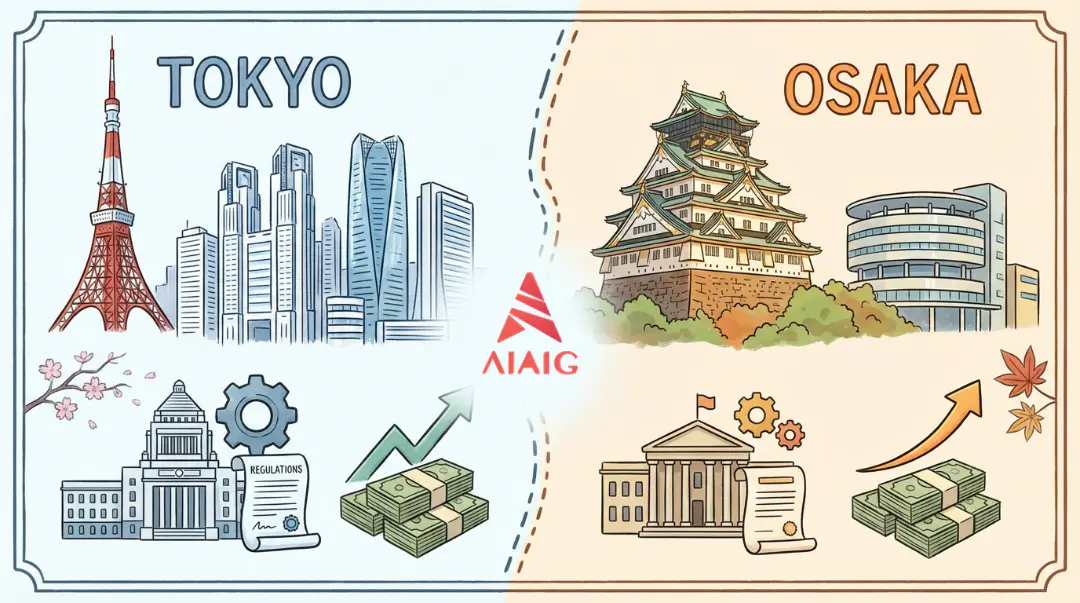
1. Core Conclusion: Tokyo is 'Residential Order-Oriented', Osaka is 'Tourism Economy-Oriented'
The difference in homestay policies between Tokyo and Osaka is not simply a matter of 'strict vs. lenient,' but rather a long-standing divergence in the urban positioning of the two cities:
Tokyo: A Megacity with High Population Density
Tokyo's core governance pressure stems from high residential density, high demands for community stability, and high sensitivity to neighborhood complaints, leading to regulations that lean more towards controlling nuisance and residential safety risks.Osaka: A City with Active Tourism and Commerce
Osaka has long viewed tourism as one of its urban growth drivers, showing greater acceptance of flexibility in accommodation supply, with policy designs emphasizing the accommodation of tourists and urban vitality.
In simple terms: Tokyo is more concerned about 'homestays affecting residents' lives,' while Osaka focuses more on 'whether homestays promote tourism economy.'
II. Differences in Policy Design: Tokyo Focuses More on Subdivided Areas and Time, Osaka Emphasizes Operational Compliance
Tokyo's Regulatory Logic: Reducing Nuisance Risks Through Detailed Restrictions
Multiple wards and prefectures in Tokyo employ more refined time and area restrictions, for example:
- Limiting weekday operations in some residential areas, allowing openings only on weekends or holidays.
- Imposing higher requirements on the distance of operation managers, complaint handling capabilities, and guest guidance.
The core of Tokyo's policy is: ==Allowing homestays to exist, but prioritizing the stability of residential communities==.
Osaka's Regulatory Logic: Allowing Development, but Increasing Non-compliance Costs
Osaka generally provides more space for homestays to exist, but regulatory focus is on:
- Implementation of registration and licensing systems
- Penalties for illegal operations and unlicensed businesses
- Accountability for neighborhood complaints and operational responsibilities
The core of Osaka's policy is: ==Allowing homestays to become part of the city's tourism supply, but they must be compliant and subject to regulation==.
III. Differences in Implementation Methods: Tokyo Emphasizes "Pre-Event Restrictions," Osaka Relies More on "Post-Event Supervision"
Tokyo's Implementation Characteristics
- Emphasis on pre-operation rules
- Management regulations and local ordinances have a significant impact
- In some areas, even with legal registration, operational revenue may be reduced due to time restrictions
Osaka's Implementation Characteristics
- Operational space is relatively clearer after compliance registration
- Enforcement focuses more on illegal operations
- Relatively stable for legal operators
Summary from an investment perspective:
Tokyo's risk lies in 'revenue caps,' while Osaka's risk lies in 'compliance thresholds and enforcement risks.'
IV. Impact of Real Estate Investment: The Pricing Logic of Short-Term Rental Assets in the Two Cities is Completely Different
Tokyo Homestay Investment Structure
- Homestay cash flow is usually just an added value
- Assets are closer to long-term residence or long-term rental logic
- Homestay operational capability relies more on "special areas" and "scarce permits"
Core of Tokyo investment:
==Property long-term preservation ability > homestay income ability==
Osaka Homestay Investment Structure
- Homestay cash flow has a greater impact on asset value
- Short-term rental income model is more mature
- Homestay operational capability directly affects asset return rate
Core of Osaka investment:
==Operational capability and compliance ability = important components of asset value==
V. Impact on Rent and Housing Prices: Tokyo Relatively Stable, Osaka Shows More Volatility
Tokyo Market Characteristics
- Homestay supply is limited, short-term rentals have less impact on the overall rental market
- Long-term rental market is more stable
- Housing prices are mainly driven by employment population and international financial demand
Osaka Market Characteristics
- Homestay supply is highly correlated with tourism cycles
- Short-term rental income fluctuates significantly during tourist seasons
- Changes in homestay policies may quickly affect housing prices in specific areas
Summary:
Tokyo housing prices are more like "driven by urban fundamentals," while Osaka housing prices are more easily affected by "tourism economic cycles + homestay policies."
- Is Tokyo vacation rental completely unsuitable for investment?
- No. Tokyo is more suitable for 'asset preservation + stable rental' type investments, with vacation rental income typically serving as an added value, not the core source of revenue.
- Does Osaka mean lower risk for vacation rental investment?
- Not necessarily. Osaka has higher potential for short-term rental income, but it requires greater operational capability and compliance, with more obvious risks of violations and income fluctuations.
- Why do Tokyo apartment management regulations have a greater impact on vacation rentals?
- Tokyo has high residential density and prioritizes community stability, so apartment management associations often impose stricter restrictions on short-term rentals, which directly affects the feasibility of vacation rentals.
- Will Tokyo and Osaka policies converge in the future?
- Differences will persist in the short term due to the distinct population structures and economic positioning of the two cities, but the overall regulatory trend will move towards greater standardization and enforceability.
Last updated Feb 10, 2026