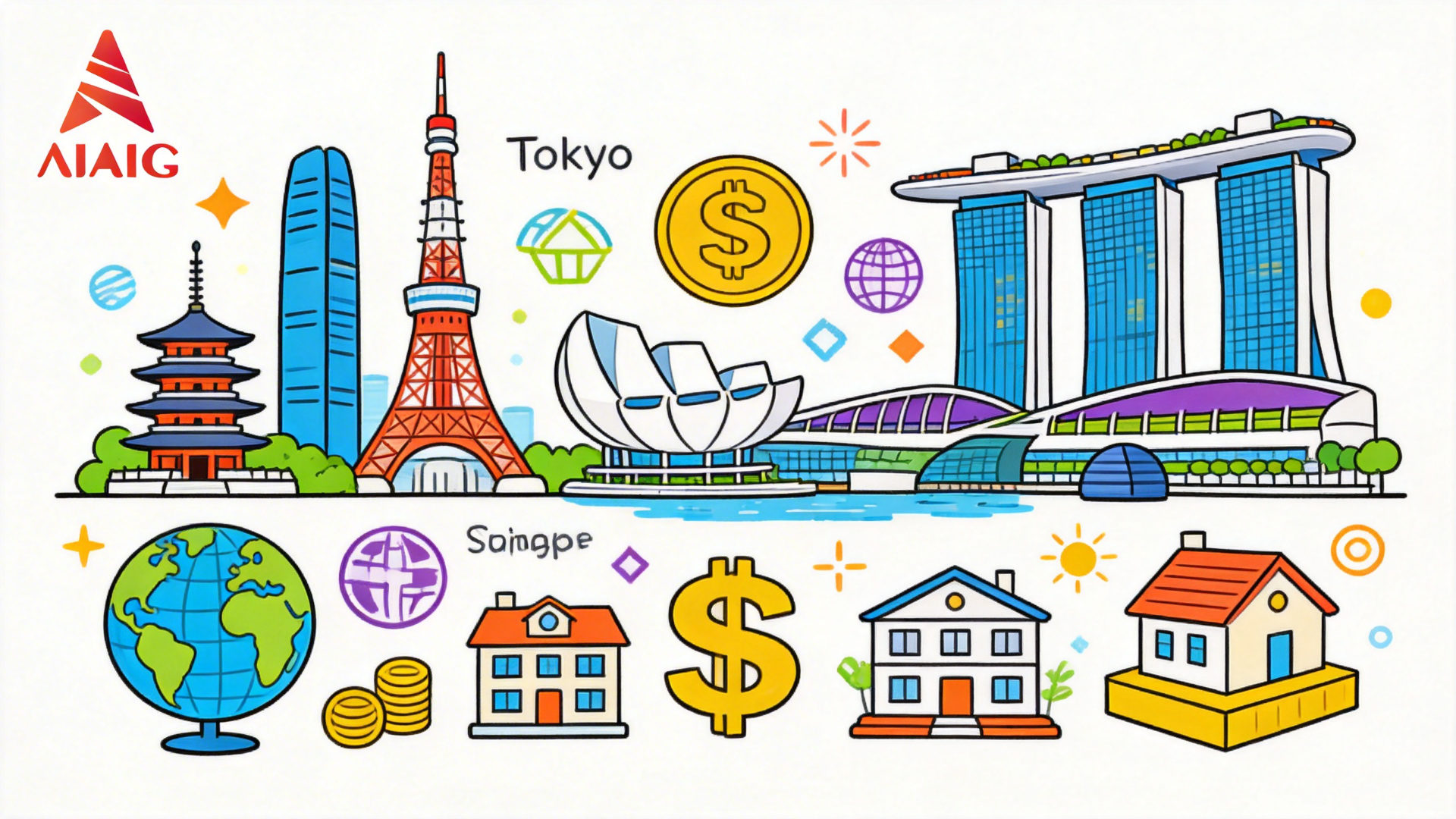
1. Institutional Conclusion: Tokyo and Singapore Consistently Rank Among Top Asian Investment Cities
According to reports from multiple international real estate agencies, Tokyo and Singapore have long been ranked among the top in global real estate investment attractiveness.
For example, the "Emerging Trends in Real Estate Asia Pacific 2026" report released by PwC and ULI shows:
Tokyo, Singapore, and Sydney are the top three cities in the Asia-Pacific real estate investment outlook for 2026, with Tokyo ranking first for many consecutive years. oai_citation:0‡asia.uli.org
At the same time, in cross-border capital investment preference surveys, Tokyo has been one of the most preferred real estate investment cities for global investors for many consecutive years, while Singapore has also consistently ranked within the top three to five. oai_citation:1‡Reuters
This means:
Tokyo and Singapore are not "short-term hot cities" but belong to core asset markets for long-term global capital allocation.
II. Why Global Capital is Turning to Core Cities in Asia
After the 2020s, the global real estate investment structure has undergone significant changes:
In the past decade, global capital was mainly concentrated in traditional cities such as London, New York, and Vancouver; but in recent years, investment institutions have begun to increase allocations to core Asian cities.
The main reasons include:
Asian economic growth rates are still higher than those in Europe and America
Population and urbanization are still ongoing
Multinational corporations and financial capital are concentrating in the Asia-Pacific region
The transparency of real estate markets in some Asian cities continues to improve
For example, JLL's Global Real Estate Transparency Index shows that Japan and Singapore are among the most transparent real estate markets in Asia. oai_citation:2‡tokyoportfolio.com
Transparency means:
- More open transaction information
- More stable legal systems
- More predictable costs for foreign capital entry
This is crucial for international capital.
III. Tokyo's Investment Logic: Stable Cash Flow and Low Financing Costs
The attractiveness of Tokyo real estate investment primarily stems from three core factors.
1) One of the Lowest Financing Costs Globally
Japan's long-term low-interest-rate environment makes real estate financing costs significantly lower than those in European and American markets.
In cross-border investment surveys, Tokyo consistently ranks as a top choice for investors, with low debt costs being a key reason. oai_citation:3‡Reuters
2) Megacity Population and Rental Demand
The Tokyo metropolitan area has a population exceeding 37 million, making it one of the largest urban agglomerations in the world.
The consequences of this population scale are:
- Long-term stable rental demand
- Smaller fluctuations in real estate cycles
3) High Transparency in the Real Estate Market
The JLL Transparency Index shows that Japan's real estate market ranks first in Asia and is among the top transparent markets globally. oai_citation:4‡tokyoportfolio.com
This means investors can more easily access:
- Rental data
- Vacancy rate data
- Transaction data
Thus, Tokyo is more akin to a "stable income-type real estate market."
IV. Singapore's Investment Logic: Financial Center and Capital Safety
Unlike Tokyo, the attractiveness of Singapore real estate investment comes more from its financial and capital safety attributes.
1) Asian Financial Hub
Singapore is one of the world's major financial centers, with numerous multinational corporations and financial institutions headquartered there.
The direct outcomes of being a financial hub are:
- Concentration of high-income populations
- Stable demand for high-end residential properties
2) Global Capital Safe-Haven Asset
Singapore's real estate market has long been regarded as a safe haven for capital.
Even with the government imposing higher taxes and fees on foreign property purchases, high-net-worth individuals continue to enter this market.
3) Market Transparency and Regulatory Stability
In the JLL Global Real Estate Transparency Index, Singapore is categorized as a "highly transparent market" and ranks among the top globally. oai_citation:5‡The Business Times
This makes it easier for institutional investors to allocate large-scale capital.
Five, Tokyo vs Singapore: Two Completely Different Investment Models
From an investment logic perspective, the real estate models of these two cities are actually completely different.
Tokyo Model:
- Stable rental cash flow
- Low financing costs
- Huge market size
- Suitable for long-term institutional investment
Singapore Model:
- Strong capital safety attributes
- Stable demand for high-end residential properties
- High concentration of foreign capital
- More akin to wealth management-type assets
Therefore, a common structure in global investment portfolios is:
Tokyo = Stable income asset
Singapore = Capital safety asset
Six, Future Trends: The Real Estate Status of Asia's Core Cities Will Continue to Strengthen
Over the next decade, the core positions of the Tokyo and Singapore real estate markets are likely to continue strengthening, due to reasons including:
Continued growth in Asian population and wealth
Gradual shift of global capital allocation towards the Asia-Pacific region
Continued concentration of financial and technology industries
Increasing transparency in the real estate market
Therefore, in the global real estate investment map, these two cities are likely to remain at the forefront of global investment cities.
- Why is the return on real estate investment in Tokyo typically lower than in Southeast Asia?
- Tokyo real estate is often viewed as a stable cash flow asset, with low interest rates and high safety leading to lower returns, but also lower risks.
- Why have real estate prices in Singapore remained high over the long term?
- The main reasons are land scarcity, population concentration in the financial center, and global capital inflow, which sustain stable housing demand over the long term.
- Is Asian real estate investment replacing that in Europe and America?
- Currently, it is more accurate to say that global capital allocation is becoming more diversified, with the weight of Asian core cities in global investment portfolios continuously increasing.
- Which is more suitable for overseas individual investors, Tokyo or Singapore?
- Tokyo is more suitable for investors seeking stable rental income and long-term asset allocation, while Singapore is more suitable for asset security and wealth allocation for high-net-worth individuals.
Last updated Mar 16, 2026