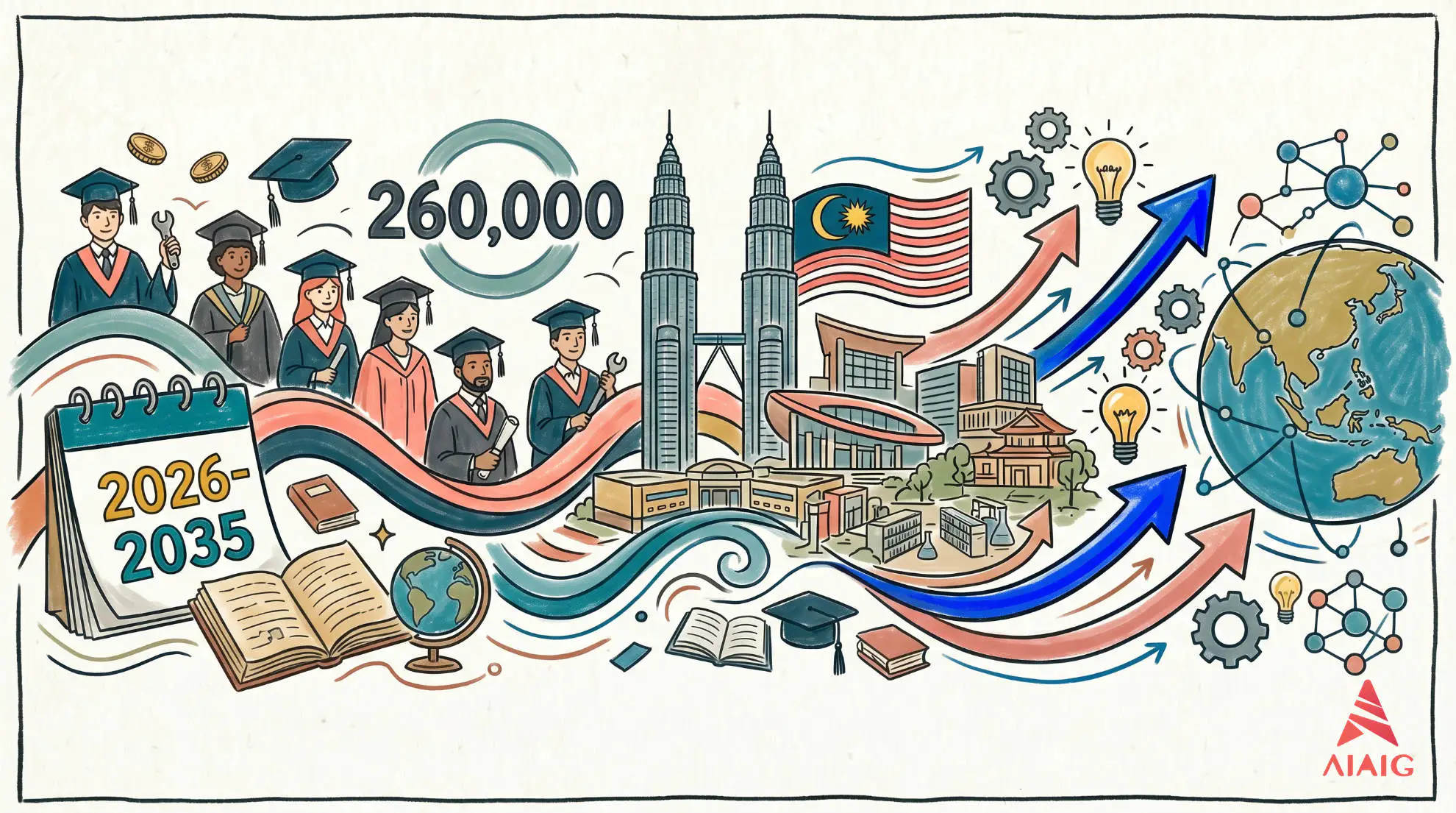
Malaysia's Ministry of Higher Education officially announced the 'Higher Education Blueprint 2026-2035' in December 2025, a milestone policy for the country's education internationalization. The blueprint clearly positions Malaysia to upgrade from a regional education center to a globally influential education hub, targeting 260,000 international students by 2030, achieving an annual growth rate of 8.5%.
According to Malaysian Ministry of Education data, 20 public universities enrolled 53,322 international students in 2024, with Universiti Malaya (UM), Universiti Kebangsaan Malaysia (UKM), and Universiti Sains Malaysia (USM) attracting 27,669 students alone. These students mainly come from China, Indonesia, and Bangladesh, with postgraduate students accounting for 73.8% (39,336), demonstrating Malaysia's strong appeal in postgraduate education.
Four Strategic Initiatives Detailed Explanation
1. Malaysia University Centralised Admissions System (MUCAS)
The blueprint will launch a centralized admissions platform to streamline application processes through Education Malaysia Global Services (EMGS). International students can enjoy one-stop services including welfare, accommodation, medical care, and cultural activities support. This significantly simplifies the application process, with processing time expected to be reduced by 30-40%.
2. Priority Talent Development Areas
- TVET Technical and Vocational Education: Under the Madani Economic Framework, Malaysia plans to establish a National TVET Chamber of Commerce to cultivate talents in advanced manufacturing, digital infrastructure, healthcare, and other fields
- Postgraduate Level Priority: Clear priority in recruiting postgraduate students, especially research-based masters and PhDs, where foreign expertise can add value to local research
- Undergraduate Reserved for Locals: The Deputy Minister emphasized "Our focus will always be on Malaysian students, undergraduate programs prioritize local students"
3. Tuition and Living Cost Advantages
Malaysian tuition fees are only 1/3 to 1/4 of UK/US countries, averaging about USD 5,000-8,000 annually. Combined with low living costs (USD 800-1,200 monthly) and a Muslim-friendly environment, it has strong appeal for Middle Eastern, South Asian, and African students.
4. Research and Innovation Collaboration
The Academia Research fund (AReF) will allocate funds to support universities in conducting market and society needs-driven research, reducing reliance on foreign resources. Simultaneously, universities are mandated to integrate planetary health and sustainable development into curricula, aligning with international trends.
Sources
- 作为中国学生,申请马来西亚研究生的具体要求和流程是什么?
- 申请马来西亚研究生需要:1)本科学位证书(CGPA 2.75以上);2)英语成绩(雅思6.0或托福80+);3)研究计划书(Research Proposal);4)推荐信2封。申请流程:通过EMGS平台在线申请 → 提交材料 → 获得offer → 申请学生签证 → 单次入境签证 → 到校后换签。处理时间约4-6周,比英美快50%。学费约人民币3-5万/年,生活费约2-3万/年。
- 马来西亚的学历回国后认可度高吗?就业前景如何?
- 马来西亚学历在中国教育部认可名单内,特别是马来亚大学(QS世界前100)、博特拉大学(QS前150)等公立大学。回国后认可度逐年提升,特别是在一带一路相关岗位、东南亚贸易、跨国公司等地区。优势在于:1)英语+中文+马来语三语能力;2)熟悉东南亚市场;3)留学成本低,投资回报率高。建议优先选择QS前200院校和STEM专业。
- 相比新加坡,马来西亚留学的优势在哪里?适合哪些学生?
- 马来西亚相比新加坡的核心优势:1)成本优势:学费+生活费仅为新加坡1/2-1/3;2)穆斯林友好:清真饮食、清真寺便利;3)文化多元:华人占比23%,无文化隔阂;4)签证友好:通过率高,无需面试;5)跳板作用:可作为申请新加坡、欧美名校的跳板。适合:预算有限(20-30万/年)、希望体验多元文化、计划留东南亚发展、需要穆斯林环境的学生。
Last updated Apr 21, 2026