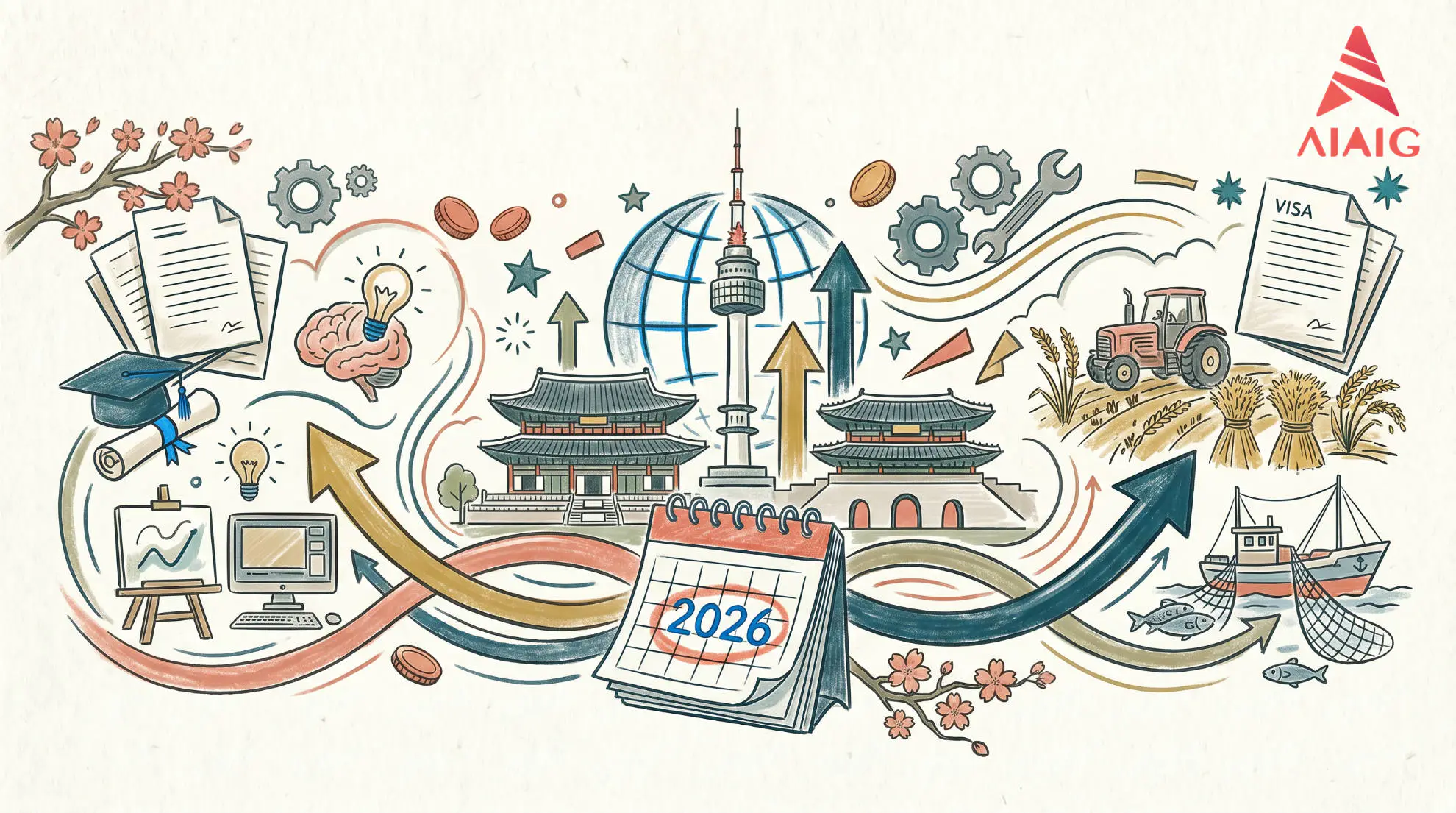
South Korea's Ministry of Justice released the '2026 Immigration Policy Strategy,' marking the largest reform of Korea's immigration system since implementing Electronic Travel Authorization (K-ETA). This strategic document clearly shifts Korea's positioning from an 'immigration-restrictive country' to a 'talent attraction hub,' aiming to address population aging and labor shortages.
Core Policy Reform Content
Global Talent Visa (Top-Tier Visa) Significantly Expanded
The Korean government expanded the Top-Tier Visa, originally only available to Nobel laureates and Olympic medalists, to include STEM (Science, Technology, Engineering, Mathematics) field professors and researchers. This change means Chinese scientists and engineers at international universities and research institutes will have more opportunities to obtain Korean permanent residence.
Relaxed visa application conditions include:
- Elimination of Korean residency duration requirements
- Allowing holders to freely choose employers within Korea
- Synchronized simplification of dependent visa conditions
- Fast-track approval (completed within 30 days)
New Agriculture & Fisheries Skilled Worker Visa (E-7-M K-CORE)
Addressing severe labor shortages in agriculture and fisheries, Korea launched the specialized E-7-M visa in 2026. This visa targets foreign workers with professional skills, providing:
- Maximum 5-year residence period, renewable
- Eligibility to apply for permanent residence after 3 years of employment
- Flexible employer sponsorship requirements, allowing seasonal work
- Family members can accompany and obtain work permits
This is a major benefit for Chinese skilled workers with relevant expertise (e.g., modern agricultural technicians, aquaculture specialists).
Simplified Post-Graduation Work Visa for International Students
Starting February 2026, Korea will implement major reforms:
- Visa type consolidation: Streamlining the D-2 student visa to E-7 work visa process from 5 steps to 2 steps
- Accelerated degree recognition: Foreign university degrees recognized by Korea's Ministry of Education require no additional certification
- Adjusted language requirements: TOPIK Level 3+ sufficient for professional work visa (previously required TOPIK Level 4)
- Reduced salary threshold: For foreign graduates employed by high-tech enterprises, starting salary requirement reduced from 30 million KRW to 27 million KRW annually
Digital Nomad Visa (F-1-D) Permanent Program
Korea's digital nomad visa, piloted in 2024, officially became permanent in 2025. This visa allows foreign remote workers to reside in Korea for 1 year, renewable for 1 additional year. 2026 changes include:
- Clarified income threshold: Annual income requirement set at $66,000 USD (approximately 88 million KRW)
- Optimized dependent policy: Spouses receive open work permits, children can attend public schools tuition-free
- Tax benefits: Tax-free on global income for first 183 days as non-tax resident
- Digital application process: Fully online application, completed within 3 weeks
Policy Implementation Timeline
| Policy Item | Implementation Date | Affected Population |
|---|---|---|
| STEM Global Talent Visa Expansion | January 1, 2026 | ~5,000 research personnel |
| Agriculture & Fisheries Skilled Worker Visa | March 1, 2026 | Initial quota 2,000 |
| International Student Work Visa Simplification | February 15, 2026 | ~15,000 fresh graduates |
| Digital Nomad Visa New Policy | January 1, 2026 | Expected 3,000 digital nomads annually |
South Korea's Minister of Justice stated: 'We are transforming Korea's positioning from merely a manufacturing base to a global innovation hub, which requires us to open our doors wide to welcome outstanding talent from around the world.'
South Korea New Immigration Visa Categories Comparison 2026
| Visa Type | Target Group | Minimum Requirements | Residence Duration | PR Pathway |
|---|---|---|---|---|
| Top-Tier Visa (Global Talent) | STEM professors, researchers | PhD + 3 SCI papers | 3 years, renewable | Eligible after 1 year |
| E-7-M K-CORE (Agri/Fisheries) | Agriculture/fisheries skilled workers | 5 years experience + certification | 5 years, renewable | Eligible after 3 years |
| E-7 (Professional) | Bachelor+ degree graduates | Bachelor degree + TOPIK Level 3 | 2 years, renewable | Eligible after 5 years |
| F-1-D (Digital Nomad) | Remote workers | $66,000 annual income + 1 year experience | 1 year, renewable once | No direct pathway |
South Korea International Student Work Visa Process: Before vs After
| Process Step | Before Reform (2025) | After Reform (2026) | Time Saved |
|---|---|---|---|
| Degree Recognition | 30-45 days | Exempted | 30-45 days |
| Employer Sponsorship | 7-14 days | 3-5 days | 4-9 days |
| Visa Conversion | 14-21 days | 7-10 days | 7-11 days |
| Total Processing Time | 51-80 days | 10-15 days | 41-65 days |
Living Cost Reference for Foreign Residents in Major Korean Cities (2026)
| City | Monthly Rent (1BR Apt) | Monthly Living Cost | Minimum Annual Income |
|---|---|---|---|
| Seoul | ₩800,000-1,200,000 | ₩1,500,000-2,000,000 | ₩27,600,000 |
| Busan | ₩500,000-800,000 | ₩1,200,000-1,500,000 | ₩27,600,000 |
| Daegu | ₩400,000-600,000 | ₩1,000,000-1,200,000 | ₩27,600,000 |
AIAIG Analysis: Impact of South Korea's New Policy on Chinese Immigrants
South Korea's 2026 immigration policy reform creates multiple opportunities for the Chinese community. Our analysis is as follows:
1. Fast-Track for STEM Talent
The Top-Tier Visa expansion to STEM professors and researchers represents a major benefit for Chinese scientists with PhDs from the US and Europe. Compared to the uncertainty of the US H-1B visa lottery, Korea offers a certain path with approval within 30 days. We recommend Chinese research personnel with relevant backgrounds directly contact top institutions like KAIST and POSTECH, which have dedicated budgets for foreign talent recruitment.
2. New Option for Skilled Workers
The E-7-M agriculture & fisheries skilled worker visa provides Chinese workers with expertise in modern agriculture, aquaculture, and food processing a new option after Canada and Australia. While Korea's salary levels (2.5-3.5 million KRW monthly) are lower than Canada's, living costs are relatively moderate and cultural adaptation is easier. We recommend skilled workers consider agricultural and fisheries concentrated regions like Jeju Island and South Jeolla Province.
3. Clear PR Pathway for International Students
Reducing TOPIK requirements from Level 4 to Level 3 and exempting degree recognition significantly lowers the threshold for Chinese students to remain and work in Korea after graduation. Korean universities' international rankings continue to rise (e.g., Seoul National University entering QS Top 50), and combined with friendly policies, are expected to attract more Chinese students instead of traditional study destinations. We recommend Chinese students planning to study in Korea choose STEM programs in major cities like Seoul and Busan.
4. Asia Hub Advantage for Digital Nomads
For Chinese remote workers, Korea's F-1-D visa is more flexible than Japan's digital nomad visa (6-month limit) and more cost-effective than Singapore (high living costs). Korea's high-speed internet, developed co-working spaces, and geographic centrality in East Asia make it an ideal base for serving Chinese, Japanese, and Korean clients. We recommend IT, design, and consulting remote workers consider Korea as their Asia headquarters.
5. Real Estate Investment Opportunities
Korea has relaxed foreign property purchase restrictions (except Jeju Island), allowing foreigners with work visas to buy residences in non-speculation areas. With the influx of foreign talent, properties in Seoul's Gangnam and Yongsan international communities have appreciation potential. We recommend high-net-worth applicants consider investing in properties near their employment locations for both personal use and rental income.
6. Geographic and Cultural Advantages with China
Compared to North America and Australia, Korea is only 1-3 hours flight time from China, making it convenient to return home during holidays. Korea's society retains Confucian cultural elements that lower adaptation costs for Chinese. Additionally, Korean IT, gaming, and beauty industries heavily depend on the Chinese market, giving Chinese people natural bridge advantages.
Action Recommendations:
- STEM PhDs: Apply directly for Top-Tier Visa, contact research universities like KAIST, POSTECH, UNIST
- Skilled Workers: Check the Korean Ministry of Employment and Labor website for E-7-M visa designated employers, focusing on agricultural and fisheries cooperatives
- Students: Choose STEM majors, aim for TOPIK Level 3 during school, apply for E-7 visa immediately after graduation
- Digital Nomads: Prepare income proof and industry experience documents, apply online for F-1-D through Korean visa portal
- Investors: Focus on foreigner communities in Seoul Yongsan and Busan Haeundae for property projects
Overall, Korea is transforming from an 'immigration-restrictive country' to a 'talent-competitive country.' Its policy flexibility and geographic-cultural advantages make it an emerging choice for Chinese immigration, study, and work. Compared to traditional destinations, Korea offers faster approval, lower costs, and smaller cultural barriers.
Sources
- Can I apply for Korean work visa without TOPIK certificate?
- According to the 2026 reformed policy, the minimum language requirement for E-7 professional work visa has been reduced from TOPIK Level 4 to Level 3. For Top-Tier Global Talent Visa, applicants can be exempted from TOPIK if they have outstanding achievements in STEM fields (e.g., SCI papers). We recommend taking the TOPIK exam as soon as possible. Even if you don't reach Level 3, you can attend government-provided Korean language courses for foreigners after arriving in Korea.
- Are there age restrictions for Korea's new visas?
- Korea's 2026 new visa policy has no hard age limits, but different visas have implicit preferences: Top-Tier Global Talent Visa suits researchers under 45; E-7-M Agriculture & Fisheries Skilled Worker suits skilled workers under 50; F-1-D Digital Nomad requires applicants to be at least 18 with no upper limit; E-7 General Work Visa recommends applicants not exceed 55. Overall, Korea is more lenient than Canada and Australia in age restrictions.
- Can I apply for mortgage with Korean work visa?
- Starting January 1, 2026, foreigners holding E-7 or higher-level work visas can apply for housing loans in Korea's non-speculation areas, up to 70% of property value, with interest rates same as Korean citizens (about 4-5%). Need to provide income proof (annual salary at least 30 million KRW), employment contract, and alien registration card. Seoul Gangnam and other speculation-overheated areas restrict foreign home purchase loans, but foreigner-concentrated areas like Yongsan and Gijin-dong can apply.
- What are the requirements for Korean permanent residence (F-5)?
- Korea's adjusted permanent residence application conditions for 2026 are: 1) Continuous residence for 5 years (E-7) or 3 years (E-7-M agriculture & fisheries) or 1 year (Top-Tier); 2) Annual income reaching 100% of Korea's per-capita GNI (~42 million KRW, ~¥230,000); 3) Pass TOPIK Level 4; 4) No criminal record; 5) Basic understanding of Korean society (through social integration exam). Compared to Canada and Australia, Korea requires shorter residence but higher language proficiency.
Last updated Apr 24, 2026